22 June, 2026
|
16 minutes to read

On June 7, 2026, voters in Armenia delivered Nikol Pashinyan’s Civil Contract (CC) party a renewed mandate despite what European election observers described as direct Russian interference aimed at reversing the country’s westward turn. Two days later, the U.S. House of Representatives passed legislation ordering a classified assessment of Russian and Chinese penetration of Georgia’s security services. Tbilisi’s response came within hours: on June 9, Mikheil Kavelashvili and Xi Jinping announced the elevation of Georgian-Chinese relations to a “comprehensive strategic partnership,” while Irakli Kobakhidze dismissed Congressman Joe Wilson, the legislation’s architect, as “not serious.” A few days later, it became known that the court cases against the Georgian opposition leaders had accelerated, now scheduled twice a week, while a new wave of political prisoners received prison sentences of up to seven years for offenses that, in a normal country, would at most warrant an administrative penalty.
This is the context in which the current U.S. engagement with Tbilisi is taking place. For the first time since Washington suspended the U.S.-Georgia Strategic Partnership Charter in 2024, citing the Georgian government’s democratic backsliding and anti-democratic actions, contacts with Georgian Dream resumed in early 2026. These included a State Department visit in March, the first ministerial-level phone call in years, the announcement of a 70-story Trump-branded tower in Tbilisi in April, and visits by two senior State Department officials in May.
Yet the developments that prompted the suspension of relations have not improved. On the contrary, by most objective measures, they have deteriorated further. Democratic institutions have weakened, political repression has intensified, and relations with Georgia’s traditional Western partners have become increasingly strained.
Against this backdrop, the renewed engagement has generated significant debate within Georgia’s overwhelmingly pro-Western and pro-American society. Many are asking what Washington hopes to achieve through this reengagement, what concessions it expects from Georgian Dream, and whether renewed contacts reflect a broader strategic recalibration or simply a pragmatic attempt to preserve channels of communication in an increasingly volatile region.
The only way Georgian Dream can become useful to American interests is if structural conditions on the ground change and the regime is forced to reconsider its calculus and authoritarian alignment.
Washington has likely reengaged with Georgia because it recognizes that a Georgia controlled by Russia, China, or Iran severely disrupts its interests and initiatives in the region. It must also reckon with the fact that Georgia under Georgian Dream cannot be a reliable partner. The only way Georgian Dream can become useful to American interests is if structural conditions on the ground change and the regime is forced to reconsider its calculus and authoritarian alignment. Until now, its survival has been politically and economically linked with Moscow, Beijing, and Tehran, which means it cannot align with American interests without upsetting America’s adversaries.
Georgia is now ruled by the family of autocratic, Russian-style laws – rule by law instead of the rule of law.
The gloomy reality is that the Georgian Dream disenfranchised a significant portion of the Georgian population, leaving them outside the political process through repression and the weaponization of legislation. Georgia is now ruled by the family of autocratic, Russian-style laws – rule by law instead of the rule of law. Georgian Dream holds power exclusively through coercion and manipulation rather than legitimacy, making it permanently vulnerable to instability. It cannot deliver the domestic stability that President Trump’s regional vision requires, and its leadership cannot be expected to make decisions based on Georgia’s national or even their own egoistic interests. They will have to do what their authoritarian club requires.
The United States must draft a strategic policy vision towards Georgia based on these realities and use available instruments to enforce it.
The United States must draft a strategic policy vision towards Georgia based on these realities and use available instruments to enforce it. By reactivating the MEGOBARI Act and building credible, believable threats against Ivanishvili personally and his financial network, Washington should explicitly articulate the conditions under which the restrictive measures would not be carried to their full conclusion.
Those conditions can only be defined by a simple framework if Georgia is to remain stable in the short to medium run: the release of all political prisoners, the revocation of the party bans, the repeal of the repressive legislative package that produced them, and an electoral system and legal environment restoring the rights of its citizens and capable of producing political change. Anything short of this will fit into Georgian Dream’s “legitimacy” propaganda narrative without serving American interests in the region.
For more than three decades, the South Caucasus functioned as a set of closed loops, and Russia maintained an interest in keeping it that way. Armenia and Azerbaijan remained at war, or in a frozen confrontation over Nagorno-Karabakh from 1992 onward, and Türkiye closed its border with Armenia in 1993 in solidarity with Baku.
For Moscow, the unresolved conflict kept Armenia dependent on Russian security guarantees through the Collective Security Treaty Organization (CSTO), justified a Russian military base in Gyumri and a border guard presence on Armenia’s frontiers with Türkiye and Iran and in the Zvartnots airport, and, after 2020, placed roughly 2,000 Russian peacekeepers inside Nagorno-Karabakh under the 2020 ceasefire. On the western side of the South Caucasus region, Russia’s occupation of Abkhazia and the Tskhinvali Region/South Ossetia, consolidated after the 2008 war, performed a similar fragmenting function.
Since Armenia shares no border with Russia, the only land route between the two passes through Georgia, which made Georgia both a target of this fragmentation and one of its load-bearing elements, the corridor through which Russia’s relationship with its most dependent regional ally had to run.
The defeat of Armenian forces in Nagorno-Karabakh in 2020, and Azerbaijan’s final operation in 2023, which ended Nagorno-Karabakh’s de facto autonomy and the Russian peacekeeping presence, removed the dispute that had underwritten this arrangement. By 2023, Russia’s military and diplomatic capacity was absorbed by Ukraine, and the peacekeeping force it had deployed did not act to prevent the conflict’s resolution on Azerbaijani terms. Baku read the moment correctly and acted. At a White House summit in August 2025, Presidents Trump, Aliyev, and Pashinyan agreed to the Trump Route for International Peace and Prosperity (TRIPP), a corridor through Armenia’s Syunik province linking Azerbaijan to its disjoined Nakhchivan region and onward to Türkiye. For the first time since independence, Azerbaijan gained a route to its own exclave that does not depend on Iranian transit, and Türkiye gained direct overland access to Azerbaijan and Central Asia without crossing Iran or Russia.
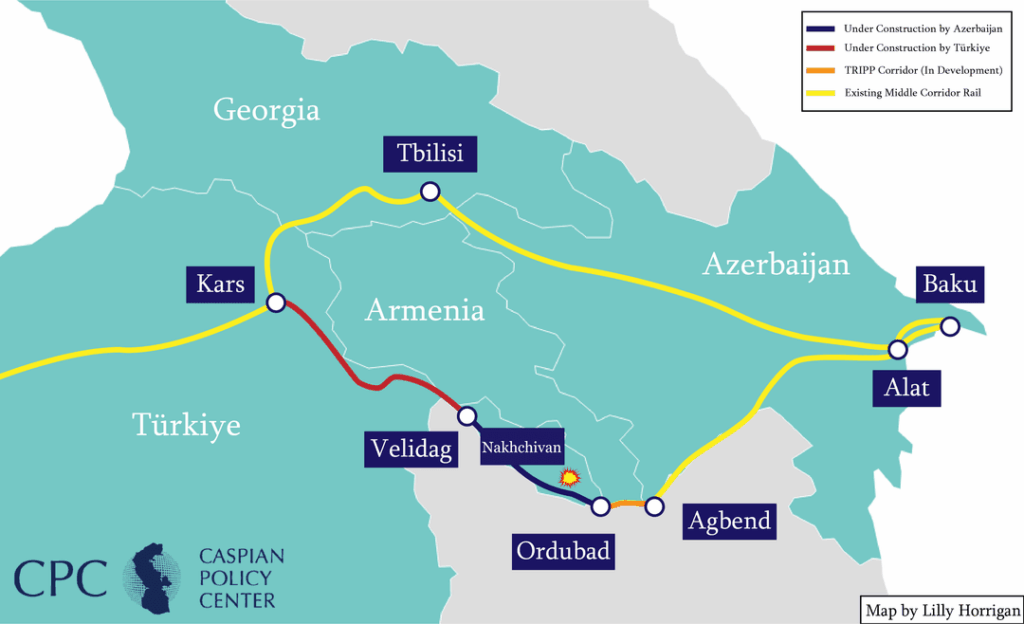
Source: Caspian Policy Center (CPC)
TRIPP, however, resolves only half of the region’s connectivity problem. A corridor connecting Central Asia to Türkiye through Armenia and Azerbaijan still does not reach Europe. That leg is the Middle Corridor, the Trans-Caspian route carrying cargo from China and Central Asia across the Caspian to Baku, overland through Georgia, and out through the Black Sea ports of Poti and Batumi. Since 2022, as Western governments and shippers have sought alternatives to Russian transit routes, traffic on this route has grown substantially. Azerbaijan has no Black Sea coastline. Armenia has no coastline at all. Georgia is the cheapest and shortest route in the South Caucasus with the existing infrastructure to move cargo to the Black Sea, bypassing Russia and Iran.
Washington’s investment in TRIPP assumes that regional transit routes remain open, reliable, and interconnected, and the Armenia–Azerbaijan settlement alone cannot guarantee that.
TRIPP and the Middle Corridor are therefore two pieces of the same architecture. Cargo entering the South Caucasus from the Caspian can reach Europe either through Armenia and Türkiye or through Georgia. Yet the western exit through Georgia remains irreplaceable. Washington’s investment in TRIPP assumes that regional transit routes remain open, reliable, and interconnected, and the Armenia–Azerbaijan settlement alone cannot guarantee that.
What makes this more than a routing question is Georgia’s geography. It is the only South Caucasus state bordering Russia, Türkiye, Armenia, and Azerbaijan, and it provides access to the Black Sea. Decades of investment in the Baku–Tbilisi–Ceyhan oil pipeline, the South Caucasus gas pipeline, the Baku–Tbilisi–Kars railway, and the ports of Poti and Batumi have created infrastructure that no alternative route could quickly replicate. Whoever “controls” Georgia holds the key to the region.
This is why Georgia matters more to Moscow than ever. Russia’s influence elsewhere in the South Caucasus has declined sharply. Armenia has frozen its participation in the CSTO and is deepening ties with the United States. The Nagorno-Karabakh conflict, long Russia’s main source of regional leverage, has effectively disappeared. Azerbaijan was never dependent on Moscow and is now a partner in a U.S.-brokered corridor initiative. Georgia is the exception. A government aligned with Moscow, Beijing, or Tehran would allow Russia to preserve significant influence over the region’s future despite the loss of its other levers of influence. What Georgian Dream seeks from its engagement with Washington, and what the United States is prepared to accept in return, should be viewed in that context.
What Washington needs from Georgia is a government whose security services, foreign alignment, and infrastructure decisions make it a reliable anchor for a corridor in which the United States has invested significant political and financial capital. The Countering China’s Control of the Caucasus Act reflects this concern by requiring an assessment of Russian and Chinese penetration of Georgia’s security services. Whatever else renewed U.S. engagement with Tbilisi produces, the key question remains who controls the institutions responsible for protecting a multibillion-dollar transit corridor.
Georgian Dream’s objectives are far narrower. Since December 2024, Bidzina Ivanishvili, the ultimate decision-maker in Georgia, has been under U.S. sanctions for conduct benefiting Russia at Georgia’s expense, although a general license still allows American businesses to engage with most of his holdings. Irakli Kobakhidze has denounced the MEGOBARI Act as a hostile measure and welcomed its stalling in the Senate as proof that Georgia’s position was justified.
What Georgian Dream seeks from a clean slate is not a change in U.S. policy toward Georgia. It seeks relief from personal and financial pressure, continued access to what the current sanctions regime still permits, and a diplomatic narrative that feeds its propaganda, claiming that relations have been repaired. This reflects the stabilization-normalization gap at the heart of the engagement. Stabilization, meaning lower tensions, fewer sanctions, and better headlines, is actively pursued. Normalization, a change in the institutions and foreign alignment that made the relationship adversarial in the first place, is not.
While Georgian Dream promotes these projects as evidence of normalized ties with Washington, Anaklia, the port that would truly define Georgia’s strategic role in the Middle Corridor, is being negotiated away to Beijing.
To sustain this narrative, Georgian Dream is using business ties with the United States to create the appearance of an improving bilateral relationship. Frontera Resources illustrates the lobbying side of this strategy: its executive, Steve Nicandros, has lobbied Congress against the MEGOBARI Act and in support of Georgian Dream while the company remains locked in a dispute with the Georgian state over a USD 15.4 million debt. Trump Tower Tbilisi represents the visible side. Developed in part by Archi Group, led by former Georgian Dream MP Ilia Tsulaia, on land partly owned by Uta Ivanishvili (also under U.S. sanctions), the project attaches a prominent American brand and investment figure to the Georgian government without changing the underlying political reality. While Georgian Dream promotes these projects as evidence of normalized ties with Washington, Anaklia, the port that would truly define Georgia’s strategic role in the Middle Corridor, is being negotiated away to Beijing.
This is where the chronology becomes revealing. In May 2025, Secretary of State Marco Rubio asked Ambassador Robin Dunnigan to deliver a message directly to Ivanishvili outlining steps Georgia could take to reset the relationship. Ivanishvili refused the meeting and instead described the sanctions against him as personal blackmail, citing funds from a Credit Suisse settlement he could not access. A year later, the same government was telling visiting State Department officials that it wanted to restart the partnership from a clean slate. The pattern is clear. When Washington asks for something concrete, the conversation ends. When Georgia can signal goodwill without changing anything, the conversation goes on.
Georgian Dream’s reaction to the House passing legislation requiring a review of Russian and Chinese penetration of Georgia’s security services was equally revealing. Rather than distancing itself from Beijing, it announced a comprehensive strategic partnership with China. If the clean-slate policy reflected a genuine reorientation, this is where it would have paused. Instead, it accelerated. The message was loud and clear: American pressure would not alter the Georgian Dream’s strategic alignment, either in the eyes of its domestic audience or of Moscow and Beijing.
A clean slate built around business deals and diplomatic optics costs Ivanishvili nothing. One that touches the institutions Washington cares about could cost him everything.
This is not a failure of diplomacy that better engagement could fix. Genuine normalization, as Washington understands it, would require Georgian Dream to loosen its grip on the security services, the judiciary, and the electoral system – the very institutions that secure Ivanishvili’s position at home and preserve his value to Moscow. Such a shift would expose him on two fronts. Domestically, it would weaken the mechanisms that keep opponents marginalized and under pressure. Internationally, it would raise doubts in Moscow about the reliability of a partner whose value rests on political alignment. A clean slate built around business deals and diplomatic optics costs Ivanishvili nothing. One that touches the institutions Washington cares about could cost him everything.
The issue, therefore, is not whether engagement with Tbilisi is worthwhile. It is that the current approach is being absorbed into Georgian Dream’s strategy rather than being tested. The real question for Washington is not how to improve the diplomacy, but what would need to change in Ivanishvili’s calculations for genuine normalization to become possible.
Georgian Dream remains in power through control, but no system built primarily on force has proved permanently stable.
There is also a second problem. Ivanishvili has polarized Georgia to the point that a large share of the population no longer feels represented in the political system. Continuous protests since the November 2024 elections, sustained despite repression, arrests, and an extensive propaganda campaign, are not signs of political vitality or stability. They are signs of a governing arrangement that increasingly relies on coercion rather than consent. Georgian Dream remains in power through control, but no system built primarily on force has proved permanently stable.
For Washington, this carries a strategic risk. President Trump’s regional vision requires a stable Georgia and a government capable of delivering on its commitments. Georgian Dream offers neither. Its survival increasingly depends on support from Beijing, Tehran, and Moscow, limiting its ability to act as a reliable U.S. partner. Engagement under these conditions is unlikely to advance American interests and risks reinforcing a status quo that alienates Georgia’s pro-democracy constituency – the very actors that are Washington’s strongest strategic allies in the country. Genuine normalization cannot occur while those actors are being harassed, prosecuted, and excluded by the same government that Washington would be treating as a normal partner. Georgia is not a problem to be accommodated within the current arrangement. It is a strategic opportunity, provided Washington is willing to apply the pressure necessary to secure the dependable partner its regional ambitions require.
There is a comprehensive, internationally recognized framework for what a genuine return to Georgia’s pro-democracy, pro-Western course requires. When the European Commission recommended candidate status for Georgia in November 2023, it conditioned nine areas of concern, covering the political environment, institutional independence, and civil liberties. Any government in Tbilisi that wants to credibly claim it is restoring normal relations with Georgia’s Euro-Atlantic partners has to show real progress against these nine benchmarks. There is no other test that matters, and there is no silver bullet that substitutes for it.
Since 2023, Georgia has moved in the opposite direction on all nine. According to Freedom House’s latest count, 113 people are imprisoned or in pretrial detention on charges related to political dissent. Civil society and media face both physical assault and legal coercion: journalist Mzia Amaglobeli was sentenced to two years while covering the 2024 election crackdown and was awarded the European Parliament’s Sakharov Prize while still behind bars. The new broadcasting laws now allow the government to impose “coverage standards” on outlets and to bar them from foreign funding.
The political opposition has been largely dismantled. Party bans are before the Constitutional Court at Georgian Dream’s request. The legislation adopted in 2025 allows the Constitutional Court to ban any party deemed to “substantially repeat” a prohibited one, placing up to 10 parties at risk. Eight opposition leaders have been jailed for refusing to cooperate with a parliamentary commission widely seen as a tool for removing them from politics. Cases against most major opposition figures were accelerated in June, with verdicts expected in early autumn 2026. Helen Khoshtaria remains imprisoned for damage to a campaign poster, while her health deteriorates.
At the same time, electoral competition has become largely meaningless. The December 2025 Election Code abolished voting from abroad and redrew municipal boundaries in ways monitors say distort representation. Georgian Dream then won all 64 municipalities in the October 2025 local elections amid boycotts, record-low turnout, and the absence of credible international observation. Restoring Georgia as a legitimate and dependable partner means reversing all of this, not merely softening its edges.
What Ivanishvili seeks is improved tone, not the deeper relationship that genuine normalization would require. He cannot afford that relationship. Moscow expects loyalty, not strategic ambiguity, and any serious move toward Washington would invite risks he has little incentive to take. Tone costs him nothing. Substance could cost him everything.
The EU’s nine criteria clarify what normalization would look like. What is missing is a mechanism capable of changing Ivanishvili’s calculation of personal costs and benefits of his geopolitical decisions.. This is where EU conditionality failed: it described compliance without creating sufficient incentives and pressure to achieve it. Washington should not repeat that mistake.
The instrument already exists. The MEGOBARI Act passed the House with overwhelming bipartisan support (349-42) and remains available, though it is stuck in the Senate. Its sanctions and visa restrictions are not a new tool to be invented, but an existing one to be used. Moving it forward and signaling a willingness to target Ivanishvili and the networks around him requires a political decision. Georgian Dream has already demonstrated that it does not respond to anything less than that.
Any credible process should begin with three benchmarks. First, the release of all political prisoners. Second, the repeal of the laws that produced them, including the foreign agents law, party-ban provisions, assembly restrictions, and media controls. Third, an electoral framework that offers a realistic path to political change. Without all three, Georgian Dream can continue extracting the appearance of engagement while preserving the authoritarian system that made normalization impossible in the first place.