8 December, 2025
|
14 minutes to read

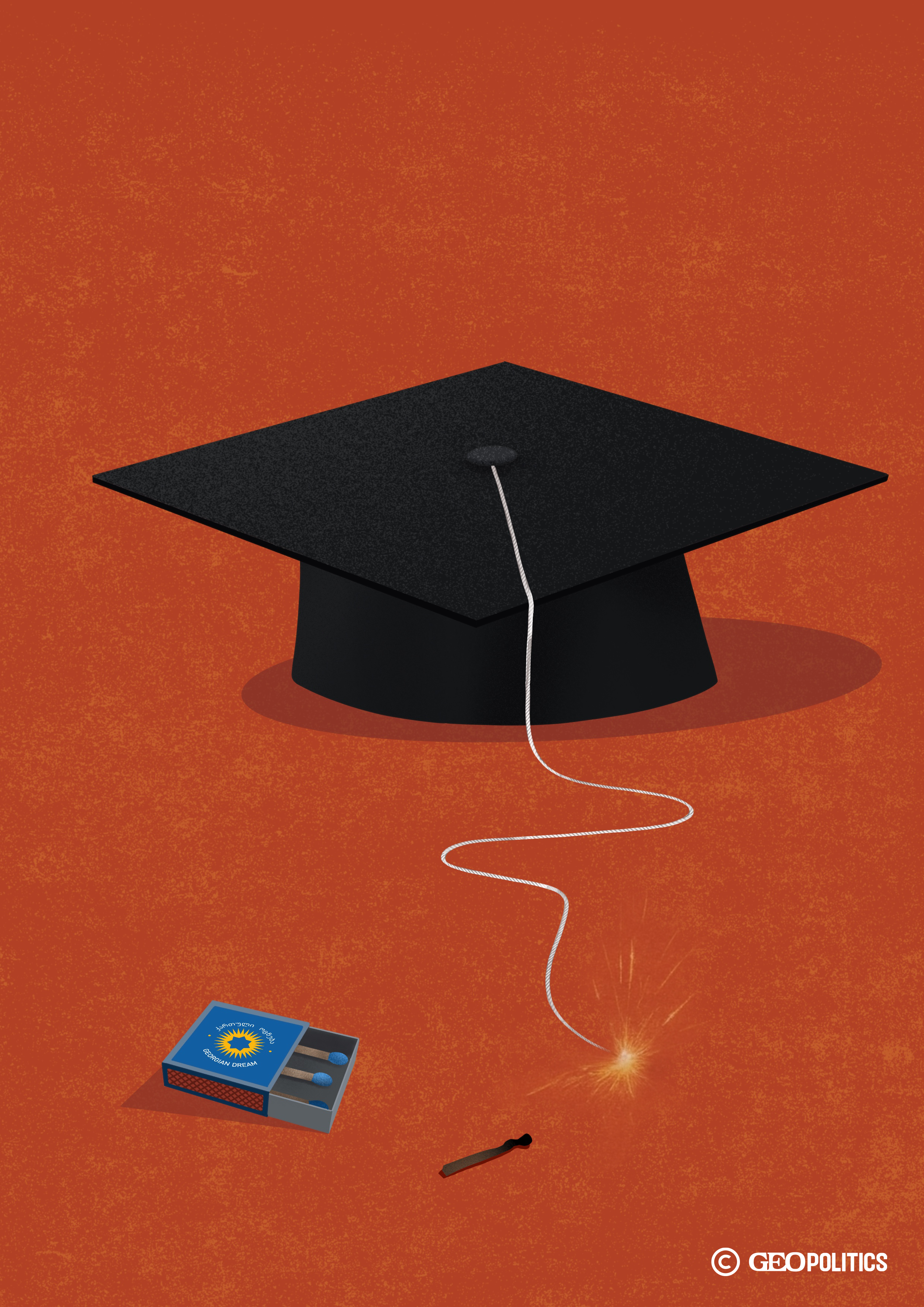
Higher education in Georgia is under attack. The outlines of this aggressive assault are well understood by now. A previous article by Sergi Kapanadze in GEOpolitics has described the contours of the planned subjugation in more detail. As Kapanadze points out, the proposed changes move Georgia “towards a system where higher education becomes a branch of the executive” and “away from the model of university autonomy developed after accession to the Bologna Process.”
What should we make of what the Georgian Dream (GD) is doing? The plan matters for its destructive scale – but it also tells us a lot about the Georgian Dream and reveals that nihilistic totalitarianism is its key characteristic.
The Georgian Dream regime is at this point seeking to destroy higher education in Georgia as it previously existed. If this wording can at first seem like hyperbole, the scale of the total assault on higher education has few precedents in its scale other than perhaps in the Bolshevik Revolution.
The Georgian Dream regime is at this point seeking to destroy higher education in Georgia as it previously existed. If this wording can at first seem like hyperbole, the scale of the total assault on higher education has few precedents in its scale other than perhaps in the Bolshevik Revolution. Practically no aspect of higher education will be left untouched by the plans that have been laid out.
The assault targets the higher education institutions, which (except for the regime-aligned universities) are likely to be cut back or destroyed entirely. It interferes with teaching in faculties on the most fundamental level, subjugating it to the regime’s whims, via a “One City, One Faculty” model in which specializations will be ordered into specific locations. If the regime were to decide that sociology can only be studied at the remote Akhalkalaki branch of Samtskhe-Javakheti University, a small town that at 1,707 meters is higher than many mountain resorts and with sub-zero average temperatures for four months of the year, there is nothing to stop them. The financing will now be determined top down from the ministry, putting the state universities in a situation where they are forced into submission. Professors will have to ask permission if they want to retain other sources of income and younger teaching staff will be subordinated to a chair and expected to work full-time, creating a system of indenture rather than tenure.
To make a rollback of these reforms difficult, if not impossible, the regime plans to sell off key buildings of existing institutions to real estate developers – likely a small coterie of cronies who, anyway, constitute the only meaningful allies of the Georgian Dream regime. The reforms will also be made more complicated to roll back by reducing the school years by one year, thus bringing even less mature people into institutions that will be even overloaded, teaching rudimentary tasks. In Germany, several Länder decided to return to 13 years of schooling after a multi-year experiment with 12 years showed that shortening the time brought few positive outcomes, although it seems to have affected the health and well-being of pupils negatively.
A characteristic of the regime’s assault on higher education is that it is unconstitutional, violating Article 27, which guarantees the autonomy of the sector (“Academic freedom and the autonomy of higher educational institutions shall be guaranteed”). It is also typical that the Constitutional Court is so subjugated that it is unlikely to hear an appeal.
Sensible reforms rely on at least some consultation, but no meaningful debate preceded this assault. Several of its implications are not understood. At this point, no financial planning for the changes seems to have been put forward.
In a thoughtful analysis for Gnomon Wise, Tinatin Nikoleishvili has shown, piece by piece, that the proposed rationale for what is falsely described as a reform does not hold up. For each problem this initiative is supposed to solve, it will create many more.
While Ilia State University has spoken up in criticism, some other university leaders, including leaders of private universities, appear to be intimidated. One university leader commented in an interview that “will the education reform be good or bad, we do not know,” omitting to say that if you do not know if a massive disruption of a broadly functional system will be good, it is something terrible. Sensible policy does not tear down institutions without certainty that something better will arise.
While the Georgian Dream was potentially encouraged to assault higher education by what other governments have done, such as Hungary’s Fidesz government targeting the Central European University, the scale of what is planned in Georgia is far greater than what we have seen abroad. The confrontation of the Trump administration with American universities is also with reference to a narrower set of issues and based mostly on withholding extensive federal research funding, rather than seeking to massively subjugate the entire sector. It is an established practice of the Georgian Dream to claim that their actions are based on international precedent when, in fact, the regime’s actions are much more sinister.
Although directed at higher education, the assault tells us a lot about where the Georgian Dream stands now. As mentioned above, it displays strong features of what we can call nihilistic totalitarianism.
This is totalitarian to the extent that it reaches far into private lives through its impact on the educational opportunities of tens of thousands of people. It is nihilistic because there is next to no positive content. Under its current Robespierrean Prime Minister, the regime seems committed to destroying alternatives to its dominance, subjugating any autonomous professionalism, eliminating alternatives, and, in the end, shredding the hope that Georgia could be a better or at least somewhat normal country.
The Speaker of Parliament, Shalva Papuashvili, is a prime example of this approach. Foreign observers sometimes imagine that he might be engaged in actually running the parliament and that they only see the worst lines that actually get cited. Instead, Papuashvili is in a mode of constant assault. Papuashvili is smart enough to realize in his better moments that what he is doing is terrible, but likely feels that there is no way back since all bridges have been burned anyway.
The attack on higher education thus underscores the Robespierrean quality of Irakli Kobakhidze — an inability to disengage from the cycle of aggression he himself unleashed, regardless of what originally prompted it. This nihilistic drive sets him apart from the broader family of authoritarian populists. Most populist movements, for all their destructive tendencies, still anchor themselves in real societal anxieties — immigration being a genuine pressure point, however much the liberals may prefer otherwise. Kobakhidze’s animus, by contrast, is not rooted in grievance but in a self-propelling logic of ideological hostility.
In Russia, Vladimir Putin can connect to an imperial tradition that is intelligible to people. Viktor Orbán responds to the truncation of Hungary in the Treaty of Trianon much as Türkiye’s Recep Tayyip Erdoğan draws on the Treaty of Sèvres as a national humiliation. The Georgian Dream, by contrast, has to create its enemies out of thin air – there is no reason for Georgians to resent Europeans when over the centuries other neighbors have been much more dangerous to Georgia’s survival.
The Georgian Dream, in that sense, is totalitarian rather than authoritarian, as authoritarians primarily seek to consolidate power rather than remake a society.
The Georgian Dream, in that sense, is totalitarian rather than authoritarian, as authoritarians primarily seek to consolidate power rather than remake a society. By contrast, under Irakli Kobakhidze, there is an active attempt to destroy others, reaching deep into spaces that many authoritarian regimes would allow as areas of retreat for those who just want to get on with their lives.
This aggressive assault perpetuates itself as regime followers understand they will be sidelined – or worse – if they do not demonstrate loyalty proactively, in cases probably seeking to outdo Bidzina Ivanishvili’s expectations. As I wrote elsewhere, Irakli Kobakhidze likely has concluded that the only way he can stay in his boss’s graces is to inflame his suspicions. He probably concluded that he cannot make Ivanishvili more reasonable, but that he might as well make him much more paranoid to get things done. To rank-and-file Georgian Dream supporters, this must be a bewildering time – but amidst the confusion and misdirection, they have learned that one thing remains true: never question the leadership.
It is now entirely clear – if it were not before – that you can only have two out of these three: being honest, intelligent, and prepared to defend the Georgian Dream. In 2024, some people still tried to defend the regime on geopolitical grounds. In this defense, the Georgian Dream engaged in cautious balancing to avoid trouble. Yet, how does geopolitics force you to shred your higher education system?
There are, of course, people who will continue to defend the regime’s actions, but this can only be done in bad faith or from a thorough inability to understand what is going on. If you want to make higher education fundamentally better, what has stopped the Georgian Dream from investing in ventures that already succeed? And would not any sensible undertaking at least work with the people already engaged in the enterprise? As Ilia State University is ahead in the country in established research rankings, why take it apart?
If this attack sounds like something about to happen, it is necessary to realize that, in key respects, it has already been underway for a while. The students are already under assault. Many educators have already gone into exile. One of the people who has been fined GEL 380,000 (around EUR 120,000) for a peaceful protest, Gota Chanturia, is a teacher and father of three children. The emergency is already here, not a few months down the line.
Perhaps even more so than in other fields, it is now essential for Georgia’s international education partners to react. Higher education is a global enterprise. No serious country undertakes it in isolation. Even in Soviet days, Georgian universities benefited from international collaboration.
Partners should support genuine scholars who are threatened with displacement by this authoritarian assault.
Partners should support genuine scholars who are threatened with displacement by this authoritarian assault. Calibrating that will not be easy, as hundreds of scholars may well be affected. Offering transitional local fellowships may make more sense than mass relocations that overwhelm the limited available resources.
Expanding unpaid affiliations in themselves may be a great help, giving scholars the chance to seek their own sources of funding and access to some research infrastructure, including online resources. It may be an idea to recreate a kind of “Ilia in Exile” University at a friendly institution abroad, without expectation of an honorarium, but again to retain networks that would otherwise take a long time to recreate. In a more sophisticated version, some teaching could shift online with Georgian students obtaining degrees in delegation from, say, a university in the Baltics, and student fees supporting the professors in situ.
German universities must cut any collaborations in which they may still be engaged. To make a clear statement, this collaboration must be cut explicitly. A formal distancing is required, not just a quiet petering out of collaboration. Perhaps institutions cannot do more to help, but they have to clarify what is right.
Perpetrators, including those in academia, need to be isolated. This is particularly the case for the beneficiaries of this assault located around Tbilisi State University, especially the Faculty of Law, from where and with which most of the Sith Lords of the Georgian Dream come and remain affiliated. Especially German universities must cut any collaborations in which they may still be engaged. To make a clear statement, this collaboration must be cut explicitly. A formal distancing is required, not just a quiet petering out of collaboration. Perhaps institutions cannot do more to help, but they have to clarify what is right.
Cooperation should be revised based on this experience. Recently, perpetrators have abused scholarship schemes to gain attractive trips and stays in the very countries that the Georgian Dream regime vilifies on an almost weekly basis. Why do Western taxpayers continue to fund people who are attacking their governments? Funding perpetrators is a complete misunderstanding of the concept of academic neutrality.
This is also the point where the complicity of some German professors and higher education needs to be revisited. A handful of German law professors have repeatedly given legitimacy to people associated with repression. Key professors, such as Martin Heger (Humboldt University of Berlin), Bernd Heinrich (University of Tübingen), and Edward Schramm (University of Jena), have never distanced themselves from compromised colleagues with whom they have continued working long after the scale of the repressive assault in Georgia was entirely clear. Several of them continue to be listed as editors in a law journal together with a senior figure of the Georgian Dream regime, a person already sanctioned for human rights violations by an EU country.
The Technical University of Munich (TUM) continues to work with Kutaisi International University (KIU), a project of Bidzina Ivanishvili, likely earning significant amounts in the process. One can argue that such technical cooperation should continue as long as there is real merit in the teaching.
It is, however, unacceptable that Wolfgang Herrmann, the former president of TUM, specifically came on the regime’s propaganda TV outlet to endorse “a very good project by Bidzina Ivanishvili” at a time when his Georgian colleagues in higher education are under assault. At the very least, TUM and Professor Herrmann should transparently disclose what they earn so that people – and German taxpayers – can make up their mind on what they make of these arrangements. There is also the argument that TUM and Herrmann should sensibly donate any money they earn into a solidarity fund for Georgian scholars, rather than keeping it for themselves.
It is possible that the assault on higher education – and education in general – also shows some of the contours of a potential self-destruction by the Georgian Dream.
To take just two examples, the changes will create massive disruption for tens of thousands of young Georgians. So far, there has not yet been a plausible explanation of how they will be addressed.
This is educational disenfranchisement on a remarkable scale – or, to rephrase these abstract words, tens of thousands of young Georgians will have their life chances significantly curtailed by reckless changes for which no one asked.
As the number of high school years is reduced from 12 to 11, the number of graduates competing for university admission will double in the first year of implementation, essentially halving the chances of securing a university spot. As established universities come under attack, one can expect they will struggle to absorb increased numbers. This is educational disenfranchisement on a remarkable scale – or, to rephrase these abstract words, tens of thousands of young Georgians will have their life chances significantly curtailed by reckless changes for which no one asked.
Students who are currently at university will also be exposed to massive disruption as it will be hard to maintain teaching in their degree programs amidst all the structural changes to which they will be subjected – which in the most extreme cases might result in their being forced to move to another university, or even another town, in order to complete their studies. If the government wants current first-year students to complete their degree, they will also need to maintain at least some of the staffing for the following years.
When the Georgian Dream will end is unclear. Nothing is unclear, however, regarding its course being one of nihilistic totalitarianism. This does inflict a lot of destruction and it may well prove hard for the ruling regime to sustain itself when it has so little positive to offer.