23 May, 2026
|
21 minutes to read


Two of Europe’s most entrenched illiberal systems have now collapsed within living political memory. Vladimir Plahotniuc’s capture of the Moldovan state ended in June 2019, when a regime that controlled the judiciary, the prosecutor’s office, the central bank, and the majority of the country’s media landscape dissolved in a matter of days. Viktor Orbán’s sixteen-year consolidation of Hungary ended on April 12, 2026, when Peter Magyar’s Tisza party won a parliamentary supermajority that Orbán’s own electoral architecture had been designed to make impossible.
Both failures were the product of specific conditions that the regime’s architects had systematically worked to prevent. Understanding what those conditions were, how they materialized, and what role external and internal actors played in bringing them about, on top of being an exercise in historical curiosity, is also a practical necessity for anyone concerned with Georgia.
Bidzina Ivanishvili’s Georgian Dream (GD) has constructed a system of control that shares the essential load-bearing features of both precedents: state capture, massive levels of corruption, prosecutorial weaponization, media subordination, and the systematic elimination of organized alternatives.
This article examines the Plahotniuc and Orbán systems through five analytical lenses: the pillars that sustained each regime, the tools deployed to maintain control, the structural weaknesses each system carried, the decisive blow that proved fatal, and the actions of opposing forces that made that blow land. It then maps those findings onto Georgia’s specific conditions and closes with concrete lessons for Georgia’s democratic forces and their Western partners.
Vladimir Plahotniuc never held a leading state position. His titles were always secondary, his public profile deliberately understated. Nicknamed “the puppet master” and “the man in the shadows,” he was not a politician in any conventional sense. He was a fixer, a deal-maker, and an organizer of financial dependency. What he built was a vertical of monetary control that made formal institutional authority largely irrelevant to whoever nominally held it.
Plahotniuc’s system rested on a single organizing principle: money as the universal solvent of political loyalty.
Plahotniuc’s system rested on a single organizing principle: money as the universal solvent of political loyalty. He entered the political arena by financing a nominally pro-European coalition and gradually redirected its institutional authority toward his own party, transforming a broad governing alliance into what became, in effect, a one-party financial machine. Over time, he hollowed out the opposition, purchasing influence across the political spectrum, including among his nominal adversaries, with the explicit strategic objective of being the only viable force in the room.
Elections in Moldova, despite manipulations, remained largely competitive. Plahotniuc did not control the central electoral commission and could not reliably alter results at scale.
His control over law enforcement, prosecutors, and the judiciary followed the same logic. These institutions did not serve him out of ideological conviction or personal loyalty. They served whoever held legitimate power and whoever was in charge. This is the first critical distinction from the Georgian case. His institutional control was only transactional, not political. It was a management instrument for running a corrupt system of governance, not a repressive architecture for manufacturing electoral outcomes. Elections in Moldova, despite manipulations, remained largely competitive. Plahotniuc did not control the central electoral commission and could not reliably alter results at scale.
The most documented instrument of control was the direct cash transfer. The so-called “Kuliok case” produced evidence of Plahotniuc delivering a bag of cash to Igor Dodon, then the leader of the pro-Russian Socialist Party, with reporting implicating Communist Party leader Vladimir Voronin as well. This single incident crystallized the operating logic of the entire system: ideological opponents, including those openly aligned with Moscow, were managed through financial incentives rather than confronted or eliminated.
His media empire reinforced this logic. Plahotniuc did not control the full information space, but he commanded sufficient media weight to keep his narrative anchored in Moldova’s public discourse, projecting a pro-European identity that was simply a narrative for his actual governance.
Corruption that functions as a control mechanism carries an inherent vulnerability: it scales. As Plahotniuc’s system expanded, so did its exposure.
Corruption that functions as a control mechanism carries an inherent vulnerability: it scales. As Plahotniuc’s system expanded, so did its exposure. A Moldovan court subsequently found him guilty of creating and leading a criminal organization that committed fraud and money laundering, specifically the theft of financial resources from three Moldovan banks in coordination with oligarch Ilan Shor and others. The stolen sum amounted to approximately one billion dollars, equivalent to roughly 12% of Moldova’s annual GDP at the time, in a A Moldovan court subsequently found him guilty of creating and leading a criminal organization that committed fraud and money laundering, specifically the theft of financial resources from three Moldovan banks in coordination with oligarch Ilan Shor and others. The stolen sum amounted to approximately one billion dollars, equivalent to roughly 12% of Moldova’s annual GDP at the time, in a scandal that became known as “the theft of the century.”
The scandal triggered mass protests and prompted both the IMF and the European Union to suspend financial assistance to Moldova. The pro-European identity Plahotniuc had been selling as his central political credential became impossible to sustain in light of that evidentiary backdrop.
The second and ultimately fatal weakness was geopolitical. Despite sustained effort, Plahotniuc failed to secure durable trust from either Moscow or the West. Russia regarded him as unreliable. Western governments and institutions grew progressively unwilling to treat him as a credible partner. This left him without a strategic foothold at the moment of maximum pressure.
The 2019 parliamentary elections produced a majority distributed between the pro-Russian Socialist Party and the pro-Western ACUM bloc, two forces with opposing geopolitical orientations but a convergent interest in removing Plahotniuc. He refused to concede, deploying his leverage over the Constitutional Court to contest the transfer of power. On top, what dissolved his resistance was the simultaneous withdrawal of external legitimacy from every direction. The European Union, the United States, and Russia each refused to recognize his continued claim to authority. Facing isolation from all international actors at once, a configuration with no precedent in post-Soviet Moldovan politics, his institutional leverage collapsed within days. He fled the country on June 14, 2019. He was subsequently extradited from Greece in September 2025 and sentenced to nineteen years in prison in April 2026.
Maia Sandu and the ACUM bloc had constructed a singular political offer: credible, uncompromised pro-European commitment at a moment when Plahotniuc’s version of that commitment had been exposed as fraudulent. The border coalition with pro-Russian socialists was ideologically incoherent, but it was coherent on the one axis that mattered: the removal of Plahotniuc. That tactical unity, combined with the complete withdrawal of international support for the incumbent, was what made the final blow land.
The Moldovan case establishes a template worth carrying into the next analysis. A system built entirely on financial incentives is structurally exposed without some degree of international legitimacy.
Unlike Plahotniuc, who arrived in politics from business to expand financial power, or Ivanishvili, who entered it to protect what he had already accumulated, Orbán wanted money and institutional control in the service of political dominance.
Viktor Orbán was, from the beginning, a political animal. Unlike Plahotniuc, who arrived in politics from business to expand financial power, or Ivanishvili, who entered it to protect what he had already accumulated, Orbán wanted money and institutional control in the service of political dominance. That distinction shaped everything about how his system was built and, ultimately, how it fell.
Orbán’s foundation was built on a genuine reservoir of popular discontent with the previous Socialist administration, whose mismanagement and documented corruption had left deep wounds in Hungarian public life. He systematically exploited that legacy, maintaining the previous government as the reference point for every subsequent failure, regardless of how much time had passed. This backward-pointing blame architecture gave him durable political cover in the early years.
His anti-immigration policy was not mere populism. It was a precise calibration of what a large portion of the Hungarian electorate genuinely feared and wanted addressed.
What sustained him beyond that initial advantage was a more sophisticated capacity: the ability to read and feed the cultural pulse of the Hungarian majority. His anti-immigration policy was not mere populism. It was a precise calibration of what a large portion of the Hungarian electorate genuinely feared and wanted addressed. He sensed the anxieties that other politicians either ignored or dismissed as uncomfortable, and he built policy and narrative around them with consistency. His relationship with Russia followed the same logic. Open ties with Moscow were reframed not as dependence or ideological alignment but as a pragmatic national interest, a sovereign decision to manage energy and economic relations on Hungary’s own terms. That reframing held for a remarkably long time.
His personal charisma and his cultivation of strong external partnerships, within the European far-right and with the Trump-aligned MAGA movement in the United States, reinforced his domestic image as a leader of consequence operating on a global stage.
Orbán understood early that parliamentary control alone was insufficient to guarantee durable power. He moved systematically to consolidate authority over the media, the judiciary, and the executive apparatus, reaching a point of effective control over all major institutional levers. Checks and balances were architecturally dismantled and replaced with structures of accountability that ran vertically toward his office.
The information space was the decisive long-term instrument. Over sixteen years, he succeeded in shifting the center of gravity of Hungary’s media landscape from a liberal-leaning baseline toward his own far-right framing, establishing narrative dominance that shaped how millions of Hungarians perceived political reality. This was not accomplished through a single dramatic intervention but through sustained, incremental pressure on ownership structures, licensing, and editorial independence.
Two weaknesses proved fatal, and they compounded each other. The first was that Orbán never secured the personal loyalty of law enforcement. Security forces obeyed the orders of legitimate political leadership, as institutional logic dictates, but they carried no ideological commitment to Fidesz and no personal allegiance to Orbán. The projection of strength was real and effective for years, but it rested on institutional compliance rather than genuine loyalty, a distinction that matters at the moment of crisis.
The second weakness was overreach. Orbán’s system grew too large, looted too visibly, and drifted too far from the material conditions of ordinary Hungarian life. The corruption that had once been managed at a distance from public view became impossible to ignore. Consequent economic stagnation and rising living costs eroded the social contract that his early years had established. He lost the pulse of his own electorate, and when that happened, the cultural attunement that had been his greatest political asset became, in its absence, his most damaging liability.
The 2024 scandal related to the pardon of the regime’s loyalist involved in the child abuse case served as a springboard for Peter Magyar to escalate protests; later, the triggering event arrived in February 2026, when the Orbán camp attempted to discredit Magyar using a sex tape, a tactic Magyar publicly characterized as Russian-style and a moral failure of the moralizing regime. The operation backfired completely. Rather than turning against Magyar, the public turned against the system that had deployed the tactic, and Magyar’s support consolidated around the perception of a regime willing to use intelligence-style tools against a political opponent.
The decision to invite the U.S. Vice President J.D. Vance to campaign on Orbán’s behalf in the days before the April 12 election further compounded the damage. Vance was a figure with negligible popularity among Hungarian voters outside Fidesz’s shrinking base, and the intervention read as a demonstration of how far Orbán had drifted from his own people’s concerns and how dependent he had become on external validation.
Critically, when the result came in, Orbán accepted it. He had lost before, in 2002, stepped down, and returned stronger in 2010. He was not completely disconnected from reality, and he did not attempt to hold power through institutional manipulation at the scale that Plahotniuc had tried in 2019. He conceded a painful defeat and announced that Fidesz would serve from the opposition.
Peter Magyar’s campaign succeeded for reasons that are analytically transferable. He spent the campaign in smaller cities and rural areas, and made a direct material argument: that he understood what people needed on the ground and could deliver it. He did not campaign on foreign policy abstractions. He campaigned on highways, schools, healthcare, and the cost of living. His victory, securing nearly 70% of parliamentary seats, was built on the turnout of nearly 80% of eligible voters, a figure that reflected the breadth of the trust he had assembled.
His personal credibility among traditional Fidesz supporters rested on a specific kind of insider legitimacy. He had been part of the Orbán world, understood it from within, and had reached a visible breaking point over its corruption.
The Hungarian case adds a dimension that the Moldovan case lacks. Orbán’s system was ideologically constructed and internationally networked. Its collapse required an opponent who could match it on the terrain of popular legitimacy, not just institutional maneuvering. Magyar won because he out-competed Orbán on Orbán’s own ground: the claim to speak for ordinary Hungarians.
The most structurally significant similarity between Plahotniuc and Ivanishvili is one that is easy to understate: both entered politics wearing a pro-European mask they had no intention of keeping. Plahotniuc financed and led a nominally pro-European coalition while running a system of pure transactional capture beneath it. Ivanishvili entered Georgian politics in 2011 with promises of democratic renewal, framing his mission as a necessary intervention to save Georgia from autocratic rule. Both sustained that image through controlled media, non-transparent operations, and the patient construction of a perception that they were the only viable governing alternative. Both then used that initial coalition to consolidate toward a monolithic, fully controlled, self-serving political structure.
The second shared feature is the mode of control itself. Neither Plahotniuc nor Ivanishvili relied on ideology. However, both used ideologically charged narratives in massive disinformation and propaganda campaigns to control the narrative and the information ecosystems of countries. Both exercised shadow governance, maintaining formal distance from direct institutional responsibility while capturing every lever of state through informal financial incentives, elite corruption, and favoritism. Ivanishvili briefly held the Prime Minister’s position; Plahotniuc never held a leading post at all. In both cases, the formal title was irrelevant. Control ran through personal financial networks, not through party doctrine or popular conviction.
The similarity with Orbán is of a different kind and equally instructive. Ivanishvili entered politics by blaming then-President Mikheil Saakashvili for authoritarian governance and presenting himself as the antidote. Orbán also built his early dominance on the genuine failures of the previous administration. Both leaders understood that inherited grievance is a more durable foundation than a positive program, and both exploited it systematically, maintaining the previous government as the explanatory framework for every subsequent failure long past the point where that attribution was analytically defensible.
The sharpest contrast and the most important lesson concern the relationship with the international environment. Orbán’s model was one of sustained multipolarity: he worked with Russia, China, and the United States simultaneously, playing each against the others to maintain strategic room and economic benefit. This gave him a geopolitical cushion that neither Plahotniuc nor Ivanishvili possesses or possessed. Plahotniuc failed to secure trust from any direction and was destroyed precisely by that universal isolation when the crisis came. Ivanishvili has made a one-sided bet on Russia, adopting an explicitly anti-Western platform while accusing Georgia’s Western partners of interfering in the country’s sovereignty. That bet exposes Georgia to the same structural vulnerability that destroyed Plahotniuc: the possibility of coordinated external isolation, without the ideological network that gave Orbán resilience.
You can control what people think, but you cannot control what they feel when their living conditions deteriorate.
The Hungarian case also carries a lesson about the limits of information control that applies directly to Georgia. Orbán managed the information space for sixteen years with considerable skill, but he could not ultimately override what people experienced in their daily lives. Economic stagnation and visible corruption at scale severed the connection between his narrative and the material reality of his electorate. The lesson, thus, is that you can control what people think, but you cannot control what they feel when their living conditions deteriorate. The Georgian Dream is also offering to its loyalists a new social contract in which social conditions are directly dependent on the degree of loyalty to the ruling party and come at the cost of individual freedoms and democratic institutions – an explicit abandonment of the social bargain that sustained its early electoral support. Consequently, the regime increasingly relies on intimidation, coercion, and repression of dissent. The complete state capture, including full institutional loyalty to Ivanishvili, combined with the total administrative, legal, and political control of the electoral system, sets Georgia apart from Moldova and Hungary and, despite many similarities, puts it in a different category of consolidated authoritarianism.
The complete state capture, including full institutional loyalty to Ivanishvili, combined with the total administrative, legal, and political control of the electoral system, sets Georgia apart from Moldova and Hungary and, despite many similarities, puts it in a different category of consolidated authoritarianism.
The most consequential absence in the Georgian case, when set against both comparators, is the lack of a leading force: a figure with universal credibility, cross-geographic reach, and a campaign anchored in material rather than geopolitical concerns. Sandu provided that in Moldova. Magyar provided it in Hungary. Georgia’s democratic forces have not yet produced a consolidated alternative capable of carrying that argument to the parts of the electorate that Georgian Dream still controls.
The table below maps the five analytical dimensions across all three cases:
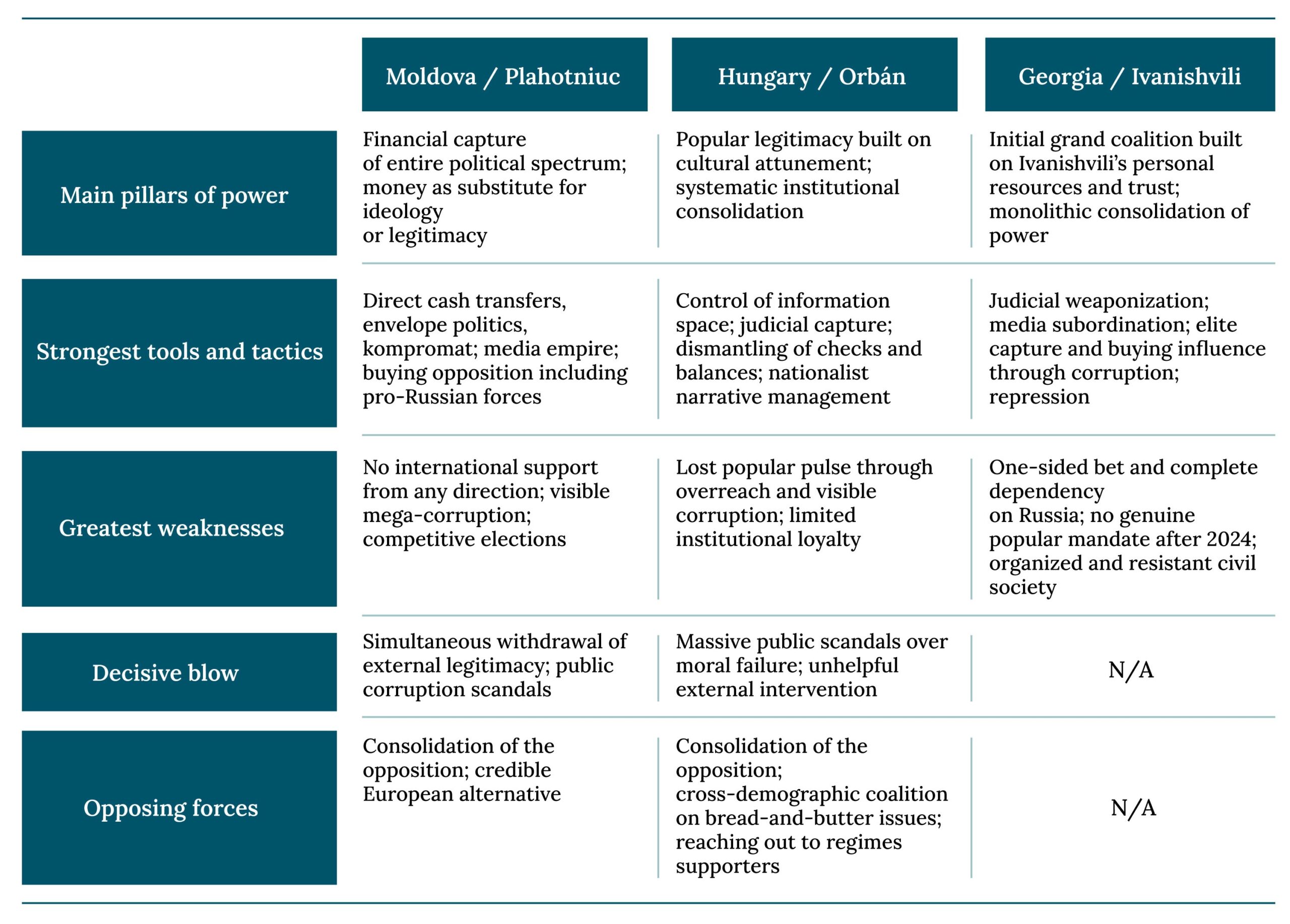
The comparative record of how Plahotniuc’s system collapsed and how Orbán’s endured for sixteen years before finally being dismantled carries specific, actionable lessons for Georgia.
The single most consistent finding across both cases is that fragmented opposition loses. What defeated Plahotniuc was a tactically unified front organized around a single axis – his removal. What defeated Orbán was not a broad ideological movement but one leader with a specific trajectory, cross-geographic reach, and the discipline to keep his message simple and material. Sandu in Moldova and Magyar in Hungary both were charismatic, telegenic, intelligent, and capable of projecting credibility to audiences that career opposition politicians had long since lost. Both understood that humility toward the electorate, an acknowledgment that the opposition had made mistakes, failed to connect, and needed to earn trust rather than demand it, was not a weakness but a precondition for being heard.
First, what Georgia needs is a unifying figure who can simultaneously consolidate the fractured opposition behind a single strategic direction and project credibility and legitimacy toward voters who have previously voted for the Georgian Dream. That second quality is the harder one to find and a very important one to have. Sandu and Magyar both possessed it. Their campaigns reached people who had never previously considered voting for the opposition, not because they preached to the converted but because they demonstrated genuine understanding of what those voters needed and genuine respect for their concerns. That is the standard Georgia’s democratic forces must set for themselves in identifying and consolidating around their own candidate. Georgia’s democratic opposition remains fragmented, and fragmentation structurally benefits an incumbent with full institutional control. A grand coalition organized around the single objective of removing the Ivanishvili system is theoretically viable but, in practice, not functional. So far, the leading force that is capable of holding it together is nowhere in sight.
Second, the opposition’s message must travel and resonate beyond Tbilisi. Magyar won because he left Budapest. Sandu won because she crafted a political offer that reached out to Moldovans who had never previously considered voting for a pro-European reformist. Georgia’s civil society and opposition forces have done extraordinary work under conditions of severe repression, and that work deserves unambiguous recognition. At the same time, the honest assessment is that the center of gravity of Georgian civic mobilization has remained concentrated in Tbilisi and in the urban, intellectually curious, and internationally connected segments of Georgian society. There is more work to be done in extending that reach, in language, in emphasis, and in physical presence, to the communities across the country. There has been much talk in the regions, but there is a need for more understanding.
Third, it is about more than values, especially for people who struggle financially, lack exposure to complex analysis, and are terrified by security concerns. The opposition’s message has been strongest on the terrain of values: rule of law, democratic institutions, European integration, and civil liberties. These are legitimate and important. They are also insufficient on their own. Orbán held power for sixteen years in part because he understood that voters make decisions based on what they feel in their daily lives, not only on what they believe in the abstract. He lost when the gap between his narrative and the material reality of Hungarian households became too wide to bridge. Magyar closed that gap by campaigning on highways, schools, and the cost of living, convincing people that he can actually solve those problems. Corruption matters to Georgian voters, and they understand concrete material consequences: why hospitals are underfunded, why young people leave the country, why prices rise while public services deteriorate. The argument from values and the argument from lived experience are not alternatives. They need to run together. However, the key missing variable is to convince people that there is an alternative force that can deliver on all this and change things for the better.
Fourth, polarization helps incumbents with state capture. Name-calling, maximalist rhetoric, and the perception of an opposition that speaks for one part of Georgian society rather than for Georgia as a whole are gifts to a regime whose primary survival tool is the claim that it alone represents the authentic Georgian nation. Plahotniuc was destroyed in part because his opponents built a coalition that deliberately crossed every ideological and geopolitical line to present a unified front. Magyar won in part because he refused to campaign on the issues that divided his potential electorate and focused relentlessly on the issues that united it. The unifying frame for Georgia’s opposition is neither a party affiliation nor a foreign policy destination. It is Georgian identity itself: the claim that Georgia’s history, culture, sovereignty, and future belong to all Georgians and are being held hostage by one man’s political and financial interests. That claim is more powerful than any ideological label, and it is considerably harder for the Georgian Dream’s propaganda apparatus to caricature as foreign-imposed.
Isolation is a powerful instrument. Plahotniuc fell when Western partners of Moldova imposed painful sanctions and every external actor withdrew recognition simultaneously.
And finally, a lesson for the pro-Democracy partners of Georgia: isolation is a powerful instrument. Plahotniuc fell when Western partners of Moldova imposed painful sanctions and every external actor withdrew recognition simultaneously. That configuration, unusual and deliberately engineered, was the decisive structural condition of his removal. Ivanishvili’s Georgian Dream is geopolitically more exposed than Orbán was, having made a one-sided bet on Russia at the cost of its relationships with the West, without Orbán’s skill in maintaining simultaneous working relationships across multiple great powers. That exposure is a strategic vulnerability that Georgia’s Western partners have not yet fully exploited.
Effective Western policy toward Georgia must abandon the assumption that continued engagement with the Georgian Dream as a governing interlocutor serves Georgia’s democratic interests.
Effective Western policy toward Georgia must abandon the assumption that continued engagement with the Georgian Dream as a governing interlocutor serves Georgia’s democratic interests. Georgia’s partners should direct their engagement, their resources, and their political recognition toward Georgia’s democratic forces, its civil society, and its people, and should coordinate that redirection with sufficient consistency and clarity. The comparative record shows clearly that, despite a more consolidated and aggressive nature of Georgia’s regime, the window for a reversible democratic outcome in Georgia remains open, and the regime’s aggression can even be turned into its vulnerability. Clearly, the pathway to success depends not only on winning the narrative and rhetoric but on the determination and hard work of a grand coalition of internal and international stakeholders.