8 February, 2026
|
14 minutes to read

The image of Nicolás Maduro and his wife being dragged away in handcuffs triggered a mix of contradictory reactions in Georgia. Among opponents of the Georgian Dream, it was greeted with a sense of elation. They hailed the move as a sign that autocrats and Vladimir Putin’s allies around the world are no longer untouchable, that the United States was “back in the game,” pursuing illegitimate dictators and abandoning its earlier posture of restraint and indecision. For many, it was not only a gesture of solidarity with Venezuelans, millions of whom have fled their country, but also an expression of hope that Georgia’s own increasingly authoritarian rulers might one day face a similar fate.
The Georgian Dream, characteristically, translated the Maduro episode into the language of domestic politics. The parliamentary speaker mocked the opposition and its supporters, quipping that Georgia’s own “Maduro” was already in prison – a reference to former president Mikheil Saakashvili. He also took aim at the European Union, declaring it no longer a relevant political force while notably refraining from criticizing the United States. Georgian Dream messaging stressed the need to remain focused on “national interests” amid uncertainty and turbulence. The speaker later added that Georgians would be far better off listening to their church rather than seeking inspiration abroad and adopting foreign values. A month later, the Georgian Dream introduced a new package of Soviet-style legislative changes restricting political participation for anyone with ties to foreign-funded organizations or to Georgians abroad who receive financial support.
The Georgian Dream’s reaction and the policies that followed suggest a strategy of self-preservation through isolation. According to this logic, Georgia as a whole is safer if it keeps its head down, shielded from external influences. This, in turn, leaves the ruling regime more secure. With the rest of the world distracted and increasingly indifferent to democratic backsliding, the moment is ripe to tighten the rules and consolidate power.
The belief that a rules-based international order can protect smaller states from the predatory instincts of great powers has been discredited in Georgia. It failed to prevent Russian aggression in 2008 and later proved equally powerless in Ukraine.
Those on the democratic side of the political spectrum, however, continue to cling to the idea of the United States as a benign hegemon that is even more effective when unconstrained by rules and norms. The belief that a rules-based international order can protect smaller states from the predatory instincts of great powers has been discredited in Georgia. It failed to prevent Russian aggression in 2008 and later proved equally powerless in Ukraine. This outlook also reflects Georgia’s enduring tradition of seeking an external patron: the conviction that democracy can be saved if sufficient external pressure is applied, sanctions are imposed, and the regime is punished abroad.
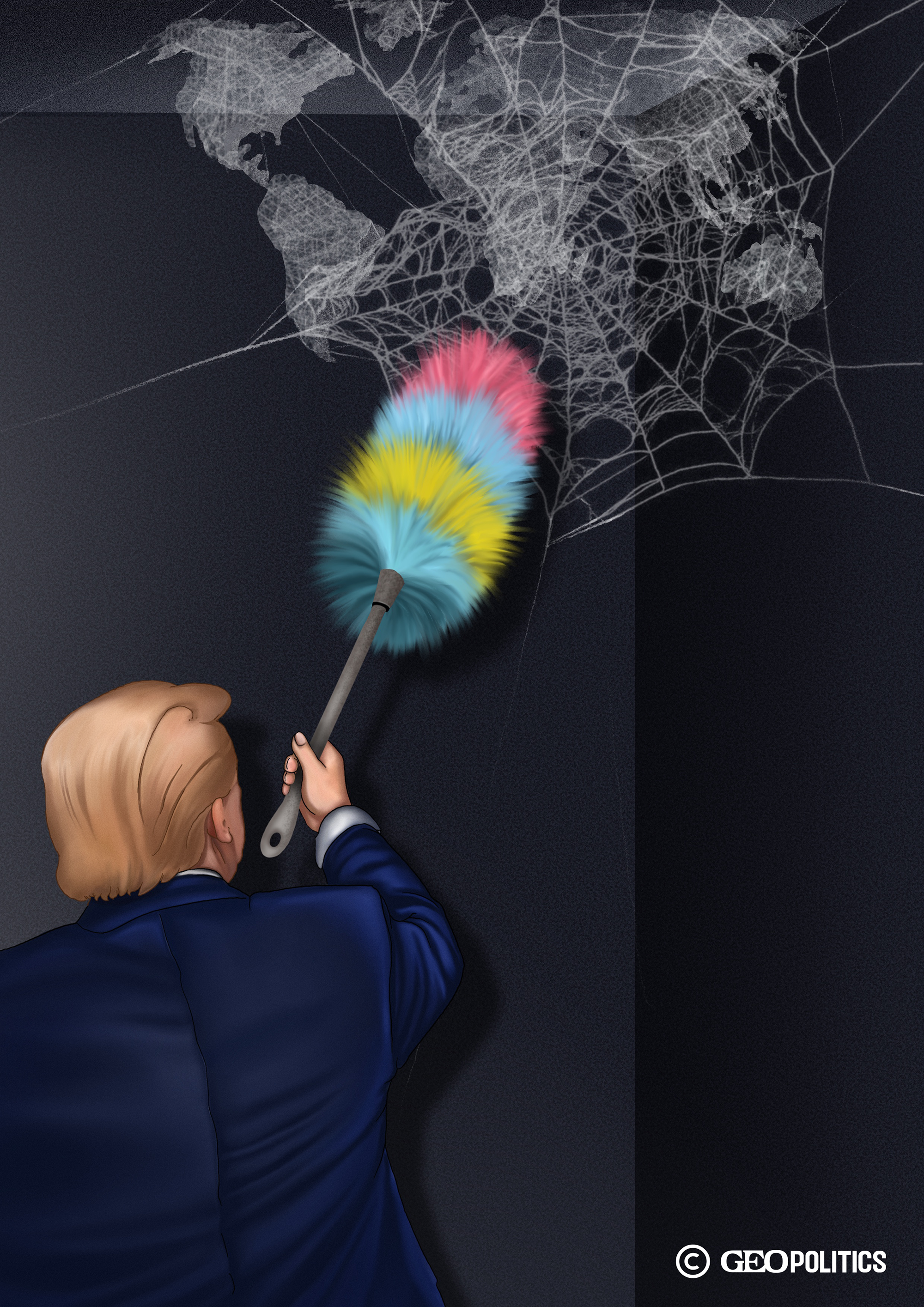
The “Maduro moment,” followed shortly by Washington’s insistence that Greenland is vital to U.S. national security, has brought the old question of spheres of influence back to the fore. The United States claims the Western Hemisphere; Russia claims its “near abroad.” Rules no longer matter, democracy is dispensable, and so are old commitments and alliances. Great powers decide; smaller states fall in line. If Greenland is vital to U.S. national security, then Crimea, as Sergey Lavrov was quick to note, is vital to Russia’s. As a new scramble for influence unfolds, Georgia is once again confronted with uncomfortable questions. What choices does it really have? Will it fall back into Russia’s sphere of influence? Is this inevitable, or does it still have agency in shaping its fate?
Georgia today faces a dual challenge: preserving its democracy while surviving as an independent state in a world that, in Stephen Miller’s words, is “governed by force, by strength and power.” This blunt affirmation that “might is right” exposes a reality many in Georgia are reluctant to accept: the United States is increasingly behaving less like a benign hegemon and more like a predatory one. The Donald Trump administration no longer regards the promotion of democracy as a core American interest and has accordingly abandoned it as a policy priority. Maduro may be gone, but his regime remains intact.
The erosion of norms and multilateral cooperation does not reduce risks for small states; it amplifies them.
The lesson for Georgia is evident. Democracy cannot be outsourced; it must be defended internally by domestic forces. Ultimately, it is Georgians themselves who have the greatest stake in the kind of state in which they will live. It is also up to Georgia to decide where it positions itself in an emerging, fractured international order. What is clear, however, is that the erosion of norms and multilateral cooperation does not reduce risks for small states; it amplifies them.
Russia, along with China and others, has long contested U.S. hegemony and resented the promotion of democracy and human rights as universal values. Moscow saw this agenda as hypocritical, masking unilateral dominance, stoking “color revolutions,” and justifying interventionism with little regard for the strategic interests of others. Today, the United States and Russia appear to be speaking the same language of power politics. The irony, however, is that even if the emerging order is more congenial to the Kremlin, it remains one shaped by the United States. This reflects a deeper strategic problem confronting Moscow: in a world that increasingly resembles the one it long claimed to want, Russia appears to have lost the initiative to shape it.
Did Russia wage four years of war only to wake up in Trump’s world? A new scramble for spheres of influence may indeed be underway—but one stripped of rules and driven by intense great-power competition could leave Russia at a disadvantage. The United States appears to be preparing precisely for such a contest: its recent moves in both Greenland and Venezuela reflect a determination to secure a competitive edge over its rivals. Although President Trump has signaled accommodation of certain Russian interests in the context of Ukraine, he has simultaneously targeted Putin’s allies one by one, undermining and constraining Russia’s global ambitions. This, in turn, has been interpreted as a reassuring sign, helping to explain a somewhat paradoxical embrace of Trumpism among many on Russia’s periphery, including Georgia.
Russia enters this competition weakened by its war in Ukraine. Its limited responses to events in Venezuela, Iran, and earlier in Syria underscore a growing overstretch. Far from moderating Moscow’s behavior, this vulnerability is likely to make it more assertive where it believes outcomes still matter most. For the Kremlin, Ukraine is not only about territory. It is about control over Ukraine’s political orientation and governance system. From this perspective, regime change, not merely territorial gains, remains central to Russia’s war aims.
Seen through this lens, Venezuela matters less as a theatre than as a precedent. The United States removed Maduro because it judged Venezuela more useful without him. Moscow draws a parallel conclusion: Ukraine, in Putin’s view, will remain hostile so long as Volodymyr Zelenskyy remains in power. If Venezuela demonstrates that regime change is permissible in the name of strategic utility, then Russia can argue that its own objectives in Ukraine require the same outcome—whether through coercion, manipulated elections, or imposed political settlements.
Where Venezuela illustrates regime removal in the name of stability, Ukraine risks becoming the inverse case: regime change pursued to neutralize a perceived threat.
This logic is not new; Russia violated international law long before Venezuela and will continue to do so. What has changed is the permissive environment. Great powers now act with increasing disregard for popular will or democratic legitimacy, guided instead by advantage in an intensifying competition. Where Venezuela illustrates regime removal in the name of stability, Ukraine risks becoming the inverse case: regime change pursued to neutralize a perceived threat.
The implications extend beyond Ukraine. For Georgia’s democrats, the emerging order offers little reassurance. Even in the unlikely event of U.S. intervention against the ruling Georgian Dream party, Trumpian logic would not necessarily favor democratic opposition or new elections. Stability and effective control would matter more than legitimacy. Supporting incumbents could be justified as the least disruptive option.
In the struggle over power, resources, and influence, Russia faces a stronger, freer, and less predictable competitor. But in countries such as Ukraine and Georgia, where democratic legitimacy collides with great-power pragmatism, the erosion of rules may work in Moscow’s favor.
Paradoxically, then, Trump’s worldview helps Russia in its near abroad even as it disadvantages Moscow globally. In the struggle over power, resources, and influence, Russia faces a stronger, freer, and less predictable competitor. But in countries such as Ukraine and Georgia, where democratic legitimacy collides with great-power pragmatism, the erosion of rules may work in Moscow’s favor.
There is nothing new about spheres of influence themselves. Despite decades of rhetoric about sovereign equality and a rules-based international order, great powers have always exerted disproportionate influence over their smaller neighbors. What has changed is how that influence is exercised. Previously, it was constrained, even if imperfectly, by norms, institutions, and reputational costs. Today, those constraints have visibly weakened. Yet, it would be unwise to assume that great powers can now dominate their respective spheres as they once did or that such domination would go uncontested. Nor is there reason to believe that mutual recognition of spheres would produce greater stability or security.
First, spheres of influence are no longer geographically bounded, nor are they static or uncontested. Russia’s policies in the Sahel are an attempt at expanding its sphere of influence beyond the traditional “near abroad.” At the same time, Russia’s once-uncontested dominance is increasingly constrained by Türkiye in the South Caucasus and by China in Central Asia. China’s economic footprint in Latin America is substantial and growing and U.S. pressure is more likely to deepen Chinese engagement than to eliminate it. The Canadian prime minister’s recent visit to Beijing underscores this reality. Rather than restoring order, aggressive reassertion of influence may encourage smaller states to hedge, playing one power against another and intensifying great-power rivalry.
Second, intensified competition does not lead to a stable equilibrium. Even where great powers tacitly acknowledge one another’s interests, they still seek advantage. Control over Venezuela does not automatically entitle Russia to control over Ukraine or to the restoration of its influence all over the former Soviet Union. Trump’s overtures towards Central Asian states or his involvement in the Armenia-Azerbaijan conflict demonstrate that the U.S. is not inhibited when it comes to engaging in, and if necessary, sidelining Russia in its traditional area of domination. According to the latest reports, Trump is dispatching Vice President J.D. Vance to both Baku and Yerevan to advance the work on the Trump Route for International Peace and Prosperity (TRIPP).
The logic of spheres of influence assumes that smaller states will submit because resistance is futile. Ukraine has demonstrated the opposite. Resistance is not irrational; it is value-driven.
Third, the logic of spheres of influence assumes that smaller states will submit because resistance is futile. Ukraine has demonstrated the opposite. Resistance is not irrational; it is value-driven. States value independence, people care about their rights, and they are increasingly willing to fight for them, even against overwhelming odds. Venezuelans may still put up a fight to dismantle what is left of Maduro’s regime rather than accept decisions made for them, as do Iranians, and durable stabilization may ultimately require democratic governance.
Moreover, while the power and capability imbalance between smaller and larger states persists, the gap has narrowed. Former Soviet republics, having gained their independence, were initially far weaker than Russia, allowing Moscow to project influence with little resistance. That is no longer the case. States that emerged from colonial domination across the globe are no longer uniformly weak or passive. Ukraine’s valiant resistance to the Russian aggression defied all expectations. Today, even smaller states are stronger than they used to be and better positioned to push back and boost their positions in partnership with others.
This leads to a final observation: the international system is no longer neatly divided between great powers and everyone else. Middle powers matter, and they are likely to play an increasingly significant role in shaping a fragmented global order—both within their regions and beyond. Türkiye’s expanding role in the Black Sea, the Middle East, and parts of Africa illustrates this shift. In the South Caucasus, the emerging Türkiye-Azerbaijan axis has become an effective counterbalance to Russia’s hegemonic ambitions. The influence of middle powers is likely to grow further as the multilateralism characteristic of the post-Cold War order gives way to more flexible, minilateral arrangements centered on shared threats and interests.
What, then, are Georgia’s choices under these circumstances? As with any period of change, the moment presents both risks and opportunities. Georgia should give up the illusion that Western support will help restore its rapidly eroding democracy, not because democracy has lost its value, but because the West, as it once existed, may no longer be there, and its principal architect, the United States, is no longer committed to promoting it. Democracy will, therefore, have to be defended primarily through domestic means.
This matters not only because of the intrinsic value attached to living with dignity and protected rights, but also for strategic reasons. In a highly competitive environment, where miscalculations carry prohibitive costs, democracy remains the most resilient and error-correcting system of decision-making. Authoritarian regimes, such as the one that the Georgian Dream is constructing, prioritize loyalty over competence and devote much of their political bandwidth to regime survival rather than to addressing genuine national security challenges.
In a world where spheres of influence are both fluid and contested, Georgia could increase its room for maneuver and protect itself by forging alliances and durable partnerships. It is not a world in which a small nation can survive in isolation and retain effective, not just nominal, sovereignty. In an era of intensifying competition, neutrality is illusory, and abstention is not an option. Participation is unavoidable, and those who fail to choose will find that choices are made for them.
As Europe assumes greater responsibility for deterring Russia, it too stands to benefit from close alignment with Georgia. Supporting a democratic Georgia is, therefore, not only a matter of values but a security imperative.
This requires a strategic choice: whether to align with a reconfigured community of democracies or to acquiesce to a model of submissive authoritarian stability. It also demands a reassessment of Georgia’s strategic value amid intensified systemic rivalry. Its transit potential remains important but is no longer unique. If and when the TRIPP becomes operational, Georgia’s route will be one among several, requiring it to compete and to demonstrate reliability. To that end, Georgia will need to work closely with regional partners—Azerbaijan, Armenia, and Türkiye—to prevent Russia from re-establishing uncontested dominance, leveraging Georgia’s position on the Black Sea coast.Most importantly, however, Georgia must decide who its principal strategic partners are and how to anchor itself within a European security architecture that is being reshaped in real time. If Georgia values sovereignty, peace, and democracy in equal measure, European integration remains its best and only viable option. As Europe assumes greater responsibility for deterring Russia, it too stands to benefit from close alignment with Georgia. Supporting a democratic Georgia is, therefore, not only a matter of values but a security imperative.