22 November, 2026
|
14 minutes to read


On November 4, 2026, the European Commission published its annual enlargement package, assessing the preparedness of ten candidate and potential candidate countries. This is the fourth comprehensive enlargement report on Georgia since the country embarked on its European path in 2022. Yet, despite starting the accession journey alongside Moldova and Ukraine, Georgia has fallen far behind its former partners. Brussels has outlined tentative timelines for Moldova and Ukraine to conclude accession negotiations by 2028, while Georgia remains what the Commission itself calls a candidate country “in name only.”
A four-year assessment (2023–2026) of the 33 negotiating chapters covered by the Commission’s reports shows a steady loss of momentum: in 2026 alone, Georgia stagnated or regressed in more than half of the policy areas (17 out of 33). In 2026, its net progress score was just 2.50 (4.50 points for progress against 2.00 points for backsliding), compared with 23 for Moldova and 17 for Ukraine, according to the scoring used in this article. Georgia is moving backward in key areas that are fundamental to accession, particularly the judiciary and fundamental rights, as well as foreign, security, and defense policy. Its alignment with the EU’s Common Foreign and Security Policy (CFSP) fell from 53% in 2024 to 38% by September 2026. By comparison, Moldova’s alignment stands at 91% and Ukraine’s at 99%. The widening gap is not simply a matter of different reform speeds; it raises a more consequential question: whether Georgia will still be in a position to benefit from the next phase of EU enlargement.
As Georgia drifts further from Moldova and Ukraine, it risks being grouped with candidate countries such as Türkiye and Bosnia and Herzegovina, whose accession processes are at a standstill.
The Georgian government’s claim that it can shelve the opening of accession talks and return to the matter in late 2028 overlooks the political and institutional realities in Brussels. By then, the EU will be approaching a new parliamentary and Commission cycle, likely focused on integrating the current frontrunners. For countries that have fallen behind, the next opportunity to move forward could be far off. As Georgia drifts further from Moldova and Ukraine, it risks being grouped with candidate countries such as Türkiye and Bosnia and Herzegovina, whose accession processes are at a standstill. This risk becomes clearer when viewed against the timetable now taking shape for the countries still advancing.
For the first time in years, the European Union’s enlargement agenda is beginning to look less like an open-ended promise and more like a process with a timetable. In its 2026 package, the European Commission sets out a cautious outlook for the countries moving ahead: if they sustain their reform momentum, Montenegro could conclude accession negotiations by the end of 2026, Albania in 2027, Moldova by early 2028, and Ukraine by the end of 2028. These dates are not guaranteed, but they show that the next enlargement is no longer a distant possibility; for the frontrunners, it is becoming a realistic political horizon.
Against this backdrop, Georgian Dream (GD) Prime Minister Irakli Kobakhidze announced on November 28, 2024, that Georgia would not put the opening of accession negotiations on its agenda until the end of 2028. Even if Tbilisi were to return to the table at that point, it would collide with a very different political reality in Brussels. By late 2028, negotiations with Moldova and Ukraine may be nearing completion, just as the EU turns its attention to the 2029 European Parliament elections, the formation of a new European Commission, and the start of a new 2029–2034 political cycle.
The renewed push for EU enlargement is rooted above all in the geopolitical transformation triggered by Russia’s full-scale invasion of Ukraine. The war has made the security of the EU’s eastern and southeastern neighborhood an urgent strategic priority. But once the current enlargement wave has helped secure the Union’s immediate eastern and southeastern flanks, that sense of urgency may begin to fade. Without that overriding security imperative, future candidates could face a slower, more technocratic, and less politically flexible process, with every legal, institutional, and economic benchmark scrutinized more rigorously.
The EU has historically taken lengthy pauses after successive rounds of enlargement, focusing on integrating new members rather than immediately opening the door to further candidates. By 2029, the bloc could be preoccupied with the substantial institutional, budgetary and decision-making reforms needed to accommodate Montenegro, Albania, Moldova and Ukraine. Georgia could find itself not simply at the back of the queue, but facing a door that has effectively closed as the EU enters another period of internal consolidation. A further complication is the possibility that public support for enlargement in EU member states could weaken, making the political climate for future accessions even less favorable. The question, then, is not only how much time Georgia is losing, but how that loss can be measured and what the record reveals about the direction of the country’s European course.
How far has Georgia really traveled on its EU accession path and, more importantly, how much ground has it lost? The European Commission’s annual enlargement reports offer a way to answer that question. They do more than describe the state of play in individual policy areas or negotiation chapters; they also assess whether each country is moving forward, standing still, or slipping backward.
The Commission uses six categories to describe progress: backsliding, no progress, limited progress, some progress, good progress, and very good progress. To make these assessments easier to compare over time, this article converts the Commission’s qualitative evaluations into a numerical scale. Each category is assigned a value: backsliding is scored at –1; no progress at 0; limited progress at 0.25; some progress at 0.5; good progress at 0.75; and very good progress at 1.
The conversion of qualitative assessments into numerical values draws on the methodology used by the European Stability Initiative (ESI) to measure preparedness. Applying the same scale to all 33 negotiation chapters makes it possible to trace changes in Georgia’s performance between 2023 and 2026 and to compare its record with those of Moldova and Ukraine. The scores should not be read as precise measurements of accession readiness. Their purpose is more modest: to make the direction and scale of progress, stagnation and regression visible, and to provide a consistent basis for comparison.
Table 1: Four Years in the Numbers: Where Georgia Has Advanced—and Where It Has Fallen Back
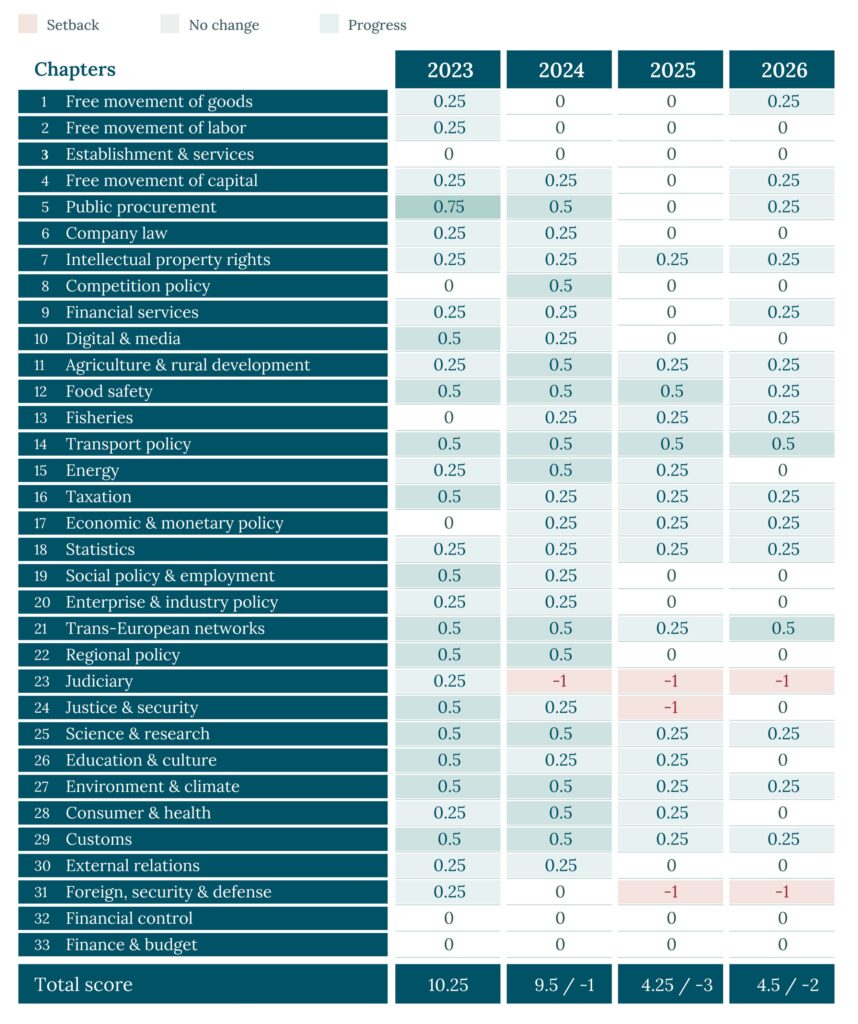
The pattern that emerges from the table above is one of diminishing momentum. Over the past four years, Georgia’s progress has slowed to a crawl, and in 2026 it stagnated or moved backward in more than half of the policy areas covered by the EU accession process: in 17 of the 33 chapters, progress stalled (15) or reversed (two). Fourteen chapters saw only limited progress, and just two (transport policy and trans-European networks) recorded some progress. Stagnation is particularly evident in areas such as media, external relations and education. The most serious deterioration, however, has occurred in the judiciary and in foreign, security, and defense policy.
The chapters in which Georgia is losing ground are not marginal areas of technical alignment; they concern the foundations on which EU membership rests: democracy, the rule of law, human rights and a country’s relationship with the Union’s common foreign and security policy.
This distinction is very significant. The chapters in which Georgia is losing ground are not marginal areas of technical alignment; they concern the foundations on which EU membership rests: democracy, the rule of law, human rights and a country’s relationship with the Union’s common foreign and security policy. Progress in these areas requires more than administrative adjustments. It depends on political commitment and institutions that can operate independently and uphold democratic standards. Candidate countries are also expected to align their foreign and security policies with those of the EU.
Georgia’s record in this respect has moved in the opposite direction. Its alignment with the EU’s foreign and security policy stood at 50% in 2023, rose to 53% in 2024, then fell to 40% in 2025 and further to 38% by September 1, 2026. The chart below places this decline in perspective by comparing Georgia’s alignment with that of Moldova and Ukraine. The figures for 2023–2025 are the annual rates given in the following year’s Commission report; the 2026 figure covers alignment up to September 1, 2026.
The recommendations issued by the EU when Georgia was granted candidate status remain entirely unaddressed, as was already the case in 2025. These nine steps range from countering disinformation, aligning with the CFSP, and reducing political polarization to ensuring free and fair elections, strengthening parliamentary oversight, reforming the judiciary, guaranteeing the independence of anti-corruption and oversight bodies, pursuing de-oligarchization, and protecting human rights and civil society. Their continued neglect points to a problem beyond the pace of technical preparations: the country is failing to act on the very commitments meant to anchor its candidacy.
Graph 1: Georgia, Moldova and Ukraine alignment with EU CFSP
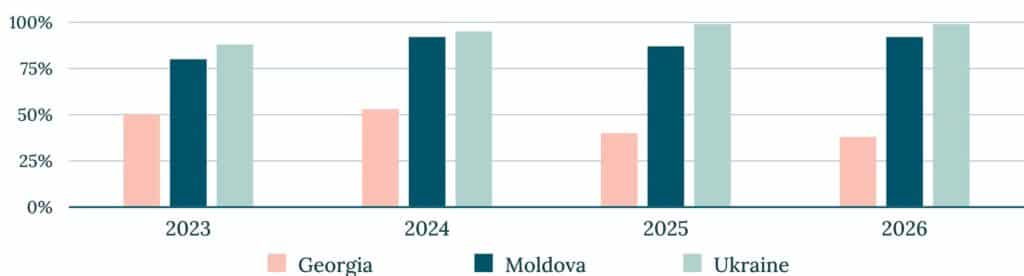
The figures show Georgia’s trajectory, but their significance becomes clearer when set beside the progress of the two countries with which it once shared the European path. EU enlargement has often advanced in regional waves, and Georgia long sought to pursue its European future alongside Moldova and Ukraine. The three countries began this phase of their EU accession journeys in 2022 and share important political and historical circumstances. Comparing their performance therefore reveals not just who is moving faster, but how differently the three governments have responded to the same historic opening. The following comparison applies the same scoring system to the Commission’s 2026 assessments of all three countries.
Table 2: The 2026 Comparison of Georgia, Moldova and Ukraine
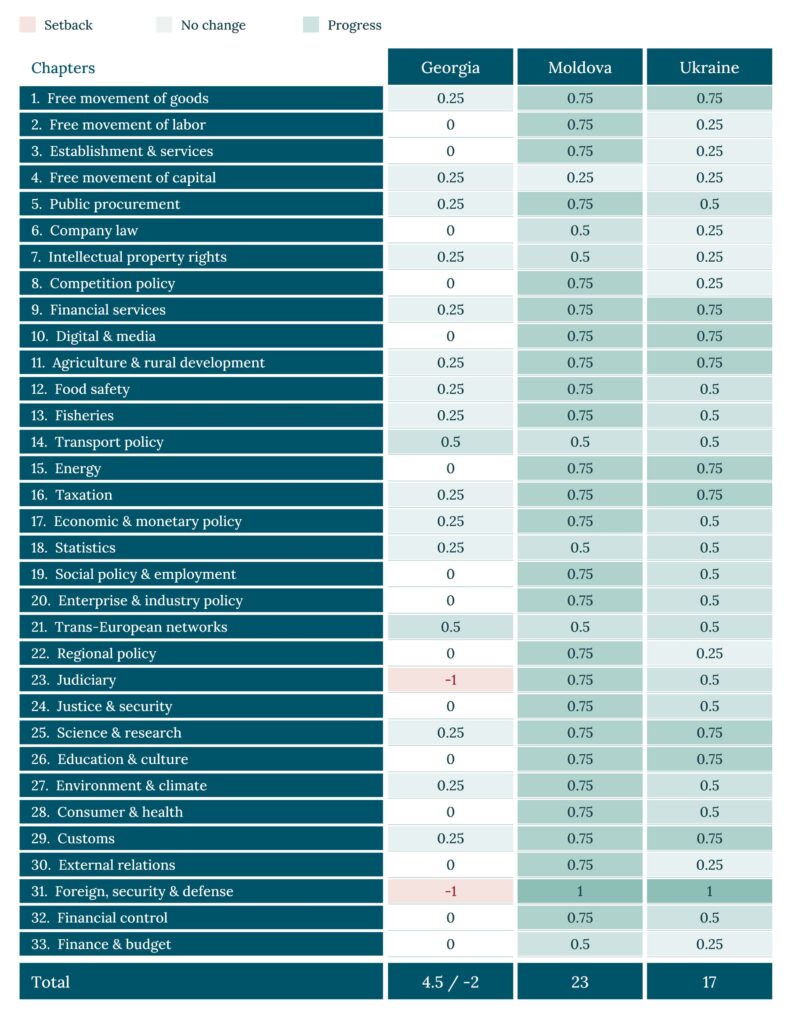
This comparison shows that Moldova and Ukraine are now several steps ahead of Georgia. Even setting aside Georgia’s backsliding in the most consequential areas and looking only at chapters where some progress has been made, the difference is striking. Moldova’s score is more than five times Georgia’s, while Ukraine’s is nearly four times as high. Moldova and Ukraine have opened four of the six negotiating clusters and, with Hungary dropping its objections in November, aim to open the remaining two by the end of 2026.
Can a country remain a credible EU candidate when its political choices pull it further from the standards and policies it is expected to adopt?
By contrast, Georgia is no longer treated as part of the group once known as the Associated Trio. Its position increasingly resembles that of countries such as Türkiye and Bosnia and Herzegovina, where the accession process has, for all practical purposes, ground to a halt. This widening gap goes beyond lost prestige or delayed negotiations and raises a deeper question: can a country remain a credible EU candidate when its political choices pull it further from the standards and policies it is expected to adopt?
Georgia’s positive overall score risks creating a misleading impression: the arithmetic may remain above zero, while the political foundations of accession are being undermined.
The most consequential finding is not that Georgia has accumulated fewer points than its neighbors, but that its weakest performance is concentrated in the very areas that determine whether accession is politically possible. Technical progress in selected economic and regulatory fields can keep parts of the process moving, but it cannot compensate for a deterioration in judicial independence, fundamental rights or democratic governance. In that sense, Georgia’s positive overall score risks creating a misleading impression: the arithmetic may remain above zero, while the political foundations of accession are being undermined.
This helps explain why the gap with Moldova and Ukraine is more than a race between three candidates. Chisinau and Kyiv have treated accession as a strategic priority and used the momentum created by Russia’s full-scale invasion of Ukraine to advance institutional reforms. Georgia’s trajectory suggests a different calculation. Georgian Dream seems to believe that formal candidate status, selective technical progress, and the country’s geographical importance might preserve its European prospects even without comparable progress on the fundamentals. The evidence here suggests this is an erroneous, and even risky, assumption.
This is the central weakness in the Georgian government’s apparent bet: it treats the country’s geopolitical value as if it could offset a failure to meet the political conditions for membership.
The EU’s approach is built around conditionality. Candidate status is not a guarantee of membership, nor is it a permanent place in an accession queue. It invites reforms, with progress assessed against political and legal standards. If those standards are not met, the process can stall regardless of a country’s strategic location or the strength of its declared European aspirations. This is the central weakness in the Georgian government’s apparent bet: it treats the country’s geopolitical value as if it could offset a failure to meet the political conditions for membership.
The danger is that this calculation may only become visible when the opportunity has already narrowed. If the current enlargement wave advances without Georgia, the country could find that its former partners have moved into a new phase while it is still debating whether to resume a process it once claimed as a national priority. The issue is therefore not simply lost time. It is the growing disconnect between the government’s stated European objective and the choices needed to make it achievable.
The gap between Georgia’s declared European ambition and its current course is not only a matter of policy; it is also a matter of how that course is explained to the public.
Georgian Dream has advanced three main narratives to justify its U-turn away from the EU. The first is that EU membership would ultimately come at the price of war with Russia. The second is that, because of the Middle Corridor, the EU needs Georgia no less than Georgia needs the EU and therefore cannot leave the country out of this strategic project. The third is the claim that Georgia’s goal remains EU membership by 2030, with implementation of the obligations set out in the Association Agreement presented as one of the main routes toward that goal.
These claims deserve a clear and sustained response. The EU and domestic pro-European actors alike need to explain what the accession process entails, what obligations candidate countries must meet, and why progress depends on democratic standards and alignment with the Union, not on geopolitical bargaining or the assumption that strategic importance can secure a shortcut. Without that explanation, the public debate risks being shaped by claims that obscure the country’s real choices. Communication matters, but it cannot substitute for policy change.
Georgia’s EU prospects are not simply a question of when accession talks might resume. The central problem is the gap between the government’s declared ambition to join the European Union and the policies it is pursuing. Georgia’s strategic location and role in regional connectivity make it an important partner for Europe, but they cannot replace the democratic reforms and political commitments required for membership.
Nor can the country assume that it can return to the accession process whenever it chooses. Rebuilding independent institutions, protecting fundamental rights and restoring trust takes time. Meanwhile, Moldova and Ukraine are moving ahead, and the EU’s priorities may change once the current enlargement round is completed. The longer Georgia delays meaningful reforms, the harder it may be to regain its place in the process.
The way forward is clear: if Georgia wants to pursue EU membership, its leadership must demonstrate that commitment through action by strengthening democratic institutions, upholding the rule of law, and aligning the country’s policies with those of the EU. Without such a change, declarations of European ambition will remain just that: declarations. The decision rests with Georgia’s political leadership, but the consequences will shape the country’s future for years to come.