22 September, 2026
|
12 minutes to read

Casting a cursory glance at the European newspaper headlines, you’d be justified in thinking that the populists – to the left and the right – are on the relentless march, and up to undoing the European project.
The unprecedented success of the Alternative for Germany (AfD) party has captured the European headlines. Most claim doom, drawing parallels with the rise of the NSDAP in the 1930s. The BBC lamented the “reckoning with Germany’s Nazi past”, while Euronews bemoaned the “shocking far right surge.” Others, especially across the Atlantic and in ultra-right circles, claim a new era of European politics: Elon Musk posted “Gut Gemacht!” (Well done! in German), and President Donald Trump celebrated victory as Make Germany Great Again, drawing Chancellor Friedrich Merz’s ire.
Look to France, and the recent extremely detailed poll (13 thousand respondents!) commissioned by Le Monde will show you that radical right-wing, Euro-skeptic candidate Marine Le Pen is comfortably heading the polls in all six surveyed scenarios with 34-35% of support, while in four out of six scenarios her challenger for the second round would be populist-left candidate Jean-Luc Mélenchon, who is no less critical of the EU. Otherwise, the mood among the French is morose: three-fourths expect things to get worse in the coming months, and the prevailing feelings are disquiet (59%), uncertainty (51%), tiredness (34%), anger (30%), and revulsion (24%). Only 17% are hopeful. 71% expect the presidential elections to bring tangible change, but drill deeper and they don’t want anything to change in their personal lives or finances much – an electoral bonanza for populists.
Gone are the hopes that Merz’s accession would “restart the Franco-German engine”: his chancellorship is now in the doldrums, with Politico even discussing the “endgame.” Macron himself is on the logical way out because of the electoral cycle and the lack of a clear successor. This does not bode well for a united Europe, especially for those, like Georgians, who count on its pull to bolster internal pro-democratic forces. But perhaps, not all is lost.
The President of the European Commission, Ursula von der Leyen, has been heavily criticized in the newspapers after her State of the European Union (SOTEU) speech, which she delivered to the European Parliament on 16 September. An influential French-language newsletter covering all things EU called her “the Queen of unfulfilled promises”, accusing her of recycling the litany of solutions that she presented months or even years ago, and that the Commission has failed to deliver on since. Many point out that the headline-grabbing “associate membership” for Canada has no legal basis in the Treaty and may reignite bickering among the actual candidate states. It already drew the anger of President Trump, who called the offer a “hostile” move and derided it as “laughable”.
Has something gone wrong with Ursula von der Leyen? A politician with so much experience, and the first to speak about Europe’s geopolitical relevance and global role. While she has been accused of a power grab, of centralizing more power in the Commission than it is supposed to have, the reality that pulls Europe back is precisely the indecision that is paralyzing the member states. The underlying truth is that “Brussels” is not the all-powerful monster that its populist opponents inside Europe and on its fringes claim it to be. The Commission depends on the Member States for its decisions, but in European capitals, we hear lots of chest-thumping and no rush to band together and find solutions on common defense, climate change, or AI.
The Commission President is trying to reach out to Europe directly: in the SOTEU, she proposed a new “Congress of Europe” to bring together thinkers, scientists, artists and citizens. Ursula von der Leyen says she wants to “reclaim […] European imagination” – and the controversial Canada offer is surely a part of that game. For Europe to survive as a joint project, it must inspire, especially in the era of social media stunts. But she is racing against the tide: according to Politico’s quick poll, 22% of the surveyed French and 10% of Spaniards have never heard of her. Of those who did, most in Germany, France, and Spain think she is doing a bad or very bad job, but the largest proportion in all three states does not know what she is doing or can’t decide. It is hard to be inspiring when you are unknown.
Most citizens in Western parts of Europe, unlike their Eastern peers, have no personal experience of undergoing hard and quick adjustments.
This is where the team formerly known as the “Franco-German engine” is coming into play. The surge of anti-European populism in these large European states is not unexpected, given the complexity of current challenges. Most citizens in Western parts of Europe, unlike their Eastern peers, have no personal experience of undergoing hard and quick adjustments. The Western and Northern European social states guaranteed growth in quality of life and stable employment from the 1950s till about the late 1980s. That model unraveled slowly in the 1990s and then came undone fast, partly due to external shocks, but also due to internal changes, such as the major demographic shift at least partially linked to prosperity. Europeans live considerably longer (81 years in Germany, 83 in France on average, a life expectancy jump of 14-16 years on average since the 1950s, according to Eurostat) and have fewer babies. The mainstream political parties haven’t prepared their citizens for the changes this entailed. Especially in France, they preferred to muddle through and borrow to keep the social system running, rather than decisively confront the powerful (and famously strike-happy) trade unions. In Germany, they did more so. Still, the economic model that relied on cheap Russian gas to finance industrial exports to China has now collapsed, taking some of that VROOM out of the German internal combustion engine.
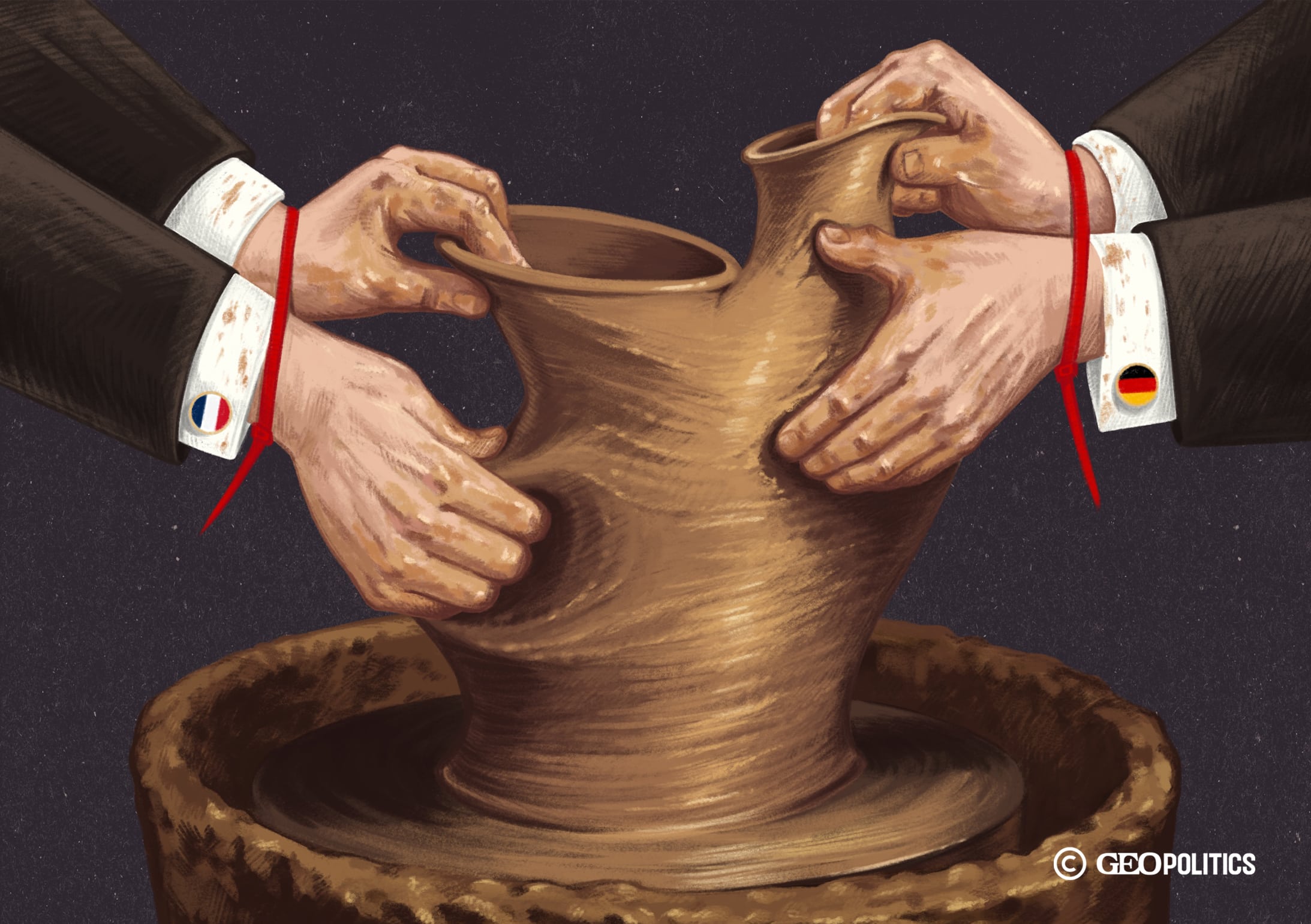
France and Germany are therefore trying to mold Europe’s future with hands shackled by their own domestic politics.
These problems should have brought Paris and Berlin together and seated them more confidently and assertively in the European Union driver’s seat. Some considerable thought has indeed gone into this: in 2023, an official Franco-German expert group published a comprehensive report on EU reform and enlargement. But as the foresightful critics pointed out at the time, this approach externalized internal problems: it sought EU-institutional solutions to a problem whose source lay at home, in the domestic political dynamics of EU states. France and Germany are therefore trying to mold Europe’s future with hands shackled by their own domestic politics.
The rise of populists who have successfully blamed outsiders (migrants and/or the EU, more often than not) for internal woes has undone the hapless ‘big tent’ post-WWII political parties. In France, where this trend was most obvious in the meteoric rise to the summit of Emmanuel Macron, who had never before held elected public office, it has proven a false start. As he is leaving office, Macron leaves little political inheritance.
Neutered at home, leaders in Paris and Berlin can no longer set the sails on the European ship the way they once could. Even their much-touted bilateral defense initiatives tend to falter: witness the collapse of the FCAS/SCAF future combat aircraft project deal in unsightly bickering between the French Dassault and German Airbus, which the leaders could not redress. Or the badly delayed future tank program.
But the implications at the European level are even more significant: delays hamper the EU Council, where decisive action is needed not because Paris and Berlin necessarily disagree, but because they no longer actively cooperate. Without the once-powerful backing from the two, Brussels ran repeatedly afoul of the trickery and stalling of the quarrelsome leaders in Budapest, or even Bratislava, on crucial subjects.
The Commission, and its President, could be excused for wanting to fill the power void that has emerged: after all, this is the internal logic of all bureaucratic institutions. Except the Commission cannot really do that, because the Treaty intentionally hobbles it. Hence Ursula von der Leyen’s symbolic acts of power and dazzling abbreviations. They do little to bridge the real power gap, and additionally irritate the European capitals even more, while handing ammo to the populists. What is more, she is failing to reach over the heads of the national leaderships to give Europeans what they expect and want.
With all the party-political vitriol and journalistic scorn poured on it, one could think that European citizens deride the EU just as much as the Rassemblement National or AfD do. But poll upon poll suggests this is far from being the case.
An impressive 74% of European respondents surveyed by the large-scale Eurobarometer study conducted in Spring 2026 on a sample of up to 26.5 thousand people in all 27 states believe their country has benefited from EU membership; 68% want the EU to play a more important role in protecting citizens from global crises and security threats, 73% believe it should receive new resources, and 90% want the member states to be more united. But the same study also revealed anxiety about the geopolitical situation (58% are pessimistic about the future of the world) and the primacy of domestic concerns such as declining living standards and inflation. Notably, these anxieties are more pronounced in France and Germany.
This chimes well with, but also contextualizes, another study – the European Sentiment Compass published jointly by the European Council on Foreign Relations (ECFR) and the European Cultural Foundation (ECF) in September 2026. This was done on a smaller scale, involving only close to 6,000 citizens of France, Germany, Italy, the Netherlands, Poland and the UK, and complemented by political and media research in 15 EU states. In this study, 56% believed Europe’s future was in danger, but three-quarters had a positive vision for Europe in the coming 20 years. Only 13% wanted “less Europe” and blamed the governments more than the EU for their daily troubles.
One conclusion that the authors draw is that Europeans want more EU, not less, but increasingly doubt that it is possible. In this way, the highly mediatized doomsaying (unabashedly amplified by the malevolent manipulators inside and outside Europe) is rapidly transforming into a self-fulfilling prophecy of an “unstoppable rise” of the radical anti-European forces.
Von der Leyen may be onto something when she speaks about citizens’ imagination: Europe must be perceived as a destiny to survive these difficult times.
Another important point is well made by André Wilkens, ECF Director: “Unless people can imagine themselves in a common European future, Europe remains an arrangement, not a destiny.” So, von der Leyen may be onto something when she speaks about citizens’ imagination: Europe must be perceived as a destiny to survive these difficult times. Unfortunately, in the French election campaign, only Raphaël Glucksmann – a maverick center-left candidate – is articulating such a vision.
Europeans are concerned, very concerned about tomorrow and politically disoriented. But a full 75% believe that a united Europe can keep them safer than any national government. This is an electoral reservoir that French and German politicians can and must tap into, with a message of shared destiny and specific – if small – deeds that prove joint action is possible.
If history teaches us anything, it is that one should never succumb to preemptive capitulation when populists are rising. Polls show that Europeans are concerned, very concerned about tomorrow and politically disoriented. But a full 75% believe that a united Europe can keep them safer than any national government. This is an electoral reservoir that French and German politicians can and must tap into, with a message of shared destiny and specific – if small – deeds that prove joint action is possible.
The European Commission – whether or not von der Leyen retains her function – will continue to find itself in a bind. The problem is structural: countries have fewer resources and thus find it logical to pool them in a common European vat to address transnational problems of security, environment and competitiveness. But they – especially smaller states – also fear that the pooling of resources is diluting their national weight in international relations and is potentially allowing larger countries – especially Germany – to make distribution choices. This tension will affect both planning and implementation of the next Multiannual Financial Framework (MFF).
Not Brussels, but national capitals distracted by internal politics are the main obstacle to membership. Ultimately, they, too, should try to reach the hearts and minds of European citizens directly and ensure the membership referenda deliver positive results.
For countries on the EU porch in the Western Balkans, and for Moldova and Ukraine, too, the lesson is that their path to membership will not get easier. Not Brussels, but national capitals distracted by internal politics are the main obstacle to membership. Ultimately, they, too, should try to reach the hearts and minds of European citizens directly and ensure the membership referenda deliver positive results.
Georgia is a special case: the Georgian Dream government has not only formally stepped back from membership but also backtracked on legislative advances of the past decades. Georgia’s body politic has been severely maimed by the past years of violence. Mutual mistrust is rife, and society is internally atomized. Yet, like the rest of Europe, Georgians believe Europe can keep them safer than they are now. But they currently see no path ahead. It is up to the Georgian political class – widely understood – to articulate a realistic vision and root Georgia’s future in the common European destiny.
For that task to succeed, one needs a strong, truthful but optimistic narrative which would put the stream of negativity that is spouting now not only from pro-Russian or MAGA outlets, but also from European mainstream publications into a narrative context. With Georgia’s weakened creative class, hamstrung journalism, civil society and academia, a bookmaker would not bet on the success of such an endeavor. But this does not mean it should not be tried.