23 May, 2026
|
23 minutes to read

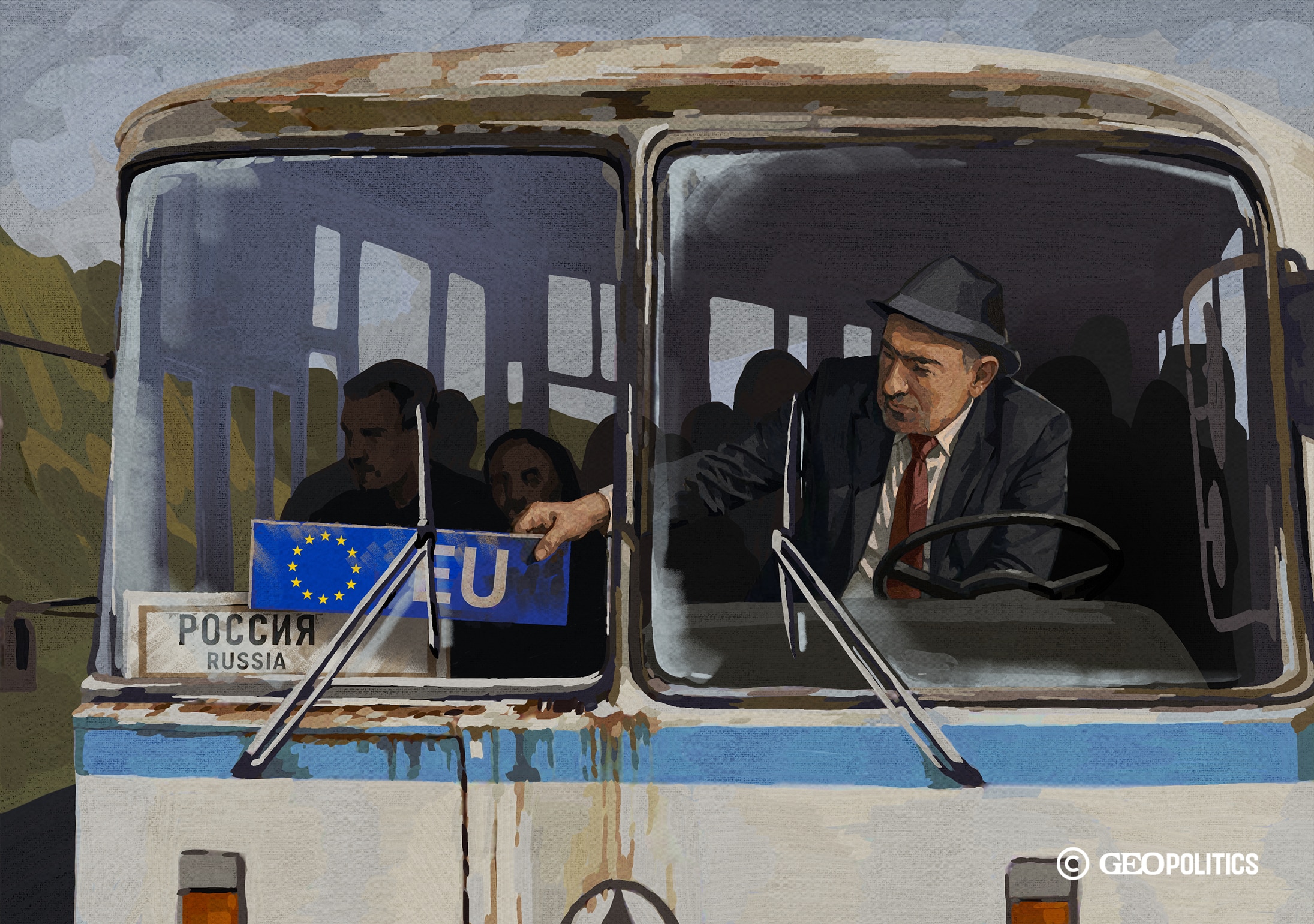
Before my latest visit to Yerevan, as the electoral campaign was heating up, an old Armenian friend warned me: “Every Armenian taxi driver is simultaneously a geopolitical analyst, a military strategist, an economist, and an opposition leader.” Yet even that did not prepare me for the very first driver who picked me up at Zvartnots Airport and drove me into the city center. When I asked him how the campaign was going, he replied: “You know, every Armenian mother has two fears: war and Nikol Pashinyan going live on Facebook again.”
It was probably the best possible introduction to the peculiar style of Pashinyan’s campaigning. Eight years after coming to power through the 2018 “Velvet Revolution,” he still campaigns less like a conventional post-Soviet leader than like a permanently restless opposition activist, though with more bodyguards than then. He travels tirelessly across the country, holding endless meetings with voters in towns and villages, arguing with people in markets and cafés, live-streaming constantly from a bus while eating local food with his entourage, often accompanied by his close ally Alen Simonyan, the Speaker of Parliament, with whom he even founded a rock band called Varchaband (it’s a pun, Varchapert meaning Prime Minister in Armenian).
Pashinyan genuinely seems to believe that politics still requires the same physical proximity to ordinary citizens that carried him to power in 2018, when he crossed Armenia on foot with a backpack and a protest movement behind him. He talks to virtually anyone. Many of these encounters are clearly not staged: people interrupt him, challenge him, insult him, sometimes shout at him, and he often shouts back. The exchanges can become emotional, chaotic, even theatrical. His wife leaves him in the middle of the campaign trail and then returns. The entire spectacle can appear exhausting, dramatic, messy, but also strangely authentic.
This is what makes Pashinyan such an unusual figure in the post-Soviet space, especially in a conservative Caucasian society. Few leaders who have governed for eight years would still expose themselves so directly, so constantly, and so unpredictably to ordinary citizens. Few leaders would dare confront so many sacred pillars of their society at once, institutions and narratives placed so high in the pantheon of national identity as the Armenian Apostolic Church, the tragic-heroic mythology of Armenian history, and the deeply rooted belief in Russia as Armenia’s ultimate security guarantor.
Having known the 3rd President of Georgia, Mikheil Saakashvili, personally, a man hardly lacking in audacity, charisma, political courage, or intellectual sophistication, shaped by some of the world’s most prestigious Western universities, even he never went quite so far in openly challenging the foundational myths and emotional pillars of national ideology. And this despite the fact that Saakashvili transformed the machinery of the state far more radically and fought corruption with a level of intensity no post-Soviet leaders ever matched.
One may dislike Pashinyan intensely, disagree with his policies, or hold him responsible for national traumas. But it is difficult to argue that he does not try to engage everyone, or that he does not genuinely believe in what he says.
The parliamentary elections of June 2026 will take place in an Armenia profoundly transformed by the defeat in the 2020 war and the final loss of Nagorno-Karabakh in 2023. Those events shattered long-standing certainties and redrew the country’s political and emotional landscape.
The central question in Armenia’s elections is about the country’s strategic destiny, almost a cultural and civilizational choice. Should Armenia continue its fragile opening toward the West, pursue normalization with Türkiye, and seek peace with Azerbaijan? Or should it retreat once again into the familiar security logic centered on Russia?
The first path is tied to an ambitious, but also controversial vision promoted by Pashinyan under the slogan of the “Real Armenia,” a project that amounts to a genuine paradigm shift in Armenian political thinking. But PM’s opponents frequently claim that if they fight against Pashinyan, the latter fights with reality. They are undoubtedly targeting his ambitious attempt to redefine Armenia’s entire national imagination. This is the vision that rests on modernization, westernization, and a deliberate break with what he sees as the romantic illusions of the past.
He argues that Armenia must finally reconcile itself with the territory it actually controls, roughly 30,000 square kilometers, rather than remain trapped in the emotional and geopolitical fantasies of a “Greater Armenia,” which he believes historically deepened the country’s dependence on Russia and isolated it from major regional transit routes and economic transformations. The opposition calls it “folly” or “betrayal”, depending on taste.
Since independence, which for Armenia also began with a war against neighboring Azerbaijan, the country has never truly had a geopolitical choice. Living under Russia’s shadow was not a preference, but the only viable option.
Since independence, which for Armenia also began with a war against neighboring Azerbaijan, the country has never truly had a geopolitical choice. Living under Russia’s shadow was not a preference, but the only viable option. For the first time in modern Armenian history, however, an alternative now appears conceivable, and the population is being asked to make a real strategic choice about the state’s future.
A few weeks before the elections, Nikol Pashinyan and his Civil Contract (CC) party remain comfortably ahead in nearly every opinion poll. Given the political alternatives currently on offer in Armenia, this is reassuring news for almost everyone, except Russia and its local networks, political clients, and old elites that still gravitate around its influence.
Paradoxically, Pashinyan is more contested inside Armenia than abroad. Yet even there, he appears far more confident than he did in 2021, before the last parliamentary elections, in the traumatic aftermath of military defeat and the failed attempts to force him from power. One could imagine that this resilience comes mainly from his ambitious promise to radically transform Armenia: to modernize it, Europeanize, make it more open, more civic rather than ethnically nationalist, more future-oriented, and less imprisoned by the grief and mythology of past catastrophes. But ideals alone are clearly not enough.
We live in a world where shameless oligarchs, corrupt predators from the Soviet ruins, imperial servants of Putin, and powerful propaganda machines dominate much of political life.
We live in a world where shameless oligarchs, corrupt predators from the Soviet ruins, imperial servants of Putin, and powerful propaganda machines dominate much of political life. In such a world, the most cynical politicians constantly wrap themselves in sacred words such as “motherland”, “faith,” “family,” and “tradition,” while emptying them of all meaning. In this part of the world, elections are rarely won by bright ideas or noble values alone.
The reality is that political programs and even political visions are not sufficient to contain the virus of disinformation and various sophisticated election meddling techniques supported by Russia.
Perhaps it is unpleasant to admit, but administrative resources, the promise of peace, and the hope of material stability remain far more powerful electoral weapons in Armenia. And Pashinyan understands this perfectly well. The reality is that political programs and even political visions are not sufficient to contain the virus of disinformation and various sophisticated election meddling techniques supported by Russia. And, as with real viruses and epidemics, the most effective response often relies on administrative measures. It is difficult to imagine what would have happened in Moldova in 2024 if Maia Sandu and the Party of Action and Solidarity (PAS) had not been in power and in control of the levers of state. We also see the reverse in Georgia. The challenge, however, is to resist the temptation to curtail public freedoms in this struggle, and that is a very difficult line to hold, which Europeans should constantly call for.
The Civil Contract party enters the June elections with the strength of those who still control the machinery of the state, but also with the anxiety of a government that can feel the ground sometimes shifting beneath its feet, as is apparently the case in central Yerevan. On election day, as in so many former Soviet republics, politics is shaped not only by ideas or speeches but also by how power uses state resources. In Armenia, that old mechanism remains very much alive. It is probably less suffocating than in Russia, Belarus, or Azerbaijan, and less absolute than in Georgia during the 2024 elections, yet still more visible than in Moldova or pre-war Ukraine.
Pashinyan governs as much through concrete as through rhetoric. As elections approach, roads are built faster, hospitals are renovated, and gas pipelines stretch deeper into forgotten villages. Social benefits rise as well, reaching an ever larger share of the population. During his second term, social spending increased from 7 to 9% of GDP, while the number of beneficiaries grew dramatically.
This presence of the state is felt most strongly far from Yerevan, in poorer provincial towns and villages where every newly paved road, every gas connection, every additional welfare payment carries a deeply political meaning. There, power does not appear as an ideological abstraction. It arrives as a construction site, a paycheck, a monthly allowance, or a doctor who is finally available.
For the past two years, not a single shot has been fired from the Azerbaijan side of the border, giving silence immense political value in a society shaped by decades of war.
Yet it would be a serious mistake to believe that Civil Contract’s dominant position rests solely on administrative resources and the loyalty of the state apparatus. At the heart of Nikol Pashinyan’s political project lies another remarkably powerful argument: peace in Armenia is no longer an abstraction, but something ordinary people can physically feel in their daily lives. For the past two years, not a single shot has been fired from the Azerbaijan side of the border, giving silence immense political value in a society shaped by decades of war. Pashinyan has therefore managed to present himself as the “candidate of peace,” while arguing that normalization with Türkiye and Azerbaijan, diversification away from Russia, and projects such as “Crossroads for Peace” can transform Armenia into a more connected, modern, and economically dynamic state rather than a permanently isolated and dependent one.
As noted above, the support, or simply the benevolent attitude, of most international partners currently works to the advantage of CC in the ongoing electoral contest.
The United States, particularly through the symbolic backing expressed during Vice President J. D. Vance’s visit, and even more so the European Union, have both invested in strengthening Armenia’s resilience against Russian pressure and in supporting its gradual turn toward Europe.
In Yerevan, this support is not perceived merely through diplomatic communiqués, but through a growing sense that Armenia is no longer entirely alone. The launch of talks on visa liberalization with the EU, European assistance programs, including the setting up of an EU-backed task force to combat disinformation and malign foreign interference in the electoral process, all reinforce the image of a country slowly being drawn into a different geopolitical orbit.
The decision to hold both the European Political Community and the EU-Armenia summits in Yerevan in May 2026 carried significance far beyond diplomatic protocol. For Armenia, it was more than a series of high-level meetings; it was a symbolic repositioning of the country on the political map of Europe. Only a few years earlier, the idea that dozens of European leaders would gather in Yerevan to discuss the future of the continent would have seemed improbable, almost surreal.
For Pashinyan, the summits represented a powerful validation of the strategic course he has pursued since the collapse of the old security order in the South Caucasus. Images of European presidents and prime ministers walking through Yerevan, speaking of partnership, connectivity, resilience, visa liberalization, investment, and democratic reforms, offered something Armenian politics has rarely possessed since independence: the feeling that the country was no longer standing alone at the edge of geopolitical isolation. The symbolism mattered enormously. In post-Soviet political culture, international recognition is deeply intertwined with domestic legitimacy.
Just as importantly, the meetings were accompanied by actionable promises and visible political gestures: discussions on visa liberalization with the European Union, financial support packages, infrastructure and connectivity projects, assistance against hybrid threats, and broader commitments to Armenia’s economic resilience and institutional modernization. A joint declaration on strategic partnership was signed with France. In a society exhausted by war, insecurity, and decades of dependency, these promises of openness and development possess immense electoral weight.
For many ordinary Armenians, Europe is not primarily an ideological abstraction. It represents mobility, stability, functioning institutions, educational opportunities for their children, protection from renewed isolation, and the hope of a more predictable future.
For many ordinary Armenians, Europe is not primarily an ideological abstraction. It represents mobility, stability, functioning institutions, educational opportunities for their children, protection from renewed isolation, and the hope of a more predictable future. The sight of Armenia hosting a major European summit, therefore, reinforced one of Pashinyan’s central political arguments: that his strategy of normalization, diversification, and gradual integration with the West is a real and tangible process already underway.
More indirectly, Türkiye and Azerbaijan also paradoxically strengthen Nikol Pashinyan’s position. The cautiously benevolent attitude of both Ankara and Baku ahead of Armenia’s 2026 elections reflects a broader regional preference for stability and predictability. Rumors continue to circulate about a partial opening of the Turkish-Armenian border and the gradual normalization of trade relations. For the first time in decades, Turkish exports can officially enter Armenia directly rather than through Georgia, reducing costs and easing economic ties. Many in both Yerevan and Ankara believe Türkiye would move much faster toward normalization were it not for Azerbaijani caution, as Baku fears losing leverage in future peace negotiations.
The potential of Turkish-Armenian normalization, economic, political, and even strategic, is widely seen as enormous. Many Armenians perceive far fewer psychological barriers toward normalizing relations with Turks than with Azerbaijanis, where the trauma of war remains fresh. Even if a peace treaty with Azerbaijan eventually emerges, it will likely remain a cautious peace between governments long before it becomes reconciliation between societies. Still, after more than three decades of conflict, Armenia and Azerbaijan have entered an unprecedented phase of direct dialogue focused on transport, transit routes, and regional connectivity, increasingly viewing Russia less as a guarantor of stability than as a source of instability itself.
This convergence is visible both symbolically and concretely. The fact that two powerful oligarchs linked to Moscow, figures the Kremlin once hoped to use as central instruments of its regional influence, ended up imprisoned almost simultaneously, one in Armenia (Samuel Karapetyan) and the other in Azerbaijan (Ruben Vardanyan, the former state minister of Nagorno-Karabakh), carries deep political significance. In both cases, the message is that the Russian interference in domestic and regional affairs is no longer welcome.
For the first time since the collapse of the Soviet Union, Russia now finds itself in simultaneous confrontation with both Baku and Yerevan.
For the first time since the collapse of the Soviet Union, Russia now finds itself in simultaneous confrontation with both Baku and Yerevan, through tensions surrounding the AZAL plane incident, pressure on the Azerbaijani diaspora, and attempts to destabilize Nikol Pashinyan’s government. Instead of preserving its influence in the South Caucasus, Moscow is increasingly alienating both capitals. Particularly striking was Azerbaijan’s public readiness to supply gas to Armenia amid Russia’s economic coercion. Azerbaijan has also begun serving as a transit corridor for Armenian cargo from Central Asia, an almost unimaginable development only a few years ago.
For all its confidence, the ruling party in these elections is carrying deep vulnerabilities of its own. The atmosphere inside the CC is no longer one of revolutionary enthusiasm, but of cautious determination. Peace and relative stability have strengthened the government’s position, yet the ideology at the center of Pashinyan’s political project, the idea of a “Real Armenia”, divides Armenian society almost as much as it inspires it.
To Pashinyan’s supporters, it is a painful but necessary attempt to reconcile the country with reality, modernize the state, and escape the cycles of dependency and permanent historical trauma. To his opponents, however, it represents something close to ideological surrender.
The opposition attacks this concept relentlessly, portraying it as a betrayal of Armenia’s historical identity and national mission. In their narrative, Pashinyan is the man who accepted the loss of Nagorno-Karabakh, who effectively recognized Azerbaijani sovereignty over the territory, and who replaced national dignity with compromise. From this perspective, he is regularly depicted as submissive to Ilham Aliyev and Recep Tayyip Erdoğan, sometimes even accused of serving Turkish or Azerbaijani interests. Before that, the same political imagination had already branded him an “agent” of George Soros.
These accusations are accompanied by a constant flow of disinformation and political mythology: rumors that he secretly promised to build mosques in Armenia at Türkiye’s request, or that he intended to strip Karabakh war veterans of their medals and honors. Most of these stories collapse under scrutiny, yet they continue to resonate with a significant segment of society wounded by defeat, humiliation, and uncertainty.
At the same time, Pashinyan now faces the inevitable fatigue that comes with power itself. The revolutionary leader of 2018 has become an incumbent. The image of the outsider fighting a corrupt system has gradually faded. Eight years in office inevitably produce disappointment, routine, frustration, and accumulated grievances.
The opposition seeks to transform him from a symbol of change into a symbol of exhaustion: no longer the man who challenged the system, but the man now associated with Armenia’s hardships and painful compromises.
The trauma of the 2020 war and the final loss of Nagorno-Karabakh accelerated this erosion dramatically. Even if Pashinyan’s message of peace and normalization still appeals to many Armenians exhausted by conflict, a portion of his original electorate has grown disillusioned, some because reforms seem too slow, others because economic and social frustrations remain unresolved, and still others because they cannot emotionally accept the new geopolitical realities he is asking the country to embrace. The opposition seeks to transform him from a symbol of change into a symbol of exhaustion: no longer the man who challenged the system, but the man now associated with Armenia’s hardships and painful compromises.
The government’s difficulties are increasingly visible in Yerevan and among younger voters. While CC remains stronger in rural areas and among older populations, the capital has become far more contested, with the party now governing through coalition politics. The opposition also demonstrated its potential strength in Gyumri, where populist figure Vardan Ghukasyan won the mayoral election with broad opposition backing. Younger Armenians remain divided between frustration with slow reforms and rejection of Pashinyan’s “Real Armenia” vision. In response, Nikol Pashinyan has embraced a highly personalized, social media-driven style of politics centered on accessibility, authenticity, and constant emotional proximity to society.
Another complex factor in the 2026 elections concerns the diaspora, refugees from Nagorno-Karabakh, and the tense relationship between the government and the Armenian Apostolic Church. Because Armenia does not allow voting abroad, a system that generally favors Nikol Pashinyan, the opposition reportedly hopes to mobilize Armenian citizens from Russia and Georgia, particularly Javakheti, alongside many of the roughly 100,000 Karabakh refugees, deeply hostile toward the government. Together, these groups could represent up to 5% of the electorate. Meanwhile, relations with the Church sharply deteriorated after the loss of Karabakh, with parts of the clergy openly accusing Pashinyan of betrayal. Although the government appears to have regained some ground, tensions remain deeply alive beneath the surface.
Perhaps Nikol Pashinyan’s greatest advantage in the 2026 elections is not his own popularity, but the weakness and fragmentation of the opposition itself. Much of it remains associated in public memory with corruption, oligarchic privilege, political cynicism, and dependence on Russia, making even dissatisfied voters reluctant to support it. The opposition landscape resembles less a unified political force than a constellation of former elites, nationalist groups, oligarchic networks, and competing personalities united mainly by hostility toward the government and skepticism toward peace with Azerbaijan and Türkiye. Many still believe Armenia’s security ultimately depends on close alignment with Moscow. Alongside them exist several openly pro-European parties, such as Republic and For the Republic, but despite media visibility, they remain electorally marginal.
Within this fragmented landscape, one of the most revealing new phenomena is Strong Armenia, a party built less on ideology or organization than on money, visibility, and the figure of its founder, Samvel Karapetyan. Head of the Tashir Group and deeply embedded in Russian economic networks, Karapetyan long cultivated the image of a discreet benefactor, especially through support for the Armenian Apostolic Church, before openly calling for regime change and later being arrested over allegations linked to coup preparations. Many observers in Yerevan believe Moscow encouraged his political rise as a fresher alternative to discredited former elites such as Robert Kocharyan.
Ideologically, Strong Armenia firmly belongs to the pro-Russian camp, advocating restored ties with Moscow while presenting Karapetyan as an efficient “manager” capable of rebuilding state power. Backed by vast financial resources, aggressive digital campaigning, and support from Russian media figures such as Vladimir Solovyov, the movement has quickly become one of the most visible opposition forces. Yet its close association with Russia also remains its greatest weakness, particularly after Vladimir Putin publicly intervened in Karapetyan’s favor. The ruling party constantly mocks his Russian ties, with Pashinyan himself frequently referring to him as “Kaluzhskii,” a reference to the Russian city where the oligarch built much of his career.
Among the more established opposition forces, the Armenia Alliance, led by former president Robert Kocharyan, remains a major actor. Closely aligned with nationalist forces such as the Armenian Revolutionary Federation (Dashnaktsutyun), the alliance promotes a hard line on Nagorno-Karabakh and strong strategic ties with Russia. Yet Kocharyan continues to suffer from his association with the 1998–2008 period, widely remembered for corruption, oligarchic rule, and dependence on Moscow, summarized by critics through the slogan: “Make Armenia 1998 Again.”
Another weakened but still relevant figure is oligarch Gagik Tsarukyan, leader of Prosperous Armenia, once a major political force but significantly weakened after failing to gain entry to parliament in 2021. Meanwhile, even Armenia’s first president, Levon Ter-Petrosyan, historically associated with a more intellectual and balanced geopolitical line, has gradually drifted into the anti-Pashinyan camp. Altogether, the opposition retains genuine mobilization potential but remains weakened by fragmentation, competing ambitions, and the lack of a coherent alternative vision.
A little more than three weeks before the vote, all available polling, whether from independent organizations such as the International Republican Institute (IRI) or from respected Armenian institutes, points broadly in the same direction: the ruling party maintains a clear lead. A more recent (May) opinion poll showed an even wider gap between CC and its closest rival, Karapetyan’s Strong Armenia.
Armenia’s electoral atmosphere is marked less by passion than by a strange political fatigue, a kind of quiet detachment that coexists with intense polarization within a relatively small but highly mobilized political minority.
Yet this apparent advantage is obscured by an extraordinary level of uncertainty. In most surveys, nearly 40% of respondents either describe themselves as undecided or refuse to reveal their preference altogether. Armenia’s electoral atmosphere is marked less by passion than by a strange political fatigue, a kind of quiet detachment that coexists with intense polarization within a relatively small but highly mobilized political minority.
In such conditions, turnout becomes the decisive variable. Participation stood at around 48-50% in the last two national elections. For a genuine transfer of power to become plausible, turnout would probably need to rise to at least 60 or even 65%. Otherwise, low mobilization mechanically favors the ruling party, whose organizational machinery remains far more disciplined and better able to bring its voters to the polls.
Under these circumstances, two elements appear essential if the opposition hopes to reverse the current dynamic. The first is a major surge in voter mobilization, which itself depends on whether opposition forces can offer something more convincing than anger alone, a coherent political alternative rather than a purely protest-driven campaign, especially on the central issue of peace, a terrain currently dominated by the government.
The second factor is unity. The opposition’s chances depend heavily on its ability to overcome personal rivalries and form a broad coalition. That remains uncertain. Relations between Samvel Karapetyan and former president Robert Kocharyan are strained, with Karapetyan unwilling to inherit the political baggage associated with the old elite.
The opposition, despite significant financial resources, especially around Samvel Karapetyan, continues to suffer from a lack of administrative networks and local organizational depth, limiting its ability to mobilize undecided or apathetic voters.
This question is all the more important because Armenia’s electoral system imposes a 4% threshold for parties running independently and 8% for coalitions, increasing the risk of wasted votes and parliamentary exclusion. In a fragmented political landscape, arithmetic can become decisive.
At this stage, a victory for the ruling party still appears the most probable outcome. Yet even such a victory would leave the deeper problem of legitimacy in a society marked more by fatigue than by enthusiasm unresolved. What has weakened is not the government’s administrative authority, but its emotional connection with parts of society. Even if Civil Contract wins again, it will still face the challenge of rebuilding trust and giving clearer substance to the idea of “Real Armenia,” which many citizens continue to perceive as abstract or divisive. Armenian politics also remembers well that the previous ruling elite won the 2017 elections comfortably, only to collapse one year later during the Velvet Revolution.
Nothing will come automatically: neither peace, nor Europe, nor normalization, nor sovereignty. The elections may determine Armenia’s direction, but the difficult part will begin the morning after.
The period after the elections may prove even more difficult than the campaign itself. Azerbaijan and Türkiye could adopt firmer positions once the vote is over, while the European Union will expect concrete reforms in exchange for deeper integration and possible visa liberalization. At the same time, Russia is likely to intensify economic pressure, trade restrictions, hybrid operations, and disinformation campaigns. Nothing will come automatically: neither peace, nor Europe, nor normalization, nor sovereignty. The elections may determine Armenia’s direction, but the difficult part will begin the morning after.