22 October, 2026
|
25 minutes to read

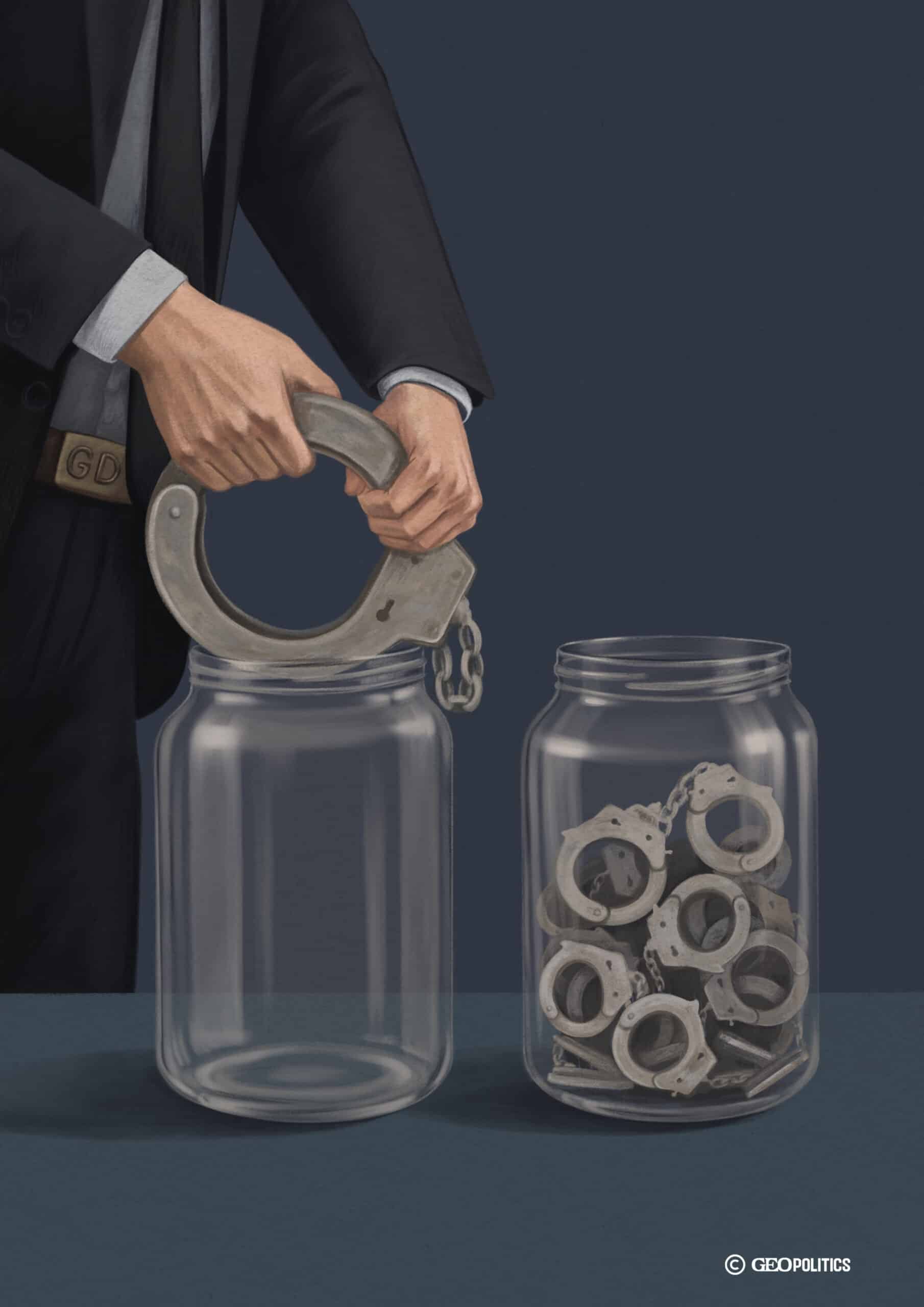
In August 2024, two months before the Parliamentary elections, Bidzina Ivanishvili declared that the vote “must become the Nuremberg Trials” for the United National Movement (UNM). The next day, Prime Minister Irakli Kobakhidze explained how this would work. Georgian Dream (GD) would ask the Constitutional Court to ban the opposition parties that crossed the threshold and cancel their members’ mandates. At the time, many observers read this as campaign talk. Two years later, on October 21, the Constitutional Court began hearing the case to ban five opposition parties, preceded by a handful of legislative changes that have set the stage for Ivanishvili’s pledge to come true at any moment. The court now has 9 months to issue a ruling, even though precedent suggests it can shelve the decision indefinitely, absent clear regulations and sanctions for missing deadlines.
On October 28, 2025, Georgian Dream MPs filed a lawsuit asking the Constitutional Court to ban the United National Movement, Akhali, the leading party of the Coalition for Change, and Lelo, the core of the Strong Georgia coalition. These three parties garnered 30 percent of the vote during the 2024 Parliamentary elections. The Federalists were added in April 2026, and in mid-September the ruling party announced it would also seek to ban Giorgi Gakharia’s For Georgia. In the 2024 elections, the parties now facing the ban won close to 38 percent of the vote between them.
The GD-dominated Parliament had laid the groundwork for these moves. A law adopted in April 2025 also envisages barring “successor” parties, and in October 2025 Parliament gave the Court the power to bar individuals “associated” with a banned party from founding, joining, or funding a party, or from standing as candidates.
If the Court bans the opposition parties, Georgia would become the first Council of Europe member to ban its entire parliamentary opposition in a single case.
If the Court bans the opposition parties, Georgia would become the first Council of Europe member to ban its entire parliamentary opposition in a single case. That alone deserves international attention, far beyond what is currently given.
But the case also raises obvious questions. Georgian Dream already holds a large majority (albeit not a constitutional one) and faces no national election until October 2028. The opposition is divided, many of its leaders are in prison or on trial, and almost all of the parties have left Parliament. So, why go to the trouble of a ban? And why, after filing the case, does the ruling party keep restarting the clock every time it adds a new party to the list submitted to the Constitutional Court?
Bans that stop halfway, leaving elections in place, have mostly failed and even backfired. But the ones that worked required full dictatorship.
This article will examine GD’s underlying motives and the political theory that helps explain both sides’ options and possible moves. Various worldwide examples of successful and attempted party bans can also help us understand what happens when governments take this route. The short version is this. The record and theory give Georgian Dream some models to follow, but most of the ones that “worked” required going much further than GD has gone. Bans that stop halfway, leaving elections in place, have mostly failed and even backfired. But the ones that worked required full dictatorship. Opposition parties and the international community can also learn interesting lessons, which we explore in detail below.
It is worth starting with the government’s own explanation. Kobakhidze has argued that “a healthy democracy cannot exist” when the ruling party’s only opponent is “a criminal political force,” and that out of 400 registered parties, the goal is to ban only one: the “collective United National Movement.” All of the to-be-banned parties are therefore portrayed as one political power, the “collective UNM.” In February 2025, after the main opposition groups refused their parliamentary mandates, Kobakhidze gloated that, “for the first time in the past 20 years,” the “collective UNM” would not be represented in Parliament.
The lawsuit relies on Article 23(3) of the Constitution, which allows a party to be banned if it aims to overthrow the constitutional order by force or undermine the country’s independence or territorial integrity. It accuses the party’s leaders of abuses committed while UNM was in power between 2004 and 2012, of refusing to recognize election results, of organizing attempts to seize power in 2022, 2024, and October 2025, and of raising tensions with Russia. Its main evidence is a report from a parliamentary investigative commission chaired by Tea Tsulukiani, which we have analyzed at length on these pages and dubbed the “unconstitutional revenge commission.” Transparency International Georgia has also pointed out that the commission was set up in a way that breached the Constitution, that past acts by state officials cannot simply be attributed to today’s parties, and that disputing an election is a political position, not a threat to the state.
But beneath the official reasons, three practical reasons make sense from the ruling party’s perspective.
The first, and probably the most important, is 2028. Georgian Dream won the 2024 elections, which the opposition and many observers dispute, and the opposition largely boycotted the 2025 local vote. But no one can be sure about the next parliamentary election, given sanctions, a frozen EU path, and a restless urban electorate that does not necessarily enjoy living under the threat of fines, arrests, curbs on freedom of expression and assembly, and relentless propaganda from state media. Georgia’s electoral system is proportional, and the GD cannot change the constitution or the electoral system. This means they need more than 50 percent in every future election to keep power. If no parties compete, the GD can easily grab all seats and even spare a few dozen for the satellite parties it has set up in recent years. Moreover, without competition, the GD can easily secure a constitutional majority, paving the way to change the constitution and remove the loathed article 78, thus removing the constitutional burden on state institutions to aspire to and work towards European and Euro-Atlantic integration.
If one wonders why Georgian Dream would want to remove an article it initiated, the answer is simple. Civil society and opposition pressured the introduction of Article 78 in 2017, and Georgian Dream had to take up the topic and present itself as a champion of European integration. That era is long gone. Since 2022, the party has moved sharply away from the EU, turning its own constitutional commitment into an increasingly inconvenient obligation. Removing the article would also offer a convenient electoral campaign issue: Georgian Dream could portray EU integration as a path to war, shifting the debate away from economic hardship and domestic repression onto the familiar ground of its anti-war rhetoric. Finally, removing Article 78 would eliminate a formal constitutional obstacle to further rapprochement with Russia, giving the government greater freedom to pursue that course.
Second, a ban removes known party brands and effectively undermines the opposition’s resources. Qualifying parties receive state funding, free airtime, and a role in election administration. A banned party loses all of this, and authorities can seize its assets. Number 5 (of UNM) is still a very strong brand. Coalition for Change also built Number 4 into a successful brand. Lelo invested heavily in its Number 9 brand and a bright yellow color. The same can be said of Gakharia’s 25 and Purple. The individual ban law removes people from politics, especially those who are active and create pressure, even if they’re not always the most popular; for example, Gakharia’s party has used parliamentary seats effectively, engaging in debates and then making the clips go viral on social media. So, as the old Soviet saying goes, “no people, no problem.”
The successor-party law is meant to stop the banned political groups from simply regrouping under a new name and a new brand. These laws aim to close the gaps that let banned parties return elsewhere, as they repeatedly did in Thailand and Türkiye. Hungary’s recent experience adds a newer lesson. In April 2026, Viktor Orbán, the ruling party’s closest ally in the EU, lost power to Péter Magyar’s Tisza, a party that had barely existed before 2024. Orbán never banned anyone. For Georgian Dream, the lesson can easily look like this: the danger is not just the old, experienced, embattled opposition, but a new party vehicle drawing on the same voters. The “associated persons” clause reads as an attempt to reach and destroy that vehicle before it forms.
The third reason is leverage, internal and external. A ban that is filed but not decided is useful in itself. It hangs over every choice the opposition makes: whether to run, whom to put on the lists, whether to protest and what means of resistance to use. It is also a card to play with Western governments. Each time the ruling party has widened the lawsuit, the nine-month deadline for a ruling has restarted, first in April and again in September 2026. Georgian Dream may fear the West’s reaction to an actual ban. GD might also want to keep something to trade. In fact, the GD can learn from Aleksandr Lukashenko. Arresting and releasing political prisoners, or threatening and then not banning political parties, moves the negotiation post away from more serious problems that need addressing – undemocratic laws, disenfranchising Georgian citizens, and undermining state institutions, which the West might well consider as sufficient grounds for sanctioning those responsible. But if a mere withdrawal or delay of the constitutional appeal can reduce pressure and even serve as a bargaining chip to normalize relations with certain Western capitals, then it is the lowest-cost option.
What will the Georgian Dream achieve by banning all the parties? The Constitutional Court will (once again) lose its reputation, as few independent observers will consider its decision as independent. One of the Constitutional Court judges, Manana Kobakhidze, recently resigned in protest, saying she did not want her career as a lawyer to end when her tenure as a judge ended. She was a GD leader until 2017 and has been a Constitutional Court judge since then, and the current GD leadership described her departure as “jumping ship.” This, along with appointing two loyal judges in the weeks before the hearings started, already undermines the Court’s reputation. On September 23, two judges, Goga Kikilashvili and Sergo Metopishvili, were appointed to the Constitutional Court, one by President Mikheil Kavelashvili and another by the Supreme Court Plenum. Kikilashvili, 37, replaced Giorgi Kverenchkhiladze, whose term ended on October 2 and who was among the few judges willing to dissent in cases that went the government’s way. He is also the son of former Supreme Court justice and known GD loyalist, Khvicha Kikilashvili. Teimuraz Tughushi, another dissenter, leaves soon. Irine Imerlishvili quit early last year. By the time the ban reaches the bench, no one will be left to write a dissenting opinion, which is presumably the point of making the appointments now rather than later.
With almost no working opposition, dismantled civil society, silenced media, and a shrinking Western partnership, the GD will have no one to counter Ivanishvili’s power, security, and finances.
The next Parliament without any opposition, like the current one, will almost certainly lack legitimacy. However, the GD will have a constitutional majority and an ostracized, arrested, or exiled political opposition, leaving no one to counter its rule. It will also save them significant financial resources needed to run elections, buy votes, and exert undue pressure on voters. With almost no working opposition, dismantled civil society, silenced media, and a shrinking Western partnership, the GD will have no one to counter Ivanishvili’s power, security, and finances. Personal sanctions, which came late and were not strong enough, are already in place against Ivanishvili and several officials, which also lowers the price of further steps. No concrete, imminent pressure is on Georgian Dream to pursue party bans, which further lowers the already low price. Moreover, GD propaganda will also point to European examples, above all Moldova and Ukraine, and ask why Georgia should be held to a different standard, since Chișinău and Kyiv have also banned opposition parties. That argument deserves a separate answer, which comes below.
Political science offers several tools that help explain what both sides, the GD and the opposition, are doing.
The first is Andreas Schedler’s idea of a “menu of manipulation.” Schedler described how rulers who hold elections without allowing fair competition choose from a menu of tactics. One of the most basic is to limit who may run. This can be easier than rigging the count: there is no ballot stuffing to film, and courts can do the work months in advance. The trade-off is that the more choice you remove, the less legitimacy the election confers. In Cambodia, the Supreme Court dissolved the main opposition party in 2017, clearing the way for the ruling party to win all 125 parliamentary seats in 2018. The election was widely condemned as illegitimate. Yet the ruling party retained its monopoly on parliamentary power. A victory stripped of democratic credibility can still serve its immediate political purpose.
Georgia has high linkage: a large diaspora, EU candidate status (albeit in name only), free trade with the EU, visa-free travel, and a young population oriented towards Europe. Its leverage, however, has fallen since the accession process stalled. In these terms, a ban bets that leverage has dropped far enough that linkage no longer matters.
The second is the idea of “competitive authoritarianism” developed by Steven Levitsky and Lucan Way. They wrote about regimes in which the competition is real but unfair, and in which the opposition can still sometimes win. Their later work argues that how such regimes develop depends heavily on two things: “linkage,” meaning the density of a country’s ties to the West, and “leverage,” meaning how much the West can hurt the government. Georgia has high linkage: a large diaspora, EU candidate status (albeit in name only), free trade with the EU, visa-free travel, and a young population oriented towards Europe. Its leverage, however, has fallen since the accession process stalled. In these terms, a ban bets that leverage has dropped far enough that linkage no longer matters.
The third tool is basic game theory, starting with the ruling party’s side. In a normal democracy, losing an election is costly but survivable. When leaders fear prosecution, loss of property, or worse after leaving office, losing becomes catastrophic, and it becomes rational to pay a high price to lower the chance of losing. Much of the Georgian opposition has promised to hold Georgian Dream’s leaders accountable if it comes to power. It is not inconceivable that the opposition leaders, who have been unjustly prosecuted, arrested, impoverished, and exiled, will seek revenge on Ivanishvili and his minions if they return to power. Even if they promise not to, Ivanishvili will likely see it as big trouble if he loses levers of power. However understandable, that raises the stakes of losing. Political scientists call this a commitment problem: the ruling party destroys the opposition, creating a vicious loop. The opposition cannot credibly promise a soft landing and a soft transfer of power, so the incumbent sees no safe way out and cracks down even harder.
The same logic explains the delay. Thomas Schelling observed that a threat is often worth more than the act it threatens. As long as the constitutional case is pending, the opposition must plan for the worst, and Western governments have a reason to keep talking, pressing, maneuvering, and looking for a face-saving way out. Once the Court rules and parties are banned, the threat is used up, and the costs arrive. Keeping the case alive and restarting the clock when needed is a rational way to maintain the threat without paying for it.
On the opposition side, the best word for the position is zugzwang, a chess term for a situation in which a player must move, has only a limited number of moves, and every available move makes the position worse.
Here are the zugzwang options for the opposition. If the opposition takes part in elections, it lends legitimacy to a process it calls rigged, and the GD has already said that taking part will not save any party from the ban. Gakharia’s For Georgia will also likely get banned despite running and entering Parliament. If the opposition boycotts, it loses seats, money, and visibility, and the constitutional lawsuit then cites its refusal to recognize the elections as evidence against it. If it takes its seats in the lost elections, it may still be targeted: again, Gakharia’s For Georgia kept its mandates but was still added to the ban list, partly because of its “conduct in parliament.”
If the opposition goes into the streets, any clash can be used as proof of a coup attempt, as the October 4 events showed. If the parties merge into one, they confirm the “collective UNM” story and offer a single target, which can still be banned under the affiliated-party clause. If they stay apart, they remain weaker, keep fighting each other, and fail to show the strength essential to defeating a potent authoritarian incumbent. If they create new parties, the successor-party law and the individual bans are already waiting to be activated.
Zugzwang, however, does not mean the opposition can do nothing. It means no move within the current rules improves its position. The only good answers are those that change the rules of the game itself.
Mikheil Saakashvili, on September 21, called through his Facebook to “overturn the table on a cardsharp” and not engage in the election or coalition-building discussion. While it is unclear what this means, Georgian Dream propaganda uses the statement as a call for a coup or revolution; the logic is understandable. If you know the game is rigged, you need to do something extraordinary to succeed. Nika Gvaramia also said the opposition’s strategy should be to either aim for fair elections or do everything to ensure no unfair elections take place. This could be interpreted as a call for an active boycott, which is a politically and legally legitimate move. In any case, whatever the move, the opposition’s only strategy is an intensified public outreach and mass mobilization campaign that needs to start as early as possible, to ensure that whatever call to action comes in 2028, people follow the lead.
Two more ideas complete the opposition puzzle. The first is what game theorists call the shadow of the future. Legal tools outlive the governments that create them. A precedent for banning the opposition and a law barring individuals from politics will be available to whoever governs Georgia next. Bangladesh shows how quickly that can happen.
The second is coordination. The opposition’s hardest problem is itself: who leads, under which name, on which list, how parties coexist, how they cooperate, share resources, distribute tasks, and work together. A ban can solve this dilemma by removing old brands and giving everyone a common enemy, as roughly happened in Senegal. Some opposition politicians consider this scenario realistic and are unconcerned; however, this calm approach reflects a degree of naivety. Once the parties are banned and opposition politicians are legally excluded from the political scene, two problems emerge.
First, they will need to find a party or other political vehicle to bandwagon for the next elections, or for whatever type of public mobilization campaign. It is not guaranteed that other actors who escape the ban would want banned party members on board, especially if it increases the risk of being placed on the banned list under the affiliated persons law. The second problem is that of name recognition. No matter how demonized state propaganda makes current opposition leaders, their name recognition and support, even by official 2024 numbers, are close to 40 percent. Bringing in new names with very low name recognition, even if they are the only alternative, may not attract general opposition supporters. Only an inspirational, energetic, and charismatic leader like Magyar could fill such a vacuum, but he is nowhere to be seen and impossible to manufacture.
Party bans are not only an African or Asian practice. Europe has a long record of them, though democracies have generally targeted parties linked to violence or threats to constitutional order, subject to judicial review. Spain banned Batasuna, the political wing of the Basque separatist movement, in 2003 because of its links to ETA, and the European Court of Human Rights upheld the decision in 2009. Once ETA abandoned violence, the Basque nationalist left returned to electoral politics. Türkiye shows the limits of such bans. The Islamist Welfare Party was dissolved in 1998, and its successor, Virtue, in 2001. Yet their political movement survived through the Justice and Development Party (AKP), which won the 2002 elections. Pro-Kurdish parties have similarly reappeared under new names after successive bans. Moldova offers a more recent and politically contentious example. Its Constitutional Court banned the Șor Party in 2023, targeting a political network associated with a convicted fugitive and allegations of illicit financing. Unlike Georgia’s proposed approach, Moldova’s principal opposition parties remained free to contest elections, although subsequent exclusions of Șor-linked parties raised concerns over electoral fairness.
Outside Europe, the record reveals two contrasting outcomes. In Thailand, courts repeatedly dissolved major opposition parties, from Thai Rak Thai in 2007 to Move Forward in 2024, only for successor parties to inherit their voters. Nevertheless, judicial intervention, combined with other institutional restrictions, prevented electoral victories from consistently translating into government power. Senegal demonstrates that bans can fail when independent institutions survive: despite the dissolution of Ousmane Sonko’s PASTEF party in 2023 and his exclusion from the presidential race, his substitute candidate, Bassirou Diomaye Faye, won the presidency in March 2024 after the Constitutional Council blocked an attempt to postpone the election. Cambodia presents the opposite outcome. After the Supreme Court dissolved the main opposition Cambodia National Rescue Party in 2017, Hun Sen’s ruling party won every parliamentary seat in 2018. The ban succeeded because the government controlled the security forces, enjoyed Chinese backing, and accepted the disappearance of meaningful electoral competition.
These cases show that, the distinction lies in whether other institutions, competitive elections, and opportunities for political organization remain intact. Where they do, banned movements often return. Where they disappear, party bans become instruments for entrenching authoritarian rule.
Nicaragua and Belarus illustrate what happens when exclusion becomes comprehensive. Nicaragua stripped its main opposition party of legal status in 2021 after arresting leading presidential challengers, while Belarus used compulsory party re-registration in 2023 to eliminate virtually all organized opposition. In both countries, loyal security forces, Russian support, and political repression helped governments consolidate control. Bangladesh provides a different warning: Sheikh Hasina banned Jamaat-e-Islami shortly before her overthrow in August 2024, only for the succeeding authorities to ban her own Awami League in 2025. Political exclusion can outlive its architects and become a weapon against them. These cases show that, the distinction lies in whether other institutions, competitive elections, and opportunities for political organization remain intact. Where they do, banned movements often return. Where they disappear, party bans become instruments for entrenching authoritarian rule.
These cases show a fairly consistent pattern. Where a banned party has a large voter base, and elections still matter, a successor appears and usually does well, as in Thailand, Türkiye, and Senegal. Bans “work” in the sense that they secure the regime only when the government goes on to close the system completely, with a foreign backer and loyal security forces, as in Cambodia, Belarus, and Nicaragua. Democracies ban small, violent parties, and Strasbourg court reviews them. What Georgian Dream is planning to do comes from the playbook of authoritarian states, not European democracies.
For Georgian Dream, the stakes are high. The party is trying to protect its hold on power, its leaders from future prosecution, and its founder’s fortune. Potential costs include losing visa-free travel to the EU, more personal sanctions, weaker investment, and a Parliament that no one abroad treats as legitimate. There is also a less obvious cost. For fourteen years, the ruling party’s main message has been that UNM might return. Banning UNM removes the opponent it knows how to beat.
For the opposition, the stakes are its legal existence, its money, the careers of hundreds of people, and the meaning of the votes of more than a third of the electorate. The historical record offers two outcomes: the parties die out, as in Tajikistan or Belarus, or they renew themselves, as in Thailand or Türkiye.
How this plays out depends heavily on timing.
In the first scenario, a ruling comes relatively soon. A decision would be due around early to mid-2027, more than a year before the October 2028 elections. Georgian Dream would pay the international price early and have time to absorb it. The opposition would have time to build new vehicles, as the Thai parties did. The key question is whether new faces can appear faster than the Court can add them to its lists. The risk for the ruling party is that an early ban clears away the old leaders, many of them unpopular even with opposition voters, and makes space for a clean challenger of the kind that beat Orbán. For the opposition, the risk is that individual bans reach the organizers and that the new vehicles compete with each other.
In the second scenario, no ruling ever comes. The case stays pending, like the HDP case in Türkiye. The Constitutional Court starting to review the case does not automatically mean it will decide before the 2028 elections. Georgian Dream keeps its leverage, avoids the cost, and leaves the opposition in limbo. Candidates think twice before joining lists that might be canceled, and donors hesitate. The criminal cases against opposition leaders continue regardless. The weakness is that threats lose force when never carried out, and Western partners may start treating the case as background noise. For the opposition, this is a scenario in which it can still operate but cannot plan, and the main danger is politicians’ and donors’ self-restraint.
In the third scenario, the ban comes shortly before the 2028 vote. This is the most damaging version for the opposition and the most clearly visible as election manipulation. Past cases show the range of timings. Cambodia banned the CNRP eight months before the election, Senegal dissolved PASTEF seven months before the planned vote, Nicaragua disqualified Citizens for Liberty three months before, and Moldova removed Heart of Moldova two days before. A late ban leaves no time to register successors, build lists, and teach voters a new name. But it also brings the strongest international reaction and risks protests when public attention is highest. Senegal shows that a late move can backfire if even one institution refuses to go along. The opposition’s defense here can only be prepared in advance: spare parties, substitute candidates, and lists of people the Court has not reached, as the HDP and PASTEF did. Without that, the vote splits or drifts into a boycott.
A fourth path is to go all the way, as Belarus did. That would require things Georgian Dream may not have: security forces tested under real pressure, an economy able to live without Europe, and a foreign patron. The obvious candidate is Russia, which occupies a fifth of Georgia’s territory, and open dependence on Moscow would be very costly politically. This is probably why the ruling party prefers the middle ground. The record, however, suggests the middle ground does not hold for long.
Georgian Dream’s tools are not unusual. Courts, commissions, successor bans and lists of barred individuals have all been used before. What is unusual is the scale, and the attempt to do it inside the Council of Europe while still holding competitive elections.
Georgian Dream’s tools are not unusual. Courts, commissions, successor bans and lists of barred individuals have all been used before. What is unusual is the scale, and the attempt to do it inside the Council of Europe while still holding competitive elections.
The record points to a simple dilemma. Where voters remain free to choose, banning the parties they vote for mostly changes the names on the ballot. Voters find a successor, sometimes stronger than the original, as in Türkiye and Senegal. Where bans secured the government, as in Cambodia, Belarus, and Nicaragua, it was because elections stopped meaning anything, and because the regime had a foreign backer and an economy that could survive isolation. Georgia’s ruling party would have to choose between these two outcomes, and neither is comfortable. The first does not solve its problem. The second would change Georgia’s place in the world far more than most of its own voters seem to want.
For the opposition, the situation looks like zugzwang, and within the current rules it is. But the history of banned parties also shows that their supporters do not disappear. The movements that survived prepared new vehicles in time, brought in new faces, kept competing, and avoided violence. Those that died out left the country or waited for the old names to come back.
For outside observers, the main point is timing. Once a ban is issued, the record suggests it is rarely reversed by foreign pressure.
For outside observers, the main point is timing. Once a ban is issued, the record suggests it is rarely reversed by foreign pressure. What happens before the ruling, and before 2028, is what will count. And the European Union, the United States, and the civilized West in general are running out of time to influence the process.