22 August, 2026
|
18 minutes to read

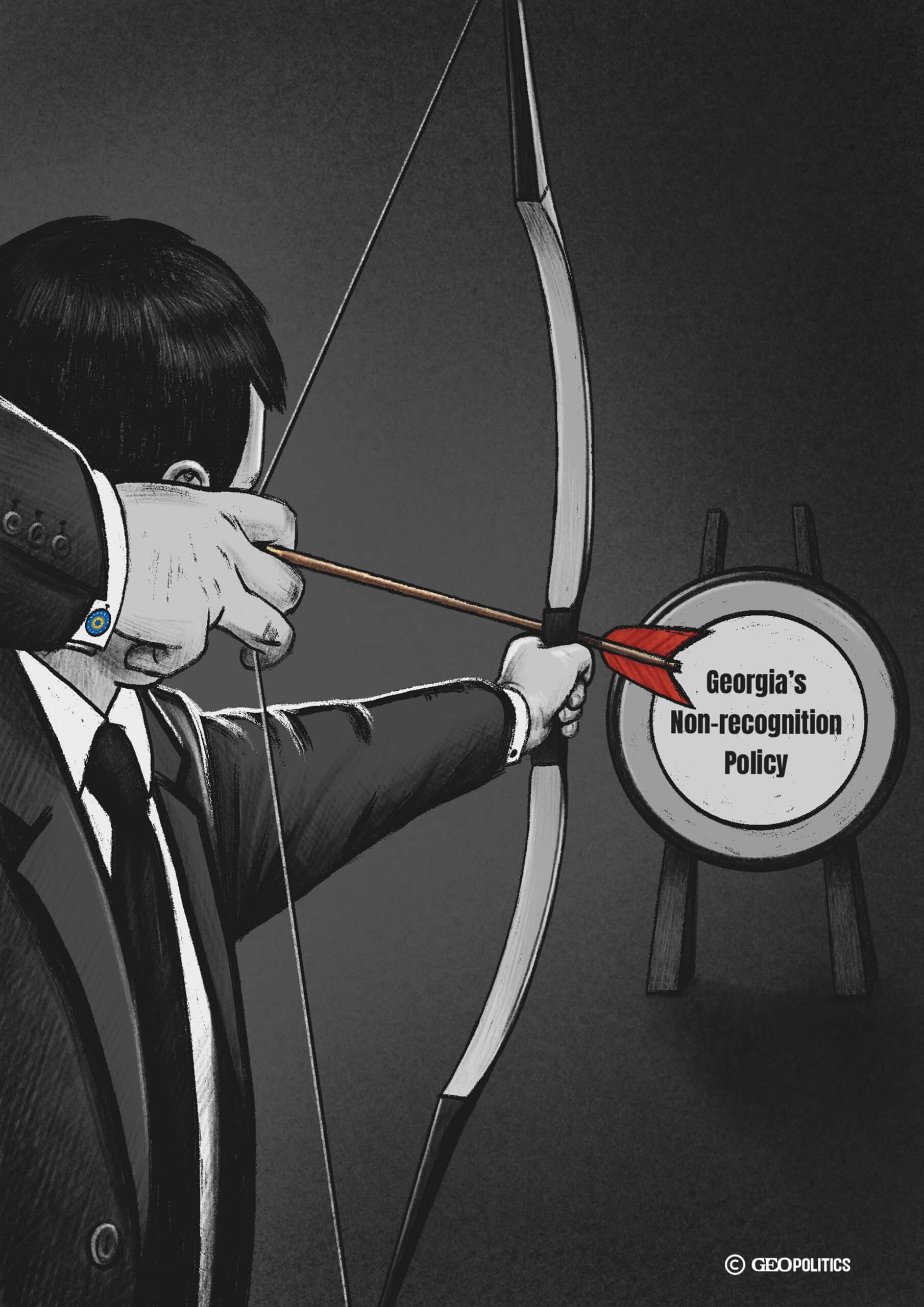
Three weeks before the eighteenth anniversary of Russia’s military invasion of Georgia in August 2008, the Government of Nauru withdrew its recognition of Abkhazia and Tskhinvali Region/South Ossetia and severed diplomatic relations with both. Tbilisi announced the decision on 29 July 2026, and Irakli Kobakhidze described it as a significant success for the non-recognition policy.
Ten days later, standing at a memorial to the soldiers killed during that invasion, the same Kobakhidze said that a Council of Europe resolution 1633 (2008) established that the conflict entered the phase of large-scale hostilities after the Mikheil Saakashvili regime bombed Tskhinvali Region/South Ossetia, and then drew the conclusion himself that the conflict turning into a war meant the Saakashvili regime started a war. In the same remarks, Kobakhidze blamed the so-called ‘deep state’, usually referred to as ephemeral forces governing the West in the Russian and Georgian Dream (GD) regime’s message box, for directly tasking Saakashvili to instigate the war. He called this a crime against the state, the country, the people and the soldiers, and accused the former government of betrayal.
Tskhinvali’s occupation regime responded in two days, with the de facto foreign ministry stating that Georgia’s political leadership has officially recognized Saakashvili as the perpetrator of military aggression against South Ossetia. As was easy to anticipate, the de facto authorities claimed that Saakashvili had acted as head of state and on behalf of Georgia, and that the country must therefore bear responsibility for the August 2008 war.
A successful non-recognition policy can rest only on an international legal assessment of what happened in 2008, namely that Russia committed aggression against Georgia and holds Georgian territory under occupation. Every withdrawal of recognition that has ever occurred rested on acceptance of that proposition.
Subtracting a name from the list of recognizers while the government itself dismantles the legal foundation of non-recognition can hardly qualify as a foreign policy achievement.
In the same month, Nauru recognized Georgia’s territorial integrity, Georgian Dream leadership announced that the Georgian government had begun the war, and the occupier turned those words into a claim against the Georgian state within forty-eight hours. Those statements were hardly improvised. They rest on the parliamentary commission’s report adopted a year earlier, formalizing the long-standing main pillars of the GD regime’s pro-Russian foreign policy. Subtracting a name from the list of recognizers while the government itself dismantles the legal foundation of non-recognition can hardly qualify as a foreign policy achievement.
The non-recognition policy that was relatively successful for eighteen years was never a product of Georgian diplomatic weight alone. Yes, Georgia established diplomatic relations with nearly the entire world after 2008, and the professional work behind that expansion was real. Its reach, however, was always limited by what a small state can do on its own.
The ledger of states recognizing Abkhazia and South Ossetia has never held more than five names, and it changed according to the recognizers’ interests and partnerships with Russia and the West rather than Georgian diplomatic efforts. Non-recognition was maintained because these limitations were compensated by the partners. In the best-documented cases, the decisive instruments were direct interventions by senior U.S. diplomats and officials, European Commission warnings linking recognition to the loss of closer EU relations, and bilateral pressure from EU member states, most clearly Lithuania’s intervention with Belarus and Spain’s diplomacy in Latin America, on governments considering Moscow’s offer. Even the Vatican contributed with Pope Benedict XVI’s diplomatic interventions and activity, persuading Latin American States to reject Russia’s pressure. Georgian notes and letters mattered, but Western diplomatic power amplified them and made them count.
The major premise underpinning Georgia’s claim to territorial integrity was that Georgia stood on the side of international law, and the law stood on Georgia’s side. Russian propaganda efforts managed to create confusion and uncertainty by imposing its own interpretations of official documents and facts surrounding its 2008 invasion of Georgia. However, Cuba, a long list of African states, and the states of the Pacific declined recognition in part for that reason, since siding with Moscow meant siding against the principles of international law they had an interest in preserving.
That asset is now being undermined. A government that has told the world its own predecessor committed aggression has removed the claim’s factual basis. On top of that, a government that shies from openly supporting Ukraine (despite voting in favor of the resolutions in international organizations), and that is perceived as the partner of Moscow, aiding them to circumvent sanctions, can no longer credibly claim that international law is on its side.
Moreover, because of GD’s hostile rhetoric and adversarial policy toward Western partners, Western diplomacy now lacks both the motivation and the ammunition to press the case. The motivation depended on a partnership that Georgian Dream has dismantled, and no partner spends scarce diplomatic capital on behalf of a government working against it.
What remains in Tbilisi is inertia. The Foreign Ministry has been purged of its professionals in a few waves of politically motivated dismissals and resignations, and the institutional resource that survived serves a ruling regime aligning away from the West and towards the North. Besides, a proper non-recognition requires diplomacy conducted at the highest political level. Bureaucratic correspondence does not substitute for it. Neither Irakli Kobakhidze nor Shalva Papuashvili and Mikheil Kavelashvili are known for investing personal effort in bilateral or multilateral high-level diplomacy related to non-recognition policy.
Two files related to non-recognition have stood open under conditions unavailable since 2008. Bashar al-Assad’s fall diminished Moscow’s leverage in Damascus, but the new Syrian authorities kept the 2018 recognition, with Abkhazia’s de facto foreign minister Oleg Bartsits even traveling there in June 2025. The four main opposition parties wrote to Ahmed al-Sharaa in January 2025, asking him to revoke the recognition, but received no answer. It is unclear what efforts Georgian Dream made in this regard, either bilaterally or through its Western allies. The only publicly available information is that Türkiye was asked to mediate with Damascus and that an OSCE Parliamentary Assembly appeal was promoted for Syria to reverse the recognition.
With Venezuela, the opportunity was even greater. Nicolás Maduro was removed from power in January 2026, and Caracas spent the following months negotiating its economic and political survival with Washington, restoring diplomatic relations in March and receiving substantial sanctions relief. A recognition purchased in 2009 with Russian money still remains intact. If Georgia had maintained a strategic partnership with the United States and the EU, it could have achieved both reversals.
Bidzina Ivanishvili’s account of August 2008 war has remained consistent since he entered politics, and it has steadily moved toward Moscow’s version. In his first press conference in 2011, he cited the Tagliavini report and described Saakashvili’s response to the shelling of Georgian villages as absolute recklessness. In 2013, he said he could not imagine the occupation of neighboring territories was indeed Russia’s strategy. By 2024, the position had hardened into an account in which the war was instigated at the behest of Western powers, an account that converges with Sergey Lavrov’s claim that Russia acted lawfully to restrain Georgian aggressors and that has drawn open approval from Russian propaganda channels.
This stance is a matter of foreign policy choice. Ivanishvili treats Russia as an ally and the West as a threat because his personal interests and the survival of his power vertical require it. His control over the country rests on Russian money and Russian methods of governing, while Western partners press for the restoration of democratic processes, which for him means surrendering the levers of power.
From that vantage point, the occupied territories are an obstacle rather than a national security issue. They are the single formal impediment to restoring diplomatic relations and a partnership framework with Russia, which would be the genuine turning point in relations between the two states and which Moscow wants precisely because it would cement Georgia inside its sphere of influence. This cannot be done while an active territorial dispute persists and while unrecognized Russian embassies operate in Sokhumi and Tskhinvali.
Ivanishvili’s September 2024 Gori speech was a strategic statement. As this journal argued at the time, its function was to establish that the Georgian Dream would settle the question of the 2008 war domestically, through a Georgian “Nuremberg trial” and an apology to Ossetians for starting a war.
The reframing of the war as a conflict between Georgians and Ossetians removes Russia as a party, removes occupation as the applicable legal category, and converts a question of international responsibility into an internal matter of reconciliation between communities. Everything that has followed, including the parliamentary commission, executes that speech.
The reframing of the war as a conflict between Georgians and Ossetians removes Russia as a party, removes occupation as the applicable legal category, and converts a question of international responsibility into an internal matter of reconciliation between communities. Everything that has followed, including the parliamentary commission, executes that speech.
The same logic is now being stretched back two centuries. Asked in August 2026 whether the 1783 Treaty of Georgievsk between the Kartli-Kakheti Kingdom (of Eastern Georgia) and the Russian Empire was a capitulation, Kobakhidze called King Erekle II’s decision to establish patron-vassal relations with the Russian Empire wise and unavoidable. Kobakhidze even claimed the treaty worked, despite clear historical evidence that Russia stood aside as Georgian kingdoms were ravaged by Persian invasions despite treaty obligations. Russian Empire then annexed Georgia in 1801 in contravention of the treaty, and even abolished the autocephaly of the Georgian Orthodox Church (also despite a clear treaty obligation). The most prominent Georgian historian, Ivane Javakhishvili, argued in 1919 that the Georgievsk treaty brought Georgia nothing but harm, an assessment now being revised by the Georgian Dream’s messaging and propaganda.
A ruling party’s narrative does matter for international law. Repeated by senior officials and amplified through the machinery of government, it shapes public understanding, influences diplomatic discourse, and signals how the state approaches the issue. Whether Georgians acknowledge it or not, a society that silently allows this discourse and does not actively oppose the government’s stance adds another argument against territorial integrity. More legally consequential, however, is converting that narrative into an official institutional record that can be cited in international proceedings. The Tsulukiani Commission, established on 5 February 2025, provided exactly that mechanism.
Although framed as an indictment of the United National Movement (UNM), the commission’s conclusion went substantially further: it attributed responsibility for the outbreak of the war to the Georgian state itself. It claimed that Georgia’s political leadership pursued “militaristic” policies, ignored warnings of escalation, disregarded military advice, and ordered an attack on Tskhinvali that caused a “three-day war, defeat, occupation, and heavy losses.”
The distinction between blaming the UNM and blaming Georgia offers little protection here, as the Tskhinvali Region/South Ossetia’s de facto authorities aptly observed. Governments change, but the state retains institutional continuity, and findings adopted by a parliamentary commission can be cited as Georgia’s own official account of its authorities’ and armed forces’ conduct in the years to come.
The commission reached this conclusion without presenting new intelligence or independently corroborated evidence, while selectively quoting military witnesses, disregarding evidence of Russian preparation and escalation, contradicting the Georgian Parliament’s comprehensive 2008 inquiry, and misrepresenting PACE Resolution 1633, which did not determine that Georgia started the war. Its significance therefore lies not merely in repeating Georgian Dream’s narrative but in placing into Georgia’s institutional record a finding that effectively assigns the country responsibility for initiating the conflict – the central proposition Russia has used to justify its invasion, occupation, and recognition of Abkhazia and Tskhinvali Region/South Ossetia.
Georgia’s diplomatic position rested on partners who advanced Georgia’s claim, but no partner can advance a claim more forcefully than the claimant itself. With the changed rhetoric and policy, Western partners now have limited ammunition.
Two consequences follow from the commission report and the August war-related rhetoric of the Georgian Dream, which is now very similar to that of Moscow. Georgia’s legal position on non-recognition rested on the attribution of responsibility for war and occupation to Russia. Once the Georgian Dream created a legislative document shifting responsibility onto itself, it gave the Kremlin an excellent defensive shield. Second, Georgia’s diplomatic position rested on partners who advanced Georgia’s claim, but no partner can advance a claim more forcefully than the claimant itself. With the changed rhetoric and policy, Western partners now have limited ammunition.
A future Georgian government can repudiate the resolution and change the rhetoric, as it should, but it will still look like one Georgian political party rebutting another. Even if that happens, every delegation arguing the case for Georgia’s territorial integrity, and every partner supporting the case, will encounter a document produced by Georgian Dream’s parliament alongside recorded statements by its prime minister, its speaker and its president. Those materials will be quoted, and no subsequent Georgian government’s position can fully neutralize them.
There is one route by which the reversal can be attempted, and it runs through the legitimacy of the body that produced the Parliamentary report rather than through the substance of what it resolved. The chamber that adopted the conclusion was elected in October 2024 in a process that remains contested at home and abroad. A future government that intends to defend Georgia’s sovereignty and territorial integrity will have to contest that legitimacy in law and establish that the acts of an unrecognized parliament’s one-party effort carry no authority to speak for the Georgian state.
Even then, Russia and its proxies will go on quoting the resolution and citing Georgian Dream officials, and they will treat any revocation as the partisan act, which is to say they will contest the legitimacy of the revocation exactly as the revocation contests the resolution. That is the position Georgian Dream has permanently created.
This is also the reality against which the Nauru episode should be read. Georgia collected a technical improvement to a list while conceding on the basic premise and structure of non-recognition policy.
Russia has never indicated that de-occupation would be a part of normalization with Georgia. The stated precondition has been the reverse. Moscow requires Georgia to acknowledge what it calls the new realities, meaning acceptance that two Georgian regions are now independent states.
The eighteenth anniversary of the war produced the operational version of that demand. On 8 August the Russian Foreign Ministry called for the delimitation and demarcation of borders with South Ossetia and Abkhazia and for an agreement on the non-use of force among Tbilisi, Sokhumi and Tskhinvali. Delimitation converts an occupation line into an interstate frontier. A trilateral non-use-of-force agreement converts an occupier and its two occupation regimes into three parties to a conflict (Abkhazia, Georgia, South Ossetia) in which Russia does not appear.
The same statement welcomed what it described as a reassessment of the 2008 war within Georgian society, and stressed that full responsibility should fall on the Saakashvili leadership. Moscow also expressed hope that Georgian statements about reconciliation with Abkhazians and Ossetians would be followed by concrete practical actions. Moscow has thus told Tbilisi what it expects next while counting the Georgian government’s account of the August 2008 war as progress toward it.
Every element of Georgian Dream’s approach to the occupied territories fits Moscow’s expectations. The war becoming a domestic crime, the parliament certifying it, the apology for the past and the replacement of the occupation-related terminology with that of reconciliation is exactly what Russia has been pushing for.
Every element of Georgian Dream’s approach to the occupied territories fits Moscow’s expectations. The war becoming a domestic crime, the parliament certifying it, the apology for the past and the replacement of the occupation-related terminology with that of reconciliation is exactly what Russia has been pushing for. It is understandable that Ivanishvili has threaded this path carefully, as he knows how sensitive the issue of territorial integrity is for Georgians. However, the trajectory leaves no room for a different reading. What remains is acceptance of Moscow’s ultimatum and the opening of a de jure partnership with Russia, ultimately through full diplomatic relations, with the territorial question settled by Georgian concession rather than Russian withdrawal. This journal has explored such possible scenarios in the past. That a pro-Russian Georgian politician with deep ties to the Kremlin is promising a Georgievsk Treaty 2.0 to be “soon issued by Moscow” shows that the “doomsday scenarios” might not be so distant.
The continuing threat that Russia will annex Georgia’s occupied regions further exposes the short-sightedness of Georgian Dream’s current stance. Since 2014, purchasing additional recognition for Abkhazia and Tskhinvali Region/South Ossetia has progressively lost its strategic importance for Moscow. Recognition was initially a tit-for-tat response to the Western recognition of Kosovo in 2008. Russia’s annexation of Crimea in 2014 and its attempted annexation of four additional Ukrainian regions in 2022 changed the rules of the game: Moscow demonstrated that, where circumstances permit, it would rather absorb territory directly, or create the legal, political and administrative conditions for doing so, than continue investing in the diplomatic fiction of independence.
Annexation has hung over Georgian geopolitics as a standing possibility since 2008 and has repeatedly returned to the agenda. It did so again only last month, when South Ossetia’s de facto leader Alan Gagloev resigned to become an adviser to Vladimir Putin, declaring that his task was to advance the “cherished dream” of reunification with North Ossetia and “Great Russia.” The “presidency” passed to Marat Kambolov, a former Russian official from North Ossetia, following an integration agreement that further opened the occupied region’s institutions to Russian personnel. Whether formal annexation follows immediately is impossible to predict, but it is quite clear that the performance of separate statehood is increasingly giving way to administrative absorption into Russia.
Georgia therefore needs to shift from a policy centered solely on non-recognition to a broader anti-annexation strategy. Non-recognition asks other governments not to legitimize a fait accompli; anti-annexation seeks to prevent that fait accompli from being created. Georgia cannot pursue it alone. Its central purpose must be to raise the diplomatic, economic and security costs of annexation to a level that Moscow is unwilling to bear. That requires advance coordination with the United States, the European Union, the United Kingdom and other partners on the sanctions and political consequences that would follow any formal incorporation of Georgian territory into the Russian Federation. Deterrence will be credible only if those consequences are communicated before annexation, rather than improvised afterward.
A future European security arrangement cannot reject territorial acquisition by force in Ukraine while leaving Russia’s earlier actions in Georgia outside the discussion.
Georgia must also ensure that its territorial integrity forms part of any eventual post-Ukraine settlement between Russia and the West. A future European security arrangement cannot reject territorial acquisition by force in Ukraine while leaving Russia’s earlier actions in Georgia outside the discussion. This requires a proper stance on the war in Ukraine and close coordination with Kyiv, which Georgian Dream is incapable of due to their client-patron relations with Russia. Preventing the annexation of Abkhazia and the Tskhinvali Region/South Ossetia, and preserving the possibility of their peaceful reintegration, must therefore become an established Western interest, not merely a Georgian diplomatic request raised at commemorative meetings.
An effective strategy must simultaneously strengthen constituencies inside the occupied regions that oppose absorption into Russia. This is particularly important in Abkhazia, where local resistance to Russian investment and property privileges has repeatedly demonstrated that dependence on Moscow does not necessarily translate into support for annexation. These constituencies need political space, economic alternatives and access to the outside world. At the same time, Georgia’s European integration must remain a credible and materially attractive counterproject to the Russkiy mir: a visible demonstration that association with Georgia offers access to a larger political, economic and security community rather than isolation and dependence.
Anti-annexation policy requires a more secure Georgia. One with stronger defense and institutional resilience, deeper military cooperation with its partners and credible external security commitments. None of these conditions can be created by a government estranged from the West and courting Moscow.
Finally, anti-annexation policy requires a more secure Georgia. One with stronger defense and institutional resilience, deeper military cooperation with its partners and credible external security commitments. None of these conditions can be created by a government estranged from the West and courting Moscow.