22 October, 2026
|
11 minutes to read

On April 26, 2022, the Kyiv municipality removed parts of a monument, the People’s Friendship Arch, that had stood in the city center since 1982, when it was unveiled for the 65th anniversary of the Bolshevik revolution. This monumental ensemble, dedicated to the “friendship between peoples,” featured two bronze workers, one Ukrainian and one Russian, standing united as they brandished the Soviet coat of arms. It also included granite Cossacks depicted after signing the 1654 Pereyaslav Treaty – the first agreement between the Zaporizhzhian Cossacks and the Moscow tsar, under which the former swore allegiance to the latter in exchange for military assistance against the Polish-Lithuanian Commonwealth.
Thanks to its “architectural heritage” status, the monument survived the collapse of the USSR and the 2004 and 2014 revolutions, as well as the passage of four “decommunization laws” in 2015. It was only in 2022, after the Russian army lifted the siege of Kyiv and the Ukrainian army discovered the scale of Moscow’s war crimes in towns such as Bucha, that the monument to the “friendship between peoples” became intolerable. Symbolically, one of the workers’ bronze heads detached during the removal and rolled onto the pavement. It was the Russian’s.
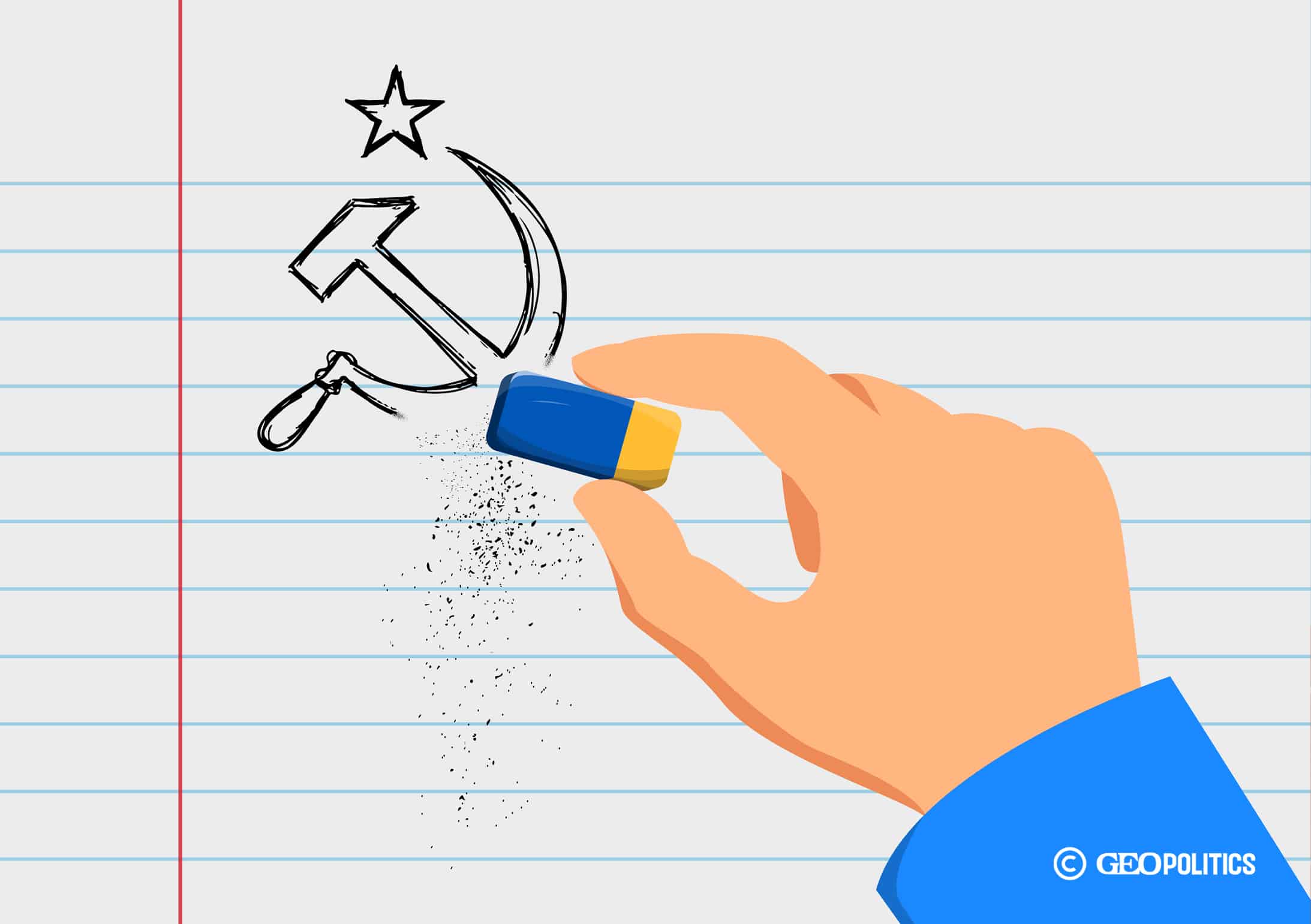
The bronze monument was entirely taken away. Soon after, the destruction of the granite Cossacks started. It was never fully completed, though. Some scattered stones remain somewhat hidden behind a fragile fence to this day. The arch still stands. Since it is visible from the Dnipro banks, it has become, over the years, a symbol of Kyiv. No decision regarding its future has yet been taken as of October 2026. Somehow, the contrasting fate of this once-massive architectural ensemble has become a symbol of Ukraine’s derussification process: a reaction to Russia’s full-scale invasion, it is both radical and indecisive, subjective and incomplete.
As in other post-Soviet republics, Ukraine began distancing itself from the Soviet and imperial Russian past as early as 1989. The country underwent various waves of a so-called decommunization process in the early 1990s and around the 2004 Orange Revolution. The last wave occurred during the 2014 Revolution of Dignity. Across the country, both civic and radical activists went on to topple more than 1,000 Lenin statues that were still standing. With over 7,000 statues of Lenin on its territory in 1991, Ukraine was the Soviet republic with the highest density of these monuments; by comparison, Russia counted only some 5,000 despite its much larger territory. This grassroots movement was soon nicknamed “Leninopad” (literally translated as the “fall of Lenin”).
Many more Soviet monuments and symbols disappeared from the public space within a few months. It was only in May 2015 that the Verkhovna Rada (Parliament) provided a legal framework for this process by voting on four laws. The first text prohibited the propaganda of totalitarian ideologies, namely Nazism and communism. The second law ordered the renaming of all toponyms inherited from the Soviet times. The third law promoted the valorization of past activists who fought for national independence, including the OUN-UPA radical nationalists. The fourth law initiated a wide-ranging opening of the Soviet archives to the public.
Lenin and other Soviet symbols were well maintained by occupation authorities. The way to deal with the Soviet legacy became much more than a matter of historiography. It turned into a marker of identity.
Ukraine implemented its decommunization process within this framework. In September 2016, the Institute of National Memory declared that the government-controlled territories had removed the last Lenin monument from the public sphere. The situation was the opposite on the Crimean peninsula and in the parts of Donbas that were directly or indirectly occupied by the Russian forces. Lenin and other Soviet symbols were well maintained by occupation authorities. The way to deal with the Soviet legacy became much more than a matter of historiography. It turned into a marker of identity.
Although the Ukrainian government considered itself “Lenin-free,” the decommunization process unfolded in a complex and contradictory way. Occasionally, some Lenin statues reappeared here and there. The Soviet leader and other symbols only partially disappeared from mosaics, facades, and factory entrance halls. Some local elites and communities long resisted the renaming of their cities and streets. Debates raged for years over implementing decommunization requirements in literature, music, and movies. Only gradually did a democratic and plural Ukraine move away from its Soviet past along the lines of an ambitious Europeanization agenda.
The decommunization process did not, however, trigger a nationwide move to cut ties with the Russian imperial past. The dramatic context of the Russian aggression in Crimea and Donbas undoubtedly stirred up anger, frustrations and calls to reduce the import of Russian cultural products across the country. State authorities implemented measures to Ukrainize the public sphere, as evidenced by a 2017 law on Education in minority languages and a 2019 law on language quotas in the media. Yet there was no radical push to derussify a country that shared a long and complex history with Russia. In the 2021-2022 winter season, the Kyiv opera staged Tchaikovsky’s Nutcracker more than twenty times. And from Kharkiv to Uzhhorod, Pushkin’s statues stood firm.
It all changed on 24 February, 2022. As Ukrainians mobilized to face the existential threat posed by the Russian full-scale invasion, a large number of them questioned their intimate connections with Russia, with its history, language, and culture. As in 2014, the movement began with local, civic initiatives. Along with every other cultural institution, the Kyiv opera canceled all Russia-related performances. Thousands of citizens publicly sent their private collections of Russian and Russian-language books to recycling facilities. Many Russian-speaking individuals abruptly shifted to using Ukrainian in their daily lives. According to annual surveys by the Kyiv International Institute of Sociology (KIIS), Ukrainian use in the family environment jumped from 52 percent in 2020 to 63 percent in 2025.
As various monuments connected to the Russian imperial past were dismantled, people placed special emphasis on the figure of the poet Alexander Pushkin (1799-1837). Many see him as a defender of freedom against tsarist authoritarianism, yet he also lauded the brutal expansion of the Russian Empire in works such as “The Prisoner of the Caucasus” and “To the Slanderers of Russia.” By all accounts, the instrumentalization of the poet’s legacy, whether by tsarist, Soviet, or Russian authorities, made him an unequivocal symbol of Russia and its political presence. Before 2022, more than 100 monuments dedicated to Pushkin stood across Ukraine, second only to those dedicated to Taras Shevchenko. His name was the third choice for street toponymy in the country, behind Shevchenko and Yuri Gagarin. As a result, Pushkin became an obvious target of Ukraine’s resistance to the full-scale invasion. The poet and writer Serhiy Zhadan began publishing photos of himself in front of Pushkin monuments to urge his admirers to topple them. And so they did.
As with decommunization, this bottom-up movement led to the adoption of a legal framework for derussification. In July 2023, the law “On the Condemnation and Prohibition of Propaganda of Russian Imperial Policy in Ukraine and the Decolonization of Toponymy” recognized Russian imperial policy as criminal. It prohibited its propaganda and ordered the “decolonization” of Ukraine’s toponymy. Thousands of city and street names that were outside the scope of the decommunization process had to be changed. And so they were.
The derussification process goes far beyond decommunization: it encompasses all aspects of Ukrainian life, education, language, cultural habits, and even culinary traditions.
Because of the shock of the full-scale invasion, the derussification process goes far beyond decommunization: it encompasses all aspects of Ukrainian life, education, language, cultural habits, and even culinary traditions. This in-depth phenomenon is reflected in the law. In June 2022, lawmakers banned the public performance of music by artists who had held Russian citizenship at any point since 1991, subject to certain exceptions. In December 2025, the Verkhovna Rada voted in first reading to retire the kopeck as a currency unit. It is to be replaced by the shah, which was first used by Zaporizhzhian Cossacks in the 17th century.
“Decolonization” is not unanimously used in Ukraine. Some prefer the terms “de-imperialization,” “Ukrainization” or even “return” to a stolen identity. This uncertainty reflects the dramatic context of this derussification process and its intimate link to the war’s outcome.
The explicit use of the term “decolonization” clearly illustrates Ukraine’s struggle for survival against the Kremlin’s revisionist imperial project. It also integrates the country’s own developments into the broader discourse on “decolonization studies,” which gained popularity in various academic circles. However, it implies that Ukraine was merely a Russian colony, whereas it exercised agency throughout the centuries. For example, the Kyivan elite played a crucial role in reforming the Russian tsardom in the late 17th century. Moreover, in the 20th century, the Ukrainian Bolshevik Party was instrumental in founding the USSR. Therefore, “decolonization” is not unanimously used in Ukraine. Some prefer the terms “de-imperialization,” “Ukrainization” or even “return” to a stolen identity. This uncertainty reflects the dramatic context of this derussification process and its intimate link to the war’s outcome.
International cultural products quickly filled the gap and, most importantly, so did Ukrainian content. Within the context of an existential war, cultural creation in Ukraine has experienced a historic boost.
On paper, the derussification process is complete. Pushkin is nowhere to be seen except in Odesa, where the local community and authorities still have not decided whether the exiled poet promoted the port as a European-minded city or permanently associated it with the Russian Empire. Other Russian historical figures have disappeared from the public space. Although Russian literature is not strictly prohibited, most of the country’s bookstores no longer sell Russian books or books in Russian. The same goes for music: commercial radio no longer airs Russian tunes, yet they remain available on online platforms. International cultural products quickly filled the gap and, most importantly, so did Ukrainian content. Within the context of an existential war, cultural creation in Ukraine has experienced a historic boost.
When it comes to deciding which features of Russian culture to ban, the Pushkin case is a matter of consensus. The treatment of Nikolai Gogol, or Mykola Hohol in Ukrainian, is slightly more ambiguous. Although he acknowledged his Ukrainian origins throughout his life, he consciously chose to publish solely in Russian. His place in the national pantheon is therefore up for debate. Another example is the prohibition of Tchaikovsky, along with other Russian composers. Tchaikovsky himself was of Ukrainian Cossack descent, who happened to be born in Russia. He remained closely connected to the Ukrainian lands, and he did not overtly contribute to Russian imperial propaganda. Thus, banning him from concert halls is more a reaction to successive Russian regimes’ instrumentalization of him than a rejection of the artist himself. This suggests that policy vis-à-vis Tchaikovsky is likely to change, depending on the war’s outcome.
Overall, the derussification process has sparked debate and controversy, showing that besieged Ukraine remains a relatively open society.
Overall, the derussification process has sparked debate and controversy, showing that besieged Ukraine remains a relatively open society. Should Ukrainians revisit their history as mere victims of Russian imperialism or differentiate between different periods of time? For example, should they denounce the USSR as a sole occupying authoritarian regime, or should they participate in celebrating the 1945 Soviet victory over Nazism? Are all Soviet and Russian movies worth banning? What should be done with culinary habits such as the “Olivier” or “Shuba” salads, which are still a sign of a festive meal for many families? Is the Russian language effectively meant to disappear from Ukraine?
Since 2022, the overwhelming majority of Ukrainians consistently assert that they do not want to be Russian. In this sense, they already live in a Derussified state of mind, and listening to or not listening to Tchaikovsky will most likely not alter this fact.
This last question is especially sensitive when dealing with Russian-speaking soldiers and with Ukrainian civilians on temporarily occupied territories. It is also the most evolving issue, given the subjective, circumstantial, and emotional aspects of any language practice. Together with the previously raised questions and more, this shows that the derussification process in Ukraine cannot be assessed in terms of success or failure. It is a moving object in itself. Since 2022, the overwhelming majority of Ukrainians consistently assert that they do not want to be Russian. In this sense, they already live in a Derussified state of mind, and listening to or not listening to Tchaikovsky will most likely not alter this fact.