22 August, 2026
|
26 minutes to read

During Ukraine’s 2004 presidential election crisis, I was among the many OSCE observers who witnessed the events that culminated in the Orange Revolution. As the protests gathered momentum, a joke circulated widely among the demonstrators: “How do you say ‘first round’ in Ukrainian? Pershyi tur. And ‘second round’? Druhyi tur. And the third? Maidan.”
Today, Ukraine’s streets appear far stronger than its institutions when it comes to defending democracy.
The protests that forced President Volodymyr Zelenskyy to reconsider recent controversial decisions demonstrate the resilience of Ukrainian society. They also reveal a deeper weakness: the institutions that should check presidential power remain fragile. Today, Ukraine’s streets appear far stronger than its institutions when it comes to defending democracy.
Ukraine’s political crises of the past year have produced a paradox. President Volodymyr Zelenskyy has accumulated extraordinary power during Russia’s full-scale invasion. Elections have been postponed, Parliament operates under wartime conditions, political parties have been restricted, and the presidency has become the central focus of national political authority. Yet when Zelenskyy has appeared to cross important political red lines, Ukrainian society has demonstrated that it can still force him to retreat.
The most striking example came in July 2025, when Zelenskyy signed legislation that weakened the independence of the National Anti-Corruption Bureau of Ukraine (NABU) and the Specialized Anti-Corruption Prosecutor’s Office (SAPO). Public protests erupted, including the first significant demonstrations against the government since the beginning of the full-scale invasion. Under pressure, Zelenskyy backed down, and Parliament restored the independence of the two institutions.
A similar dynamic emerged a year later around the dismissal of popular, reform-minded Defense Minister Mykhailo Fedorov, credited with advancing technological innovations in Ukraine’s war effort in 2026. Fedorov’s removal sparked public opposition, while subsequent political developments and calls for accountability turned his dismissal into a broader debate about the government’s direction. On August 18, Fedorov called for wartime elections, arguing that Ukraine was experiencing a crisis of governance and needed renewed democratic legitimacy.
At first glance, these episodes might seem like evidence that Ukrainian democracy is remarkably healthy. A president takes a controversial decision; citizens protest; the government retreats. What could be more democratic?
But that interpretation is too comfortable: Ukraine’s recent political crises reveal something more complicated and potentially more consequential: Ukrainian society has retained an impressive capacity to constrain presidential power, but the country’s formal political institutions have not developed an equally strong capacity to do so. Parliament, political parties and, above all, the judiciary do not yet constitute sufficiently autonomous counterweights to the presidency. Instead, when institutional checks prove inadequate, Ukrainian citizens themselves increasingly become the check.
That is a strength, but also a vulnerability. The central question for Ukraine’s democracy is therefore not simply whether people can protest. They clearly can. The more important question is whether Ukrainians can eventually move from a system in which citizens must periodically take to the streets to stop presidential overreach to one in which Parliament, courts, political parties, independent agencies and electoral competition make such intervention unnecessary.
This distinction matters particularly because Ukraine is fighting a war. Martial law has postponed national elections, and there is a compelling practical and legal case for not holding them while the country remains under invasion. Ukraine’s Constitution provides for the continuation of parliamentary powers during martial law, while Ukrainian law prohibits national elections during that period. But the absence of elections inevitably changes the nature of political accountability.
Zelenskyy is still accountable to Ukrainian society. He is not, however, currently accountable through the ordinary mechanism by which democratic legitimacy is periodically renewed or withdrawn: the ballot box. That creates a peculiar political equilibrium. The president possesses extraordinary wartime authority, but his authority remains contingent on public consent. The people can discipline him through protests and declining approval. What they cannot currently do is replace him.
The result is a democracy that works, but works in an abnormal way.
Ukraine has a long tradition of popular resistance to political power. During the Orange Revolution of 2004 and the Revolution of Dignity in 2013–14, citizens took to the streets after concluding that the government had violated fundamental political rights and choices.
Russia’s invasions in 2014 and 2022 brought the same capacity for collective action into the military sphere. Drivers, workers, students, football supporters and farmers formed territorial defense units, organized supplies and joined the armed resistance. During the opening stages of each invasion, some of these volunteer formations operated more effectively than regular army battalions.
Ukrainian society has repeatedly intervened when state institutions failed to resolve a national crisis. That instinct remains central to the country’s resistance. Ukrainians are defending their language, identity, independence and internationally recognized borders. They are also defending themselves against the political order embodied by Vladimir Putin’s Russia: a system of unchecked power, pervasive propaganda, extinguished civil liberties and almost complete subordination of society to the state.
For many Ukrainians, defending the country includes preserving the democratic order they are fighting for. Reproducing arbitrary government at home would undermine the purpose of resisting Russian authoritarianism.
The protests of 2025 and 2026 took place during an existential war and reflected the same understanding of national survival. For many Ukrainians, defending the country includes preserving the democratic order they are fighting for. Reproducing arbitrary government at home would undermine the purpose of resisting Russian authoritarianism.
This capacity for civic mobilization is among Ukraine’s greatest democratic strengths, though its frequent necessity points to institutional weakness. In a consolidated democracy, Parliament, the courts, political parties and independent oversight bodies should restrain executive overreach before public protest becomes necessary. Ukrainian citizens have repeatedly forced their government to reverse course. Their success demonstrates the strength of society; the recurring need for such intervention shows that the institutions meant to channel and protect that strength remain unfinished.
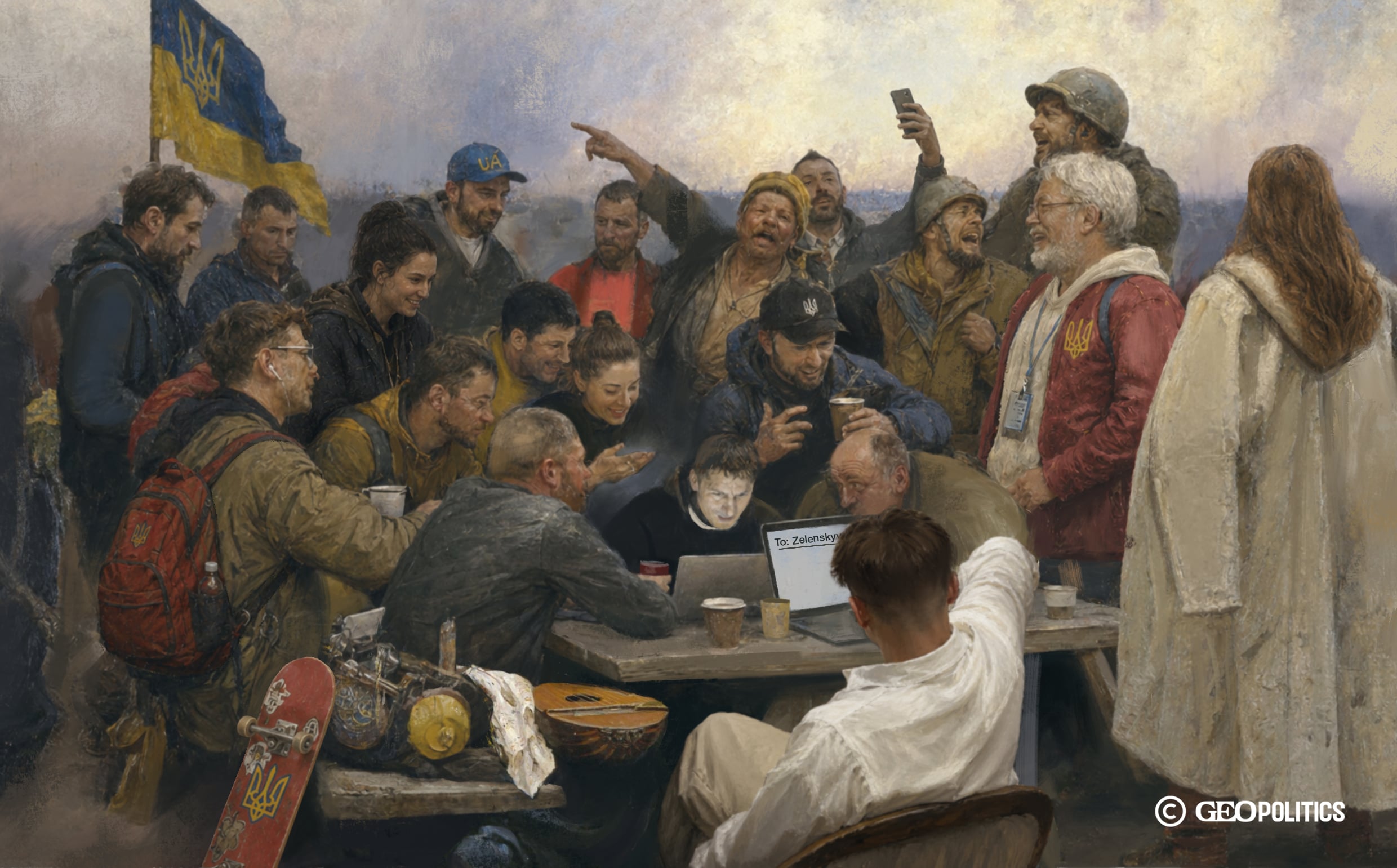
Deeper historical reasons may explain why Ukrainian society has developed such a strong repertoire of collective resistance. The Cossack political tradition is sometimes invoked to explain this. This argument should be used carefully, because the Cossack Hetmanate was not a liberal democracy in the modern sense. Political participation was highly unequal, social hierarchy was significant, and Cossack political institutions evolved toward greater concentration of power.
Nevertheless, the historical analogy contains something important. The Hetmanate combined strong military leadership with institutions through which the political community could participate in political decisions. The General Military Council (Heneralna viiskova rada), for example, could elect the hetman and debate political, military and administrative affairs. Its authority frequently overlapped and competed with that of the hetman and the Council of Officers.
Hetmans were elected, in principle for life, but their authority was not absolute. Historians specializing in this matter note that their powers varied according to their personalities and were limited or overlapped by the General Military Council and the Council of Officers.
The famous “Chorna rada”, or Black Council, offers an even more striking example. In 1663, thousands of Cossacks and other participants gathered near Nizhyn to elect a hetman. The event demonstrated both the participatory possibilities and the dangers of mass political mobilization: popular and elite interests collided, and the political outcome was extraordinarily violent.
Ukrainian history contains a political repertoire in which authority is legitimate but conditional, leaders are expected to remain answerable to the political community, and collective action against rulers can be considered legitimate when established political mechanisms fail.
It would therefore be too simplistic to say that Ukrainians protest today because of their Cossack ancestors. A better argument is that Ukrainian history contains a political repertoire in which authority is legitimate but conditional, leaders are expected to remain answerable to the political community, and collective action against rulers can be considered legitimate when established political mechanisms fail. This legacy is transferred to new generations through socialization and history textbooks as an important part of national history, keeping this repertoire of action legitimate and valuable.
This is the striking difference with Russian highly centralized absolutism: a blend of the Mongol ruthless autocracy inherited from the Golden Horde and Byzantine Imperial messianism. Even more significant is the contemporary Russian state’s glorification, through propaganda and education, of Stalinist totalitarianism and of the notion that citizens owe unquestioning loyalty and self-sacrifice to the ruler and the state.
The connection between this tradition and modern Ukraine should be treated as cultural continuity, not direct causation. The Cossack democratic legacy is a powerful political myth that can be invoked in contemporary circumstances to establish continuity with the past and, in doing so, reinforce and legitimize political mobilization in the present. The Orange Revolution and Maidan were products of modern circumstances: electoral fraud, corruption, European integration, authoritarian tendencies, civil society, and geopolitical conflict.
The two revolutions changed governments, but did not completely transform Ukraine’s political system. This is partly because it has historically been shaped not only by presidents and citizens, but by powerful economic networks.
For much of the post-Soviet period, oligarchs exercised influence through business, political parties, media ownership, lobbying and relationships with state institutions. Their power was based less on a single ideology than on flexibility. In brief, Ukrainian oligarchs are too flexible and too rich to fail.
This flexibility helped them survive Ukraine’s political upheavals. The oligarchs did not always need to oppose revolutions. They needed to survive them. When an incumbent president became too powerful, an oligarch could support political forces challenging him. When a new president emerged, the same oligarch could negotiate with the new administration. When political alliances changed, media assets and financial networks could be redirected.
This adaptability helps explain why Ukraine’s revolutions repeatedly produced political transformation without fully dismantling the underlying networks of influence. The political regime could change faster than the power structure.
The result was a peculiar political equilibrium: civil society could be strong enough to challenge presidents, while institutions remained too weak to routinely constrain political and economic elites.
This is particularly important because oligarchic influence and institutional weakness are historically interconnected. Powerful business groups benefited from weak courts, personalized politics, opaque state institutions, and political parties that were often dependent on personalities and financial networks. It was in their utmost interest to keep institutions weak and not autonomous. The result was a peculiar political equilibrium: civil society could be strong enough to challenge presidents, while institutions remained too weak to routinely constrain political and economic elites.
Thus, powerful oligarchic groups have been one of the principal reasons for the weakness of Ukraine’s democratic institutions. With their disproportionate financial resources, oligarchs could exert influence over courts, members of parliament, political parties, journalists, and even law-enforcement agencies. Through informal deals, patronage networks, and personal relationships, they could circumvent formal institutions and perpetuate a system in which political and economic power operated largely through informal arrangements.
Russia’s full-scale invasion dramatically altered, but not eliminated, the oligarchic dimension of Ukrainian politics. The traditional oligarchic clans have lost much of the political influence they accumulated during the post-Soviet period. The war-state concentrated an unprecedented amount of power in the hands of the President and his office, and the oligarchs’ ability to challenge them diminished considerably. The destruction or occupation of industrial assets, the weakening of oligarch-controlled media, the absence of elections, and the growing power of the wartime state have deprived oligarchs of several mechanisms through which wealth was converted into political influence.
Yet the decline of the old oligarchic system should not be confused with the disappearance of oligarchic practices. Informal networks, personalized access to state power and the concentration of economic opportunities remain important features of Ukrainian political economy. Moreover, the enormous reconstruction effort that will follow the war could create new opportunities to accumulate economic and political influence.
So politically, the old oligarchic model is weaker. But economically, the story is much more complicated. A fascinating recent Carnegie analysis (“Imagining Ukraine’s Political System After the War,” by Petro Burkovskyi and Olexiy Haran) of Ukraine’s postwar political system argues that although traditional oligarchic clans have declined, members of the political establishment around Zelenskyy have been accused of taking over some of the old mechanisms of personal enrichment and informal influence. That doesn’t mean that Zelenskyy’s circle is an oligarchy in the old sense. It means something subtler: the networks can disappear while the political culture and mechanisms of informal power survive.
The war created a new class of economic winners. War is not simply about destroying wealth, but it is about redistributing economic power. Defense production, energy, infrastructure, logistics, reconstruction, technology, drones, and military procurement have become strategically important sectors.
In addition, the war created a new class of economic winners. War is not simply about destroying wealth, but it is about redistributing economic power. Defense production, energy, infrastructure, logistics, reconstruction, technology, drones, and military procurement have become strategically important sectors. The people who become powerful in these sectors may not resemble the traditional oligarchs. They could be defense entrepreneurs, technology companies, infrastructure firms, energy businesses, foreign investors partnering with Ukrainian companies, or veterans entering politics. So the postwar political economy could produce new elites rather than simply resurrecting the old oligarchs.
The central question, therefore, is not whether Ukraine will return to its pre-2022 oligarchic system, but whether the postwar state will succeed in replacing personalized networks with transparent, competitive and institutionally accountable forms of economic and political power.
But the decline of oligarchs does not automatically solve Ukraine’s institutional problem. De-oligarchization is not the same as democratization. Vladimir Putin also pursued a form of de-oligarchization in Russia. Rather than dismantling oligarchic power in favor of independent institutions, he crushed, or in some cases, physically eliminated, oligarchs who challenged his authority, while bringing the remaining ones firmly under the Kremlin’s control. The result was what came to be known as the “vertical of power”: a hierarchical system in which economic elites retained their wealth and privileges in exchange for political loyalty and obedience.
Thus, weak oligarchic networks could be replaced by stronger presidential power without necessarily producing stronger democratic institutions. That is why the struggle over NABU and SAPO matters so much. The issue is not simply whether one group of elites controls another. It is whether Ukraine can create institutions sufficiently autonomous that neither oligarchs nor presidents can easily capture them.
Zelenskyy is an unusual political figure because his legitimacy comes from both electoral democracy and direct identification with the Ukrainian nation at war. In 2019, he won the presidential election with 73.2 percent of the second-round vote in an election international observers considered competitive and credible. His political appeal was based partly on rejecting the old political class and promising to break with Ukraine’s oligarchic past.
That promise was inherently populist in the broad sense: Zelenskyy presented himself as a direct representative of ordinary Ukrainians rather than as the product of traditional political institutions.
His wartime leadership intensified that relationship. Since February 2022, Zelenskyy has become the international face of Ukraine’s resistance. His authority is therefore not simply constitutional. It is also symbolic. With his anthological “I don’t need a ride, but ammunition!” addressed to the U.S. government or with his self-made, famous video from the streets of Kyiv during the night that followed Russia’s full-scale invasion, he entered history and built himself a monument. Zelenskyy thus emerged as a Churchillian figure of resistance to the Absolute Evil, when almost everyone was ready to give up.
The question is therefore not whether Zelenskyy is personally democratic or authoritarian, but whether Ukrainian institutions are strong enough to constrain any president.
This created a paradox. The same personal legitimacy that has helped Ukraine survive the war can also make institutional checks more difficult. A president with enormous personal legitimacy can easily become the political center around which parties, Parliament, and government institutions revolve. The question is therefore not whether Zelenskyy is personally democratic or authoritarian, but whether Ukrainian institutions are strong enough to constrain any president. That is the ultimate institutional test.
Ukraine’s suspension of elections needs to be understood in the context of war. Martial law prohibits national elections. Holding nationwide elections under current conditions would present extraordinary practical problems: millions of Ukrainians are displaced, millions live abroad, soldiers are serving at the front, territories are occupied, and Russian attacks and interference would create enormous security challenges. Ukrainian law therefore postpones elections while martial law remains in force.
It would be unfair to equate this situation with an ordinary authoritarian decision to cancel elections. But it would be equally mistaken to say that the absence of elections has no consequences for democracy. It does. The ballot box provides a unique form of accountability, because it gives every citizen an equal formal opportunity to reward or punish political leaders. Protest does not.
Those who demonstrate in Kyiv are self-selecting. They may be younger, more urban, more educated or more politically active than the population as a whole. Older people, rural communities, soldiers, displaced citizens, people living abroad and citizens exhausted by war may have different priorities without participating in street politics.
This produces a crucial distinction: protests provide voice while elections provide representation. Ukraine currently has an unusually powerful form of the first and lacks the second. This makes public opinion more important, but also potentially less representative.
This changes Zelenskyy’s political incentives and makes him more responsive to visible political mobilization. An elected president approaching an election must worry about voters. A president who cannot be challenged electorally must worry about legitimacy, which conceptually cannot be reduced to elections alone; it can be broader. He cannot currently say, in effect, “I have a fresh electoral mandate; you can judge me at the next election.” Nor can citizens say, “We will replace you at the ballot box.”
Instead, legitimacy is negotiated continuously through public approval. This may make Zelenskyy more responsive to visible public mobilization than an elected president with several years remaining on his mandate might otherwise be. He therefore has to maintain legitimacy through other means: military performance, public approval, international support, civil society and political responsiveness. But responsiveness is not a substitute for representation and it is not necessarily a healthy substitute for elections. It can produce a form of politics in which the president watches the street, measures public sentiment and adjusts accordingly, while institutions remain secondary
The ballot box has a different democratic logic. It gives every eligible citizen an equal formal opportunity to express a preference, regardless of whether they are young or old, urban or rural, politically active or politically passive. That distinction should be kept firmly in mind when evaluating the recent protests. They demonstrate voice, not necessarily representation.
Perhaps. But that argument should be treated cautiously. In 1968, France was shaken by massive demonstrations that have since become known as the events of “May 1968.” Hundreds of thousands of young French citizens- students, young professionals, and workers- took to the streets, occupied public buildings, universities, and factories, disrupted transportation, and organized strikes across the country. At the end of May, as the unrest continued, General de Gaulle dissolved the National Assembly and called snap parliamentary elections, held in two rounds in June. The result was striking: the left-wing parties that had largely supported or benefited from the protest movement suffered a decisive defeat, while the Gaullists secured a commanding parliamentary majority. Again, this episode of recent French history illustrates that protests are visible, but they do not always reflect the opinions of the majority.
That many urban young and educated Ukrainians are dissatisfied with some of the president’s decisions does not mean that, if elections were to be called, their new champion, Mykhailo Fedorov, would win. And if Zelenskyy wins again and his mandate is renewed, he might feel more secure and less responsive to protests.
Elections give governments a period of authority in which they can implement policies without responding to every fluctuation in public opinion. But democratic legitimacy is not simply responsiveness to immediate popularity. A government elected by a majority can legitimately make unpopular decisions. It can also lose elections precisely because citizens disagree with those decisions.
The problem with the current Ukrainian model is that the feedback mechanism is distorted. Protesters can be extremely influential, while citizens who do not protest have no equivalent immediate channel. This raises the question of whose preferences the government is responding to. If Zelenskyy reverses a decision because thousands of people demonstrate, that is evidence of accountability. But if millions of people who do not demonstrate have different preferences, the reversal may not represent democratic majoritarianism.
Many compare Zelenskyy to Churchill, as I also did above. There are indeed striking similarities, but the comparison is also relevant when reflecting on the differences.
Britain did not hold a general election during the Second World War. The previous general election took place in November 1935, and the next was not held until July 1945. Parliament repeatedly passed legislation extending the life of the wartime Parliament. Churchill became prime minister in May 1940 and remained in office until July 1945. But the important point is that Britain did not suspend political accountability simply because it suspended elections.
Churchill was not directly elected prime minister by the British people in 1940, as Zelenskyy was. He was appointed after Neville Chamberlain’s resignation because he could form a government capable of commanding parliamentary support. The wartime government was a coalition. Parliament continued to operate. Political parties remained important. The opposition was incorporated into the national unity government, but it did not cease to exist.
The British system therefore retained strong institutional substitutes for electoral accountability. This distinction matters enormously. Churchill governed without an election, but he did not govern without Parliament. Indeed, the ultimate demonstration of the strength of Britain’s institutions came immediately after the war.
The July 1945 election was the first British general election since 1935. Labour won a landslide, Clement Attlee became prime minister, and Churchill became leader of the opposition. The British electorate effectively said something profound: Winning the war did not give Churchill the right to decide what Britain should become after the war.
This is the lesson Ukraine should consider. The comparison does not imply that Ukraine should hold elections during an ongoing invasion. The circumstances are entirely different. It implies something more subtle: suspending elections is less democratically dangerous when strong institutions continue to provide alternative mechanisms of accountability, and Churchill’s Britain had them.
The Verkhovna Rada’s limited capacity to act as a counterweight to executive power was demonstrated when it first approved the presidential decision to reduce NABU’s autonomy (July 22, 2025) and nine days later (July 31) to restore it. The second decision was more the result of Zelenskyy’s U-turn and revealed the weakness of parliamentary autonomy.
The same applies to political parties. Ukraine’s parties have historically been highly personalized and frequently dependent on individual leaders rather than deeply rooted ideological or organizational structures. Zelenskyy’s SN party (Sluha Narodu – Servant of the People) is a particularly clear example of this personalization.
In the 2019 parliamentary elections, SN won 254 seats and an outright majority, the first time a Ukrainian party had achieved such a majority since independence. But electoral success did not necessarily translate into a strong, autonomous party organization capable of routinely checking the president.
The judiciary presents an even greater problem. Ukraine has undertaken significant judicial reforms, but courts remain vulnerable to politicization and institutional weakness. Freedom House notes continuing problems with judicial independence, staffing, and citizens’ ability to obtain justice. It also identifies corruption as a serious problem and notes that the political will to fight it has been inconsistent.
This matters because courts are precisely the institutions that should protect citizens and state agencies from executive overreach. If Parliament, parties and courts are weak, the burden falls on society. And society has repeatedly demonstrated that it is willing to carry it.
For this reason, the NABU crisis was a test of the system, and it deserves to be seen as more than a dispute over anticorruption policy. NABU and SAPO represent something larger: the attempt to construct autonomous institutions capable of operating independently of political power. When the government moved to weaken their independence, protesters saw the issue as a democratic red line. European governments also warned that the move could undermine Ukraine’s reform trajectory and European integration.
The strongest safeguard for NABU’s independence proved to be neither the courts, nor Parliament acting in advance, nor a settled constitutional convention. It was public mobilization.
The government eventually reversed course. This was a democratic victory, but it was also an institutional warning. The strongest safeguard for NABU’s independence proved to be neither the courts, nor Parliament acting in advance, nor a settled constitutional convention. It was public mobilization. This is precisely why the protests should not simply be celebrated as evidence that Ukrainian democracy is flourishing.
They show both resilience and fragility: resilience, because citizens can impose limits on the executive and fragility, because the limits are not always embedded in institutions.
The 2026 controversy surrounding Mykhailo Fedorov illustrates another aspect of the same problem. Fedorov had developed a public reputation as a reformer and as a representative of a technologically innovative approach to Ukraine’s war effort. His dismissal therefore had significance beyond an ordinary cabinet reshuffle.
Public reaction turned the personnel decision into a broader political question. Fedorov’s subsequent call for wartime elections is especially significant. His argument was not simply that he personally deserved political support. It was that Ukraine’s wartime system needed renewed democratic legitimacy. Reuters described his intervention as the most significant domestic political challenge to Zelenskyy since the beginning of the full-scale invasion.
This introduces a new variable. The longer elections are postponed, the more political actors may seek alternative forms of legitimacy. A popular minister can become a political figure without having contested an election. A military commander (e.g., Valerii Zaluzhnyi, Andrii Biletsky) can acquire political authority through battlefield reputation. A civil-society leader can become influential through public mobilization. The president retains formal constitutional authority, but competing sources of social legitimacy begin to emerge.
That could ultimately strengthen Ukrainian democracy, but it could also produce a politics of personalities rather than institutions. The challenge will be to translate these new forms of legitimacy into competitive political parties and accountable institutions once elections become possible.
Can Ukraine transform society’s capacity to resist power into institutions capable of constraining power routinely? That is the next stage of democratic development. The answer cannot simply be more protests. Nor can it simply be more elections. Ukraine will need both electoral competition and strong institutions.
But elections alone will not solve the institutional problem. If elections merely produce another charismatic president with a weak party, a dependent Parliament and vulnerable courts, the fundamental problem will remain. The objective should therefore be to institutionalize the very values for which Ukrainians have repeatedly taken to the streets.
NABU’s independence should not depend on whether citizens are prepared to demonstrate. Parliamentary scrutiny should not depend on presidential popularity. Judicial independence should not depend on the personal integrity of individual judges. Political parties should not be vehicles created around individual personalities. And the peaceful transfer of power should become an ordinary political procedure rather than an extraordinary revolutionary achievement.
Ukraine’s democratic resilience has been tested repeatedly during the war, but the decisive test may come afterward. During wartime, centralized authority has obvious advantages, as the state must make rapid decisions, and for these reasons elections may be impossible and political freedoms may legitimately be restricted.
The danger is that exceptional institutions become permanent political habits. Ukraine must therefore avoid the temptation to conclude that the wartime model is simply more efficient than ordinary democratic politics. The opposite lesson should be drawn. The war has demonstrated the importance of a capable state. It has not demonstrated that a capable state requires weak institutions.
Indeed, the strongest postwar Ukraine will be one in which the state is powerful enough to defend itself while institutions are strong enough to constrain whoever exercises state power. This is the real meaning of the recent protests.
The history of Ukrainian politics can therefore be read as a continuing struggle between three forces: personalized political authority, informal networks of power, and societal resistance. The Cossack tradition offers a distant historical repertoire of conditional authority and collective political action. The post-Soviet period produced powerful oligarchic networks that learned to adapt to every new political order. The Orange Revolution and Revolution of Dignity demonstrated that society could overthrow governments when formal institutions failed.
Zelenskyy’s presidency represents a different form of personalized authority: less oligarchic, more directly connected to popular legitimacy, and transformed by wartime conditions. The recent protests reveal the tension among these forces. The president remains powerful, the old oligarchs are weaker, the institutions remain incomplete, and society remains capable of intervention.
That is why Ukraine’s democracy should not be described simply as “working” or “failing”. It works through an unusual mechanism. When formal checks weaken, society becomes the check. When elections disappear, public legitimacy becomes more important. When Parliament hesitates, the street acts. When parties are weak, personalities dominate. When oligarchic networks decline, presidential centralization becomes more consequential. And when the president retreats under public pressure, democracy demonstrates its resilience, but also exposes its institutional weakness.
Ukraine’s challenge is incommensurate with those of other democracies in transition. Its war is not simply a conventional conflict between states. It is also a struggle over sovereignty, political identity and the kind of state Ukraine will become.
The ultimate measure of Ukraine’s democratic success will therefore not be whether another president is forced to retreat after another protest. It will be whether, after the war, Ukrainians can build institutions that make such protests less necessary.
Ukraine has already demonstrated that its citizens can defend democracy. The next task is to make democracy less dependent on citizens having to defend it personally. The ultimate measure of Ukraine’s democratic success will therefore not be whether another president is forced to retreat after another protest. It will be whether, after the war, Ukrainians can build institutions that make such protests less necessary.
Ukraine has a democratic veto. It now needs a democratic system capable of exercising that veto institutionally. That is the difference between a democracy that survives through civic courage and one that is sustained by institutions.