22 August, 2026
|
15 minutes to read

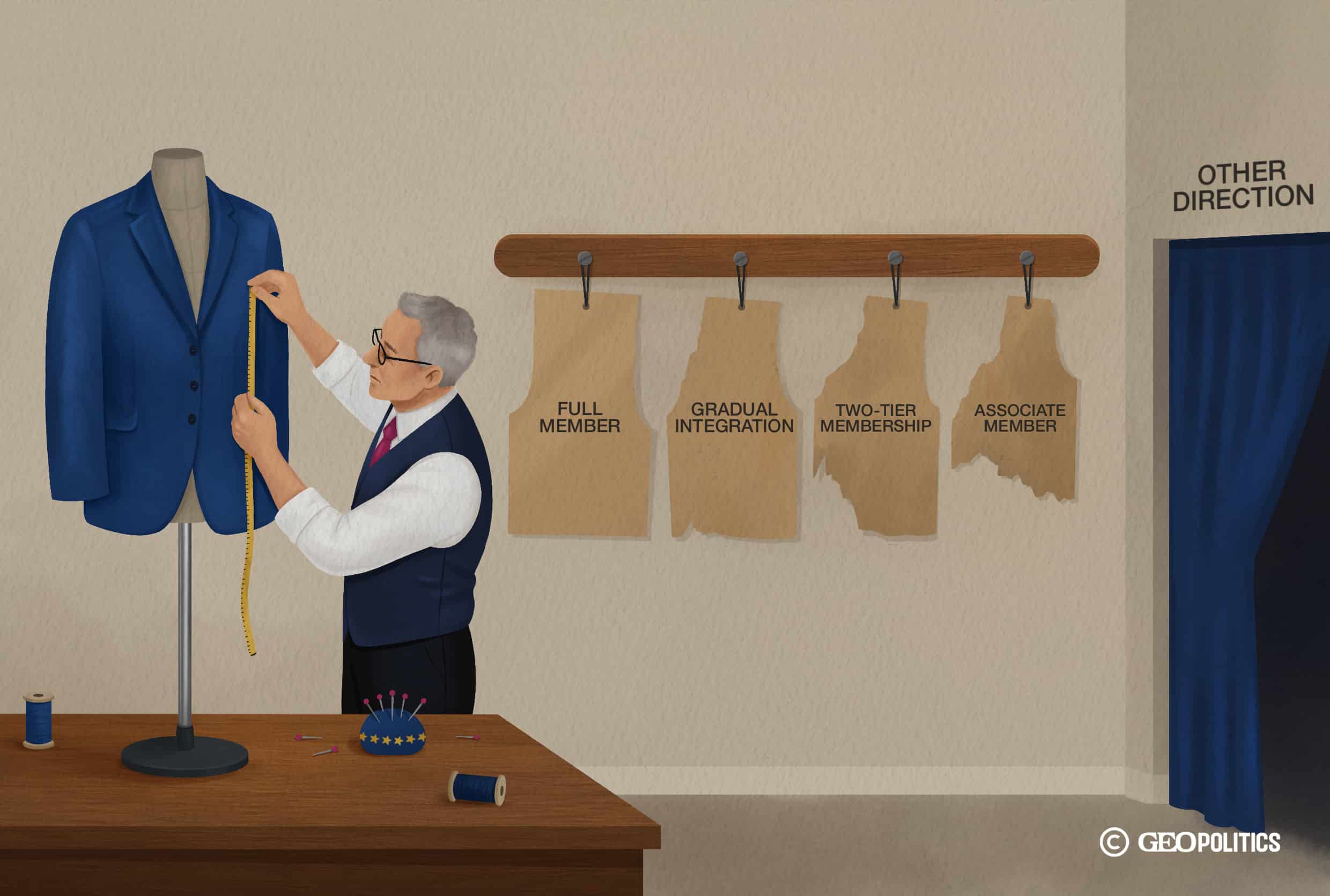
Russia’s full-scale invasion of Ukraine has been the main catalyst for the revival of the EU’s dormant enlargement process. However, clarity is still lacking, particularly on the homework the European Union itself must do before it is ready to accept new members. This includes reviewing the EU’s decision-making process, determining whether newly acceding member states should have the same veto rights as existing members, and clarifying their access to agricultural and cohesion funds.
The geopolitical arguments in favor of enlargement are as strong as they were in the 1950s, at the dawn of the European Community, or in the 1990s, when the EU was created. The EU is becoming more active and outspoken about the next wave of enlargement. In May 2026, an ad hoc working group of the Council was set up to draft the Accession Treaty with Montenegro. In June 2026, the European Commission adopted a financial package setting out the budgetary arrangements that would apply to Montenegro upon accession to the EU. The package is designed to ensure Montenegro’s full participation in EU policies and the EU budget, both as a beneficiary and as a contributor. The European Commission has also noted that the Albanian government continues to reaffirm its objective of concluding accession negotiations by the end of 2027. The Commission considers that, provided the pace of reforms is maintained, Albania is on track to meet this ambitious objective. Meanwhile, Moldova and Ukraine have opened cluster #1 (fundamentals) and cluster #6 (external relations) in their EU accession negotiations.
Enlargement is a two-way street. Candidate countries need to prepare for membership, but the European Union also needs to prepare for the arrival of new members.
But enlargement is a two-way street. Candidate countries need to prepare for membership, but the European Union also needs to prepare for the arrival of new members. In this regard, the European Commission is expected to present its long-awaited initiative, the “pre-enlargement policy review”, while the European Council is expected to hold a “strategic discussion” on EU enlargement and reforms at its meeting on October 15, 2026.
Ultimately, however, the final word on enlargement does not belong to Brussels. It goes to the member states, and all 27 must give their consent before a new member can join.
The Copenhagen criteria, established by the European Union in 1993, apply not only to countries aspiring to join the EU; they also contain the concept of the EU’s own “absorption capacity.” The EU has still never clarified what this concept means in practice. It remains largely unmeasurable, leaving considerable room for interpretation.
The EU annually assesses the preparedness of candidate countries to join the Union, it does not regularly assess its own absorption capacity. The revival of enlargement has therefore brought the debate about EU internal reform and decision-making back to the forefront.
While the EU annually assesses the preparedness of candidate countries to join the Union, it does not regularly assess its own absorption capacity. The revival of enlargement has therefore brought the debate about EU internal reform and decision-making back to the forefront. For years, Brussels think tanks have promoted the idea of “staged integration”, which would replace the traditional “all or nothing” accession process. The idea of “two-tier” membership is also back on the table.
Recently, German authorities proposed an association membership model, primarily for Ukraine, but Kyiv immediately rejected the idea. Years ago, the European Commission also put forward the idea of “reversed membership”, but it received an unenthusiastic response from the member states. More recently, Berlin and Paris presented their joint non-paper, “A New Momentum for Enlargement”, promoting gradual integration.
Despite these proposals, several key questions remain unanswered. Would newly acceding countries benefit from EU funds and, if so, how? Would they retain veto rights? And how would the European Union address the security challenges these countries are already facing?
For the EU, absorbing countries such as Montenegro, with a population of around 630,000, Albania, with 2.75 million, and Moldova, with 2.4 million, would be relatively manageable. The bigger question is how the EU will deal with Ukraine, a country of almost 40 million, whose territory is ten times larger than the combined territories of Albania, Moldova, and Montenegro, and which has been at war with Russia for years.
Ukraine’s accession would raise several difficult questions. In terms of population, Ukraine is almost as large as Poland, although post-war demographic changes will have to be factored in. If the decision-making process remains unchanged, Ukraine will therefore have significant voting weight in the Council, as its population size will affect the double-majority voting calculations.
Ukraine also possesses the largest area of arable land in Europe and could qualify as the largest beneficiary of Common Agricultural Policy subsidies. For Cohesion Funds, its allocation could reach EUR 4.8 billion annually, compared with a possible EUR 1 billion for Georgia and EUR 0.6 billion for Moldova.
These figures become even more significant when considered alongside the enormous cost of Ukraine’s reconstruction. According to UN estimates from February 2026, reconstruction and recovery in Ukraine will cost almost USD 588 billion over the next decade, nearly three times its estimated GDP in 2025, as housing, energy and other critical sectors continue to come under attack from Russian forces.
The EU will need to address whether it is ready to accept Ukraine if it meets the Copenhagen criteria but cannot restore its territorial integrity. Refusal would signal that Moscow has an indirect veto over enlargement and create an incentive to prolong the occupation in order to block Ukraine’s accession.
One key question is also whether the EU can provide security to Ukraine once it joins. The EU will need to address whether it is ready to accept Ukraine if it meets the Copenhagen criteria but cannot restore its territorial integrity. Refusal would signal that Moscow has an indirect veto over enlargement and create an incentive to prolong the occupation in order to block Ukraine’s accession.
The EU enlargement process is back on the agenda. But it takes two to tango: candidate countries need to meet the Copenhagen criteria, while the European Union itself needs to be ready for further enlargement.
The European Parliament has already flagged the issue and warned in a recent resolution that the lack of such reforms should not delay the accession of new member states.
The EU needs to turn this momentum into concrete action. The era of simply putting forward ideas to reform the EU needs to end; concrete steps must follow.
There is, however, an encouraging sign. Popular support for EU enlargement is now higher than it was in 2004, when the bloc accepted ten new member states at once. Support currently stands at 56%, compared with 41% in 2004. This should not be taken for granted. There is no guarantee that it will remain at this level for long. The EU needs to turn this momentum into concrete action. The era of simply putting forward ideas to reform the EU needs to end; concrete steps must follow. The EU’s top diplomat, Kaja Kallas, has also highlighted the need to accelerate the enlargement process.
At the same time, the French-German axis appears to be leaning towards gradual integration, which member states are also considering more broadly. The approach envisages granting candidate countries access to the EU Single Market based on their progress in the negotiations and inviting their representatives to EU institutional meetings. It would also involve including them in EU programs and projects such as PESCO, FRONTEX, the EU Agency for Cybersecurity and Digital Europe, and the Single Euro Payments Area. However, both Paris and Berlin see the adoption and implementation of the acquis in clusters 1 to 5, together with the provisional closure of the relevant negotiating chapters, as a prerequisite for granting countries full access to the EU Single Market. Cluster 1, among others, covers the chapters 23 (judiciary and fundamental rights) and 24 (justice, freedom and security), and is considered the most important part of the EU acquis. This raises an obvious question: if countries manage to negotiate and implement these core parts of the acquis, why should they not receive full membership rights?
The biggest challenge with this approach is the risk that a temporary solution between full membership and candidate status could become permanent. This risk would be particularly serious if illiberal or populist political leaderships came to power in some EU capitals. What is presented as a temporary stage could eventually become a permanent place for countries seeking to join the EU.
At the center of the EU’s internal reform debate is another difficult question: whether decision-making should move from unanimity to qualified majority voting (QMV) in areas where unanimity currently applies, including common foreign and security policy, enlargement and taxation.
The European Union needs to become more engaged in taking concrete steps on both enlargement and internal reform. The current enlargement process is not happening in a vacuum, and the EU is not the only actor competing for influence in Eastern Europe and the Western Balkans. China has offered attractive financial packages and invested in strategic infrastructure in some candidate countries, increasing their economic and strategic dependence on Beijing. The Western Balkan countries have become a major destination for Chinese infrastructure investment, accounting for 79% of China’s total investments in Central, East and Southeast Europe. Russia is also using a range of instruments, from election interference to foreign information manipulation and interference, to exploit vulnerabilities and bring countries into its orbit. Georgia is a clear example of this dynamic. While the EU remains stuck in debates about its internal reforms, these actors are taking more concrete and often bolder steps to strengthen their influence. Delays to enlargement therefore weaken the EU’s influence in candidate countries. Time is being lost, and trust is being shaken.
The second challenge is the rise of illiberal and populist political groups in EU member states. Some oppose further enlargement, while others support the accession of hybrid democracies as a way to weaken the European Union from within. This creates an additional political constraint on an enlargement process that already requires unanimity among member states.
Changing the system would require treaty change or the use of a so-called “passerelle clause” which itself requires the Council to act unanimously after obtaining the consent of the European Parliament.
Another challenge is the Catch-22 surrounding the move from unanimity to qualified majority voting (QMV) in areas such as foreign policy, enlargement and taxation: changing the system would require treaty change or the use of a so-called “passerelle clause,” which itself requires the Council to act unanimously after obtaining the consent of the European Parliament. Some EU member states, particularly smaller and mid-sized ones, support retaining unanimity to protect their national interests. This dilemma has fed one of the most controversial proposals in the current enlargement debate: whether new members should have the same veto rights as existing members.
As mentioned, one idea being considered by some EU member states is to allow new countries to join without veto rights in certain policy areas, particularly enlargement, the Common Foreign and Security Policy, taxation, and sanctions. The objective would be to prevent institutional gridlock and the abuse of veto power, often associated with former Hungarian Prime Minister Viktor Orbán. This could be described as the “Orbán effect.”
The proposal can also be viewed through the prism of domestic politics. It could make enlargement easier to sell in member states where support is relatively low, including France and Czechia, where support stands at 43%, and Austria, where it stands at 45%, particularly as illiberal and populist groups gain political ground.
In this context, it will be particularly interesting to see how the EU treats Montenegro, whose accession treaty is currently being prepared. Montenegro could serve as a blueprint for future treaties, with safeguards introduced there potentially reflected in the accession treaties of other candidate countries.
The candidate countries themselves are divided over the idea. Montenegro and Kyiv do not support it, while the Prime Minister of Albania and the President of Serbia have already signaled their openness to waiving veto rights if and when their countries join the club.
Allowing new members to join without veto rights is being presented as one possible solution. The idea is backed by the EU’s founding states: Belgium, France, Germany, Luxembourg and the Netherlands.
The proposal is framed as a “transitional” and “temporary measure”. However, acceding countries fear that it could undermine the principle of equal membership and leave them without an effective means of protecting their national interests.
The proposal is framed as a “transitional” and “temporary measure”. However, acceding countries fear that it could undermine the principle of equal membership and leave them without an effective means of protecting their national interests. There is also a political problem. Candidate countries are undertaking costly and often painful reforms, making it difficult for their political elites to sell the idea of “second-class” EU membership to their own citizens.
The EU therefore faces another challenge: how to communicate the idea to candidate countries clearly and convincingly.
The proposal has already generated repercussions and has been instrumentalized by anti-EU political forces. The Georgian Dream leadership, for example, immediately seized on the argument, claiming that candidate countries would be admitted only if their voices served a “merely decorative function” and that such arrangements would transform the EU from a union of equal nations into a union of “first-class” and “second-class” nations. Such ambiguity gives political leaders in candidate countries an opportunity to portray the EU as a scapegoat and use uncertainty about future membership to justify refusing to pursue the accession process or carry out democratic reforms.
While EU candidate countries are doing their utmost to prepare for membership, the EU itself still needs to speed up its internal reforms. The idea of scrapping or suspending veto rights for newcomers, while potentially addressing some of the EU’s institutional concerns, cannot be treated as a “silver bullet.” It requires greater clarity and better communication. Looking at the history of EU enlargement, there have been cases where transitional periods were introduced for newly joined states to gain full access to the Internal Market. One example was the seven-year transitional period on the free movement of workers for most of the countries that joined the EU in 2004. However, no newly acceding country has ever been denied the right to exercise veto power in the EU’s decision-making process. If introduced, such an arrangement would therefore represent an unprecedented step in the history of EU enlargement.
The EU is preparing to draft a new generation of accession treaties, starting with Montenegro. One key element is expected to be post-accession safeguards designed to ensure that countries remain on track on the rule of law and the fight against corruption. However, when it comes to suspending voting rights, the absence of a clearly defined timeline could indirectly introduce a form of “second-class membership.” This could undermine the credibility of the EU accession process itself.
The EU should take the “absorption capacity” component of the Copenhagen criteria more seriously. It should consider developing a clearer definition of what this means and regularly assessing its own preparedness in much the same way as it assesses candidate countries. Such an assessment could include, but should not be limited to, the EU’s institutional capacity to accommodate new Commissioners and Members of the European Parliament, the implications for voting weights in the Council, the impact on cohesion and regional funds, and the consequences for the Union’s security.
The European Union cannot afford to lose the current enlargement momentum. It has done a great deal over the past few years to accelerate the enlargement process, but there is still a long way to go, particularly on internal reform. The EU needs to move faster and make the structure, timing and scope of its internal reforms and the enlargement process clear.
The European Union cannot afford to lose the current enlargement momentum. It has done a great deal over the past few years to accelerate the enlargement process, but there is still a long way to go, particularly on internal reform. The EU needs to move faster and make the structure, timing and scope of its internal reforms and the enlargement process clear. If a mechanism suspending or limiting the veto rights of newly acceding countries is introduced, the conditions and duration of such a mechanism should also be clearly defined.
Enlargement and internal reform therefore need to advance in parallel, without reforms to the Union undermining the credibility of the accession process.
And time matters. The longer the EU remains unclear about how it intends to accommodate new members, the more space it leaves for anti-EU forces—both inside and outside the Union—to exploit that uncertainty and undermine public support for enlargement.