25 April, 2026
|
24 minutes to read

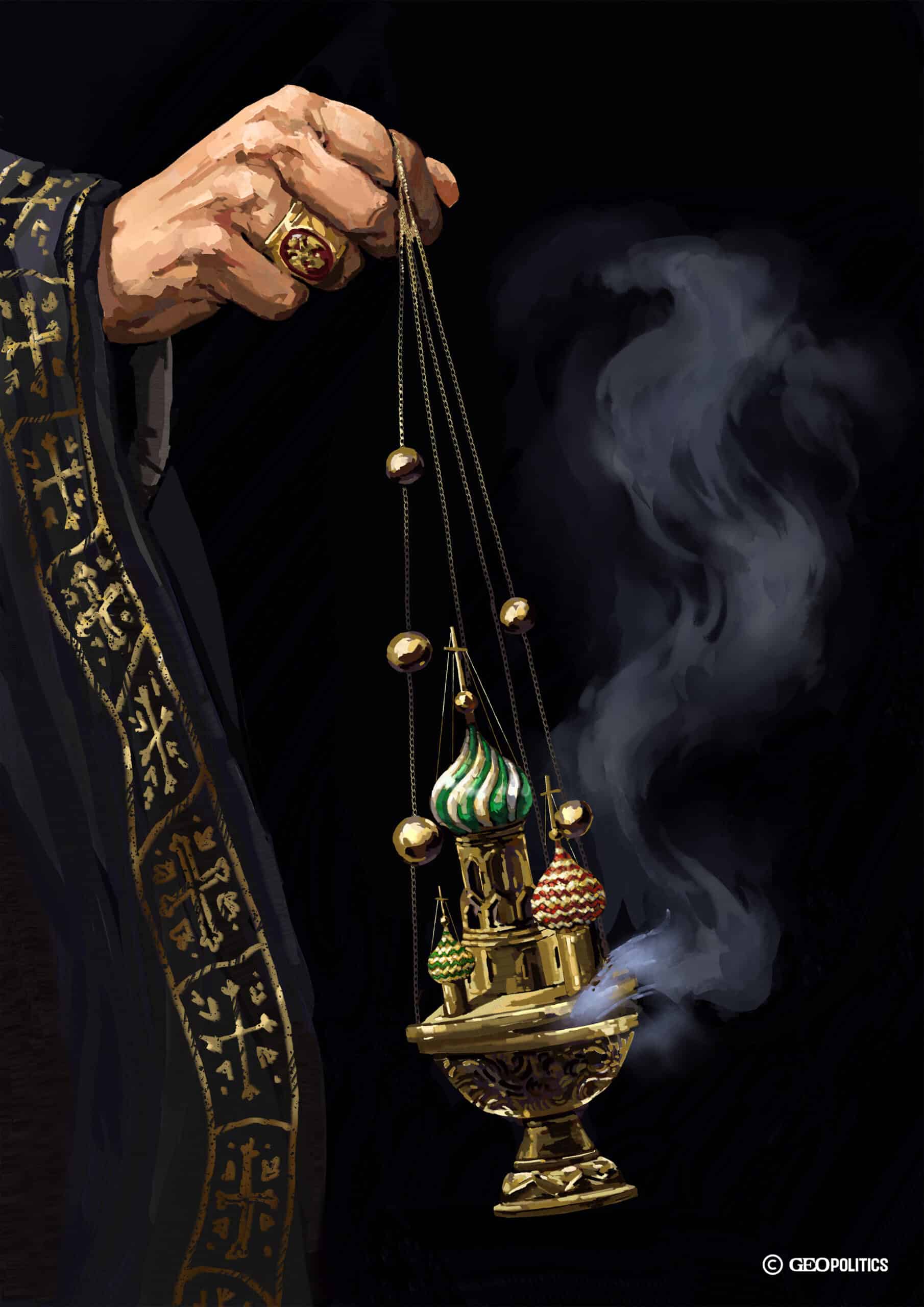
At the beginning of the 18th century, in the Persian Letters, Montesquieu had one of his Oriental travelers observe that the Pope appeared to him as “an old idol to whom people have grown accustomed to render worship.” This judgment, at once naïve and penetrating, revealed less about Pope than about Europe itself, seen through the eyes of a foreigner pretending not to understand what everyone else took for granted.
Let us, in turn, imagine such an observer, a fictional stranger, transported to contemporary Tbilisi on March 22, the day of a patriarchal funeral. He would first see an immense crowd, disciplined without apparent coercion, pressing forward to glimpse a coffin of the Catholicos Ilia II. He would then notice, not without surprise, that the highest dignitaries of a state that constitutionally claims to be secular arrive in luxury cars, surrounded by small armies of bodyguards, directly at the entrance of the cathedral, where thousands stood for endless hours to approach the deceased Patriarch.
The foreigner would observe them adopting attitudes of solemnity whose nature he might struggle to determine, whether they belong to devotion or to political communication. Perhaps he would notice, with a mixture of curiosity and irony, that neither of the two most influential men in the country present there, one lying in his coffin, the other standing beside it and presiding over the scene, was elected by anyone from the hundreds of thousands gathered outside.
Insiders say the two men didn’t like each other much, but what made them similar was that they exercised immense, almost unlimited power, largely informal and diffuse, escaping the usual mechanisms of democratic accountability.
Our traveler, taking appearances seriously, might then conclude that he finds himself in a singular regime, where sovereignty is divided, or at least staged in a dual form. At the same time, the Georgian Constitution affirms the separation of church and state and guarantees freedom of religion. Yet, it simultaneously recognizes the Georgian Orthodox Church (GOC) as having a “special role” in the nation’s history. It is within this gap, between what the law proclaims and what bodies express, that the central question of this article emerges: while Georgia is, without question, a secular state in law, why does the issue of the succession of the head of the Georgian Orthodox Church become such a significant political and even geopolitical issue?
The process of selecting the head of any major religious organization can carry political implications and consequences, and this is not unique to non-Western societies. However, in Georgia, such an event assumes significance that extends well beyond the average, certainly beyond that of any post-Soviet country. This spillover effect stems from persistent ambiguity and opacity in the separation between church and state, the loss of credibility of political institutions, actors, and media, and a thoroughly Georgian passion, in a country with richer monarchical traditions than anywhere else in the entire post-Soviet space, for the mystical aura that surrounds crowned idols.
The United National Movement (UNM) initially treated the Georgian Orthodox Church as a secondary institution, prioritizing rapid modernization and Euro-Atlantic integration. However, from the late 2000s onward, the Church emerged as a central actor in political competition. Faced with declining legitimacy and growing opposition, the Mikheil Saakashvili government moved toward cautious accommodation with the Patriarchate, despite ideological differences. At the same time, the Church strengthened its ties with domestic opposition forces and increasingly maintained channels with Russia. This period marked the gradual transformation of the GOC from a primarily religious institution into a politically consequential actor capable of influencing electoral outcomes and shaping governmental legitimacy.
By the time of the 2012 parliamentary elections, relations between the Church and the UNM had significantly deteriorated. A decisive factor was the rise of Georgian Dream (GD), led by Bidzina Ivanishvili, whose substantial financial resources far exceeded those of the incumbent party. Ivanishvili also cultivated a reputation as a major benefactor of the Church, financing flagship projects such as the Holy Trinity Cathedral of Tbilisi and providing direct support to clerical networks. This fostered a strong alignment between the ecclesiastical hierarchy and the opposition. In practice, the vast majority of bishops were openly sympathetic to GD, with some instances of overt political signaling within churches, including the display of party symbols and campaign paraphernalia. During the electoral campaign, the clergy was even reported to encourage voting for GD from the pulpit, blurring the boundary between pastoral authority and political mobilization. Only a marginal minority within the episcopate expressed support for the UNM.
Following GD’s victory, the Church appeared politically empowered, a shift that coincided with rising pressure on religious minorities. Between 2012 and 2013, incidents targeting Muslim communities increased, culminating in the destruction of a minaret in the village of Chale, justified officially on procedural grounds but widely perceived as reflecting alignment with Orthodox demands. The trend reached its peak on May 17, 2013, when anti-LGBT demonstrations were violently disrupted by large counter-mobilizations involving clergy. The state’s failure to protect participants or ensure accountability reinforced perceptions of institutional tolerance toward religiously framed violence.
Shortly thereafter, following an initiative originally proposed by Catholicos-Patriarch Ilia II, the government declared May 17 a “Family Purity Day,” formalizing its implicit alignment with the Church’s positions. While initially perceived as political reciprocity, this also revealed growing ambivalence within the ruling elite: the Church had become both a crucial ally in consolidating power and a potentially autonomous force capable of mobilizing society against the state itself.
Tensions also emerged in the economic sphere, as the Church, emboldened by political and ideological gains, increasingly sought to convert its influence into material benefits, revealing a transactional dimension of Church–state relations.
Tensions also emerged in the economic sphere, as the Church, emboldened by political and ideological gains, increasingly sought to convert its influence into material benefits, revealing a transactional dimension of Church–state relations. A recurring pattern of bargaining developed: the Church would mobilize campaigns against “moral decay,” targeting specific commercial projects, such as the Shangri-La casino near the Patriarchate or electronic music festivals on the Black Sea coast (KaZantip), which clerics denounced as a “den of vice.”
These pressures were often resolved through negotiated exchanges, including material concessions or shared economic arrangements. In the Shangri-La Casino case, land and property were reportedly transferred to secure ecclesiastical approval. For KaZantip, an agreement allowed the Church-affiliated “Sno” mineral water to be supplied and exclusively distributed at the festival. Similarly, a dispute with SOCAR over mosque financing in Muslim regions was defused through pragmatic accommodation, including energy-related benefits to Church institutions.
An excessively powerful Georgian Orthodox Church does not align with Bidzina Ivanishvili’s broader logic of power. A defining feature of his informal system has been the systematic neutralization of autonomous centers of authority.
An excessively powerful Georgian Orthodox Church does not align with Bidzina Ivanishvili’s broader logic of power. A defining feature of his informal system has been the systematic neutralization of autonomous centers of authority. From the outset, he has fragmented political parties, weakened influential figures, and hollowed out state institutions to prevent the emergence of any rival power. In this framework, the Church, initially a useful ally against the UNM, gradually came to be perceived as a potential competitor once the political landscape stabilized.
Rather than confronting it directly, Ivanishvili adopted a strategy of calibrated pressure. In 2014, he publicly stated that even the Patriarch “can make mistakes,” framing criticism as being in the Church’s own interest. The same year, he supported the anti-discrimination law linked to EU integration despite ecclesiastical opposition, testing the Church’s resistance.
Tensions deepened in 2017 with disputes over liberal drug reforms and the presidential nomination of Salome Zourabichvili, both strongly contested by conservative clergy. While some policies were later adjusted (repressive drug policy was reinstated as a primary method for detaining disloyal youth, and Mrs. Zourabichvili, accompanied by an unconventional group of priests and nuns, marched on the steps of St. Nino while carrying a large wooden cross), this period marked the Church’s growing role as both moral veto player and political constraint within Ivanishvili’s evolving system of controlled pluralism.
The most destabilizing episode in the internal politics of the Georgian Orthodox Church was the so-called “cyanide case” of 2017, which unfolded as a quasi-medieval political-religious drama. In February, authorities announced an alleged plot to poison the Patriarch, later reframed as an assassination attempt targeting his influential secretary, Shorena Tetruashvili. Archpriest Giorgi Mamaladze, director of the GOC medical clinic, was arrested at Tbilisi Airport carrying cyanide and a firearm, and accused of planning an attack on figures within the Patriarchal inner circle. The case exposed deep rivalries within the Church and particularly damaged the reputation of the Metropolitan Dimitri Shiolashvili of Batumi and Lazeti, the Patriarch’s nephew, who had long been seen as his potential successor.
The scandal weakened the Patriarchate’s cohesion and undermined Ilia II’s succession strategy, which increasingly reflected his eschatological and quasi-dynastic worldview. He had come to associate his lineage with the Bagrationi royal tradition (hence the nephew as potential successor) and cultivated a symbolic geography centered on his family’s ancestral village, which he believed held sacred significance.
Tensions resurfaced in 2019 when Bishop Petre Tsaava publicly accused the Patriarch of homosexual misconduct and systemic corruption. Although swiftly removed from office, his statements circulated widely, inflicting lasting damage on the Patriarch’s moral authority. In retrospect, these episodes have been interpreted as part of a broader pattern in which state security structures and political actors close to Bidzina Ivanishvili exploited internal divisions to weaken the Church’s institutional autonomy and reputational standing.
Some time later, according to testimony by Bishop Iakob of Bodbe, senior state officials, Prime Minister, Minister of Interior and State Security service head, allegedly discussed a managed transition in 2017, involving the possible resignation of Ilia II and the transfer of effective authority to Metropolitan Shio Mujiri, a cleric with strong ties to Moscow who had been appointed in January 2017 Patriarch’s locum tenens amid Ilia II’s declining health.
While the plan was not implemented, the Catholicos’ health and public appearances continued to decline, contributing to a gradual shift in influence within the Patriarchate toward state-aligned actors and intermediaries embedded in its administrative structure. The government was reported to exert influence both over the Patriarch’s security detail and through elements of the Patriarchate’s administrative apparatus, notably figures such as Archpriest Andria Jaghmaidze, Head of Public Relations of the Patriarchate, and Protopresbyter Giorgi Zviadadze, Rector of the Theological Academy and Seminary, who acted as key intermediaries between the Church leadership and Ivanishvili’s state apparatus. This dual structure, between the Patriarch’s personal secretariat and a more politically aligned institutional bloc, produced growing divergences between the comparatively cautious, politically neutral, and somehow equivocal and enigmatic interventions of Ilia II and the official positions of the Patriarchate, which increasingly echoed government narratives.
Thus, Ilia II’s rare interventions, including a May 2024 biblical reference to Nebuchadnezzar, amid the pic of street rallies against the Russia-inspired “foreign agents law” and police brutality, were widely read as a veiled critique of Ivanishvili, and were quickly neutralized by official clarifications from the Patriarchate, underscoring the growing contest over the Church’s voice and autonomy.
State security structures have reportedly deepened their leverage over the GOC through the strategic use of compromising material targeting senior clerics. This included intercepted communications and private recordings related to corruption, moral misconduct, and alleged sexual improprieties. In September 2021, thousands of such files, gathered by the State Security Service, were leaked online, most of which implicated members of the ecclesiastical hierarchy. These disclosures functioned less as instruments of justice than as tools of political discipline, signaling the state’s capacity to expose or withhold damaging information at will.
This pattern reflected Ivanishvili’s broader strategy of indirect control: rather than formal subordination, the Church is managed through pressure, fragmentation, and dependence. Over time, such practices have strengthened the state’s influence within the Patriarchate, including within the Holy Synod.
This pattern reflected Ivanishvili’s broader strategy of indirect control: rather than formal subordination, the Church is managed through pressure, fragmentation, and dependence. Over time, such practices have strengthened the state’s influence within the Patriarchate, including within the Holy Synod. Several influential bishops are now perceived as structurally aligned with the government, forming an informal bloc capable of shaping decisions in line with political preferences.
Dissenting voices have been muted, while others have openly accepted pervasive surveillance. In this context, the election of a new Patriarch is likely to be influenced by this internal faction, giving the state significant indirect control. Ecclesiastical autonomy formally endures, but in practice it is increasingly mediated by networks of loyalty, patronage, and constraint.
After failing to secure the Patriarch’s resignation, the authorities under Ivanishvili shifted to a more calibrated strategy. A tacit compromise emerged: the Patriarch would remain in office, while the locum tenens, Metropolitan Shio, gradually assumed de facto leadership. In parallel, following the political crisis that led to Giorgi Gakharia’s departure, Ivanishvili reinstated Irakli Gharibashvili as prime minister, marking a new phase in state–Church relations.
Gharibashvili cultivated the image of a devout, conservative Orthodox leader, frequently invoking the “will of the majority” while downplaying protections for minorities. His rhetoric contributed to a permissive climate for radical groups, notably during the July 2021 violence in Tbilisi against activists and journalists. He consistently embedded religious symbolism into political life, speaking from the church ambo, emphasizing personal piety, and presenting himself as a national defender of Orthodoxy. During regional visits, pro-government supporters would publicly thank him “for Orthodoxy” in front of cameras, an orchestrated refrain that reflected the fusion of political authority with religious identity.
His outreach extended beyond Georgia’s borders: during a visit to Jordan, he secured from the Jordanian authorities a plot of land near the Jordan River, traditionally associated with the baptism of Christ, intended for the construction of a Georgian religious complex, similar to those already established by other Orthodox nations. Gharibashvili presented this as a major diplomatic and spiritual achievement, underscoring his effort to position himself as a guardian of national faith.
Yet this overt religiosity blurred constitutional boundaries. By repeatedly describing Georgia as an “Orthodox state,” Gharibashvili challenged its secular framework and used proximity to the Church as a resource in intra-elite competition against his rivals, Irakli Kobakhidze and Kakha Kaladze, at the court of Bidzina Ivanishvili. This strategy extended across all his political roles, including his tenure as defense minister (2019-21), when he commissioned waterproof Bibles to be included in soldiers’ standard equipment.
Rather than confronting the Church, Ivanishvili’s system sought to absorb and reframe it. Although Gharibashvili’s eventual downfall for corruption interrupted this trajectory, the broader objective of subordinating ecclesiastical influence within a controlled political order remained intact.
Paradoxically, this state-sponsored piety encroached on the Church’s own domain. In this sense, Ivanishvili’s choice of Gharibashvili could have been deliberate. By elevating a figure whose religiosity was difficult to challenge, the government could both appease conservative constituencies and subtly redirect their allegiance toward the state. Rather than confronting the Church, Ivanishvili’s system sought to absorb and reframe it. Although Gharibashvili’s eventual downfall for corruption interrupted this trajectory, the broader objective of subordinating ecclesiastical influence within a controlled political order remained intact.
The most ambitious attempt by Bidzina Ivanishvili to consolidate control over the Church came during the 2024 electoral campaign. Alongside anti-LGBT rhetoric, anti-war messaging framed against Western pressure, and proposals for reconciliation with Abkhazia and South Ossetia/Tskhinvali Region, he advanced a striking initiative: declaring Orthodoxy the state religion of Georgia. The move aimed to mobilize conservative sentiment and anchor GD within a narrative of national identity and tradition.
Ivanishvili appeared to assume broad support, believing the GOC would accept what seemed like the ultimate recognition of its status. Yet the Church declined. This refusal revealed a deeper logic. What appeared as elevation in fact implied subordination: a state religion would entail government oversight over appointments, finances, and doctrine, eroding ecclesiastical autonomy.
In its existing position, the Church enjoys a more advantageous equilibrium, exercising significant informal influence without direct responsibility.
In its existing position, the Church enjoys a more advantageous equilibrium, exercising significant informal influence without direct responsibility. It shapes public discourse, secures material benefits, and retains strategic flexibility. Formal integration into the state would jeopardize this balance.
By rejecting the proposal, the Church preserved its autonomy and avoided being incorporated into Ivanishvili’s system of control, thereby maintaining its role as a powerful yet independent actor in Georgia’s political order.
Despite controversies, Ilia II embodied a form of moral legitimacy that consistently surpassed that of any political leader, including Ivanishvili himself. Such an autonomous and widely trusted figure is structurally incompatible with Ivanishvili’s model of governance.
The death of Ilia II has opened a long-awaited window for Bidzina Ivanishvili to pursue a central objective: bringing the GOC under tighter political control. The goal is clear: to prevent the emergence of another patriarch with the kind of supra-political authority Ilia II accumulated over nearly five decades. Despite controversies, Ilia II embodied a form of moral legitimacy that consistently surpassed that of any political leader, including Ivanishvili himself. Such an autonomous and widely trusted figure is structurally incompatible with Ivanishvili’s model of governance.
Throughout his informal rule, Ivanishvili has systematically neutralized potential counterweights by weakening institutions and promoting dependent figures. The presidency offers a clear example. Although already limited, its powers were further reduced, and direct elections were abolished. Yet even carefully selected figures such as Giorgi Margvelashvili and Salome Zourabichvili developed unexpected independence. The subsequent elevation of a football player without a college degree, Mikheil Kavelashvili, illustrates a more refined strategy: the deliberate devaluation of the office to eliminate residual autonomy.
A similar trajectory is visible in the public defender’s office. While earlier appointees like Nino Lomjaria became vocal critics, the current ombudsman, Levan Ioseliani, is widely seen as compliant and non-confrontational. The pattern is consistent: positions with symbolic or institutional potential are filled with figures whose authority remains structurally constrained.
It is within this logic that the patriarchal succession must be understood. Ivanishvili appears to favor a candidate who would replicate this model: loyal, low-profile, and politically manageable. However, the challenge is greater. The Holy Synod, largely shaped by Ilia II, retains a degree of autonomy. While not liberal or pro-Western, many of its members are protective of the Church’s independence. The preferred candidate, Metropolitan Shio, lacks broad support and faces competition from other influential figures.
Reports suggest that state security structures may attempt to shape the outcome through informal pressure, including compromising material. Yet the Synod’s fragmented and competitive nature introduces uncertainty. Unlike other institutions, the Church remains only partially penetrated, making the effort to engineer a “smaller” patriarch both central to Ivanishvili’s system and far from guaranteed.
Metropolitan Shio embodies a paradox: he combines strong theological credentials and an elite pedigree with a marked lack of charisma and popular appeal. Often perceived as distant and hierarchical, he appears more at ease with institutional authority than public engagement. His elevation would likely signal a shift, from Ilia II’s charismatic, national leadership to a more restrained, technocratic patriarchate better aligned with the logic of political control.
The election of a new Catholicos-Patriarch in Georgia is never merely an ecclesiastical affair. It is a decisive political moment at home, and a geopolitical signal closely watched abroad. In Tbilisi, it will reshape the internal balance of power; in Moscow, it is treated as a strategic variable in a broader contest over influence in the post-Soviet space.
Russia’s attention is neither incidental nor discreet. The Russian Foreign Intelligence Service (SVR) has recently accused Ecumenical patriarch Bartholomew I of attempting to expand Constantinople’s influence in Georgia by backing candidates deemed sympathetic to its line. Two senior Georgian hierarchs, Metropolitan Abraham Garmelia and Metropolitan Grigol Berbichashvili, have been singled out in this narrative. In Moscow’s framing, Georgia is becoming the next arena of ecclesiastical and geopolitical competition after Ukraine.
What is striking is not only the accusation itself, but the language used. A secular intelligence agency invoking canonical law and the authority of Ecumenical Councils illustrates the extent to which Russia blurs the boundaries between statecraft and religious discourse. The patriarchal succession is thus elevated to a strategic issue, embedded in the wider Russia–Georgia–West confrontation.
Formally, the Georgian Orthodox Church is autocephalous and has no hierarchical dependence on Moscow. In practice, however, this independence conceals a dense web of historical and ideological ties. As we argued in GEOpolitics, these links, many forged during the Soviet period under the KGB’s watch, have endured, shaping a shared worldview marked by skepticism toward liberalism and Western normative influence.
This convergence is most visible in the Ukrainian case. Following Constantinople’s recognition of an independent Ukrainian Church, the Georgian Church has maintained a position of studied ambiguity. Officially “examining” the issue, it has in effect avoided recognition, an ambiguity widely interpreted as tacit alignment with Moscow.
For Russia, this alignment is strategic. The Church remains the most trusted and influential institution in Georgia, a far more stable vector of influence than any elected government. Political power in Tbilisi is volatile and contested, and is periodically challenged by mass mobilization. The Church, by contrast, offers continuity: insulated from electoral cycles, less exposed to external pressure, and governed by slow-moving internal dynamics.
This is precisely why the patriarchal succession matters. It is a rare moment when long-term orientations can be recalibrated. For Moscow, the objective is to see the emergence of a patriarch broadly aligned with Russian positions, yet not fully subordinated to the Georgian state.
The succession of Georgia’s patriarch is not just a religious transition. It is a quiet battle over the country’s long-term geopolitical orientation.
By maintaining parallel vectors, state and Church, Russia reduces its dependence on any single lever of influence. The result is a more resilient and flexible system in which the Church functions not as an extension of policy but as a parallel infrastructure of power. In this light, the succession of Georgia’s patriarch is not just a religious transition. It is a quiet battle over the country’s long-term geopolitical orientation.
The pre-electoral configuration linking the Georgian government under Bidzina Ivanishvili, Russia, and the Georgian Orthodox Church reveals a relationship that is at once convergent and structurally contradictory. At first glance, there is a zone of alignment: both Tbilisi and Moscow prefer a future Patriarch who would avoid openly pro-Western positions and would not frame the Church as a vehicle for liberal normative agendas. This shared preference establishes a minimal consensus around blocking a clearly pro-Western ecclesiastical leadership.
Beyond this surface convergence, however, the divergences are significant as well. Russia’s ideal Patriarch is a strong and charismatic figure, ideologically sympathetic to Moscow but institutionally autonomous from the Georgian state. Paradoxically, this is not a replication of the Russian model itself. In Russia, the Orthodox Church is closely integrated into the state apparatus and functions as an instrument of domestic order and external projection. In Georgia, by contrast, Moscow’s interest lies in maintaining the Church as a relatively independent structure, precisely because such autonomy increases Russia’s own capacity to influence it directly, without mediation by the Georgian state.
Russia seeks an independent Georgian Church to maximize external leverage. In contrast, parts of the Georgian political establishment would prefer a Church more structurally subordinated to the state.
The Georgian ruling elite, in other words, Ivanishvili and his cronies, by contrast, often gravitate toward a different logic: a Church more disciplined, more predictable, and more closely aligned with state authority, closer, in effect, to the Russian domestic model of Church–state integration. This produces a paradoxical inversion: Russia seeks an independent Georgian Church to maximize external leverage. In contrast, parts of the Georgian political establishment would prefer a Church more structurally subordinated to the state.
Within this configuration, Metropolitan Shio emerges as a pivotal but ambivalent figure. As locum tenens of the Patriarchal throne, he is arguably the most institutionally legible candidate for Moscow. His biography reflects deep integration into Russian ecclesiastical and intellectual networks: long residence in Moscow, theological training at the St. Tikhon Institute, a doctoral degree obtained there, and service within Georgian ecclesiastical structures in Moscow. His return to Georgia in 2016, reportedly accompanied by Metropolitan Hilarion Alfeev, then a central figure in Russian Church external relations, was widely interpreted as a sign of Moscow’s strategic interest in his trajectory. His subsequent appointment by Ilia II as locum tenens further reinforced this perception.
Yet the alignment remains incomplete. In Georgia, Shio lacks strong popular support among clergy and laity, limiting his capacity to serve as a fully consolidated moral authority. From Moscow’s perspective, this weak domestic legitimacy is a strategic drawback: influence without social anchoring risks fragility. For the Georgian political establishment, however, this limitation is precisely what is attractive. A less popular Patriarch is, in political terms, more manageable, less capable of generating autonomous legitimacy or challenging state authority.
It is therefore within this narrow corridor of partially overlapping but ultimately divergent preferences that the real logic of the Patriarchal succession is unfolding.
Whatever the outcome, the succession of the Georgian Orthodox Church marks a historical rupture. None of the candidates can replicate the aura or authority of Ilia II, who effectively embodied the institution for decades. When he assumed the patriarchal throne in 1977, the Church was marginal, with only seven members in its Holy Synod. Today, it is a vast institution with more than 40 hierarchs, thousands of churches and monasteries, and a transnational presence. It has become the most powerful social actor in Georgia, an evolution inseparable from Ilia II’s personal authority.
The succession is therefore unusually uncertain. The field includes candidates associated with authorities, figures perceived as close to Moscow, and intermediates who combine both profiles. Yet there is no guarantee that any “official” candidate will prevail within the Holy Synod. Paradoxically, patriarchal elections appear more competitive than parliamentary or local elections, where power has become increasingly structured and predictable under conditions of political monopolization and state capture by the oligarch and his party.
Yes, most candidates are not pro-Western. But the decisive cleavage is instead internal: whether the Synod prioritizes institutional autonomy or ideological alignment. If autonomy becomes the overriding concern, even conservative bishops could rally behind a moderate figure. If, however, Western liberalism is perceived as the primary threat, the balance could tilt toward candidates closer to the ruling authorities, who, in turn, possess significant informal leverage and kompromats over parts of the ecclesiastical elite.
Today, the Church remains the only institution capable of constraining the concentration of power around Bidzina Ivanishvili.
Today, the Church remains the only institution capable of constraining the concentration of power around Bidzina Ivanishvili. While its compatibility with liberal democracy is limited, it has historically functioned as a counterweight to state domination since the Soviet period. It may again play that role in the future.
At the same time, it is equally capable of legitimizing authoritarian consolidation, as historical precedents from Francisco Franco’s Spain to Colonels’ Greece illustrate. Its position in any future contestation would therefore be decisive. Today’s opposition to Ivanishvili is largely urban and educated, but structurally weak in reaching rural and peripheral segments of society. With political parties unable to mobilize nationally, only the Church retains the capacity to connect these fragmented social spaces, making it an indispensable, and potentially decisive, actor in Georgia’s evolving political equilibrium.