8 January, 2026
|
16 minutes to read

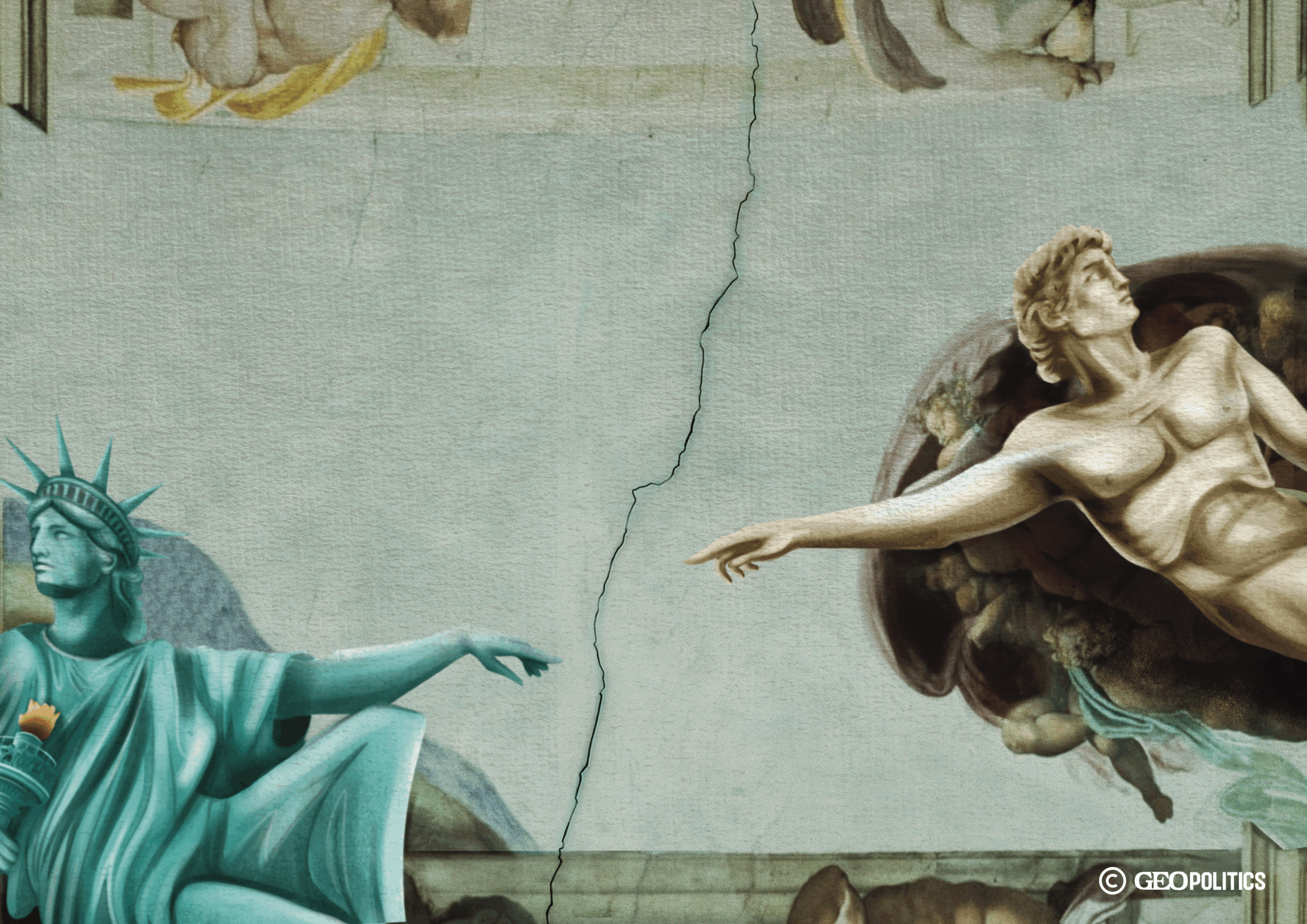
The year is 2025 and Europe is facing “civilizational erasure.” Well, not entirely…A small group of “patriotic parties” still holds out against the invaders. But life is not easy for the U.S. Ambassadors who try to fortify the garrisons of AfD, RN, and Fidesz…
This paraphrase of the opening lines of the Asterix comic book series, cherished by generations of European children, could easily fit the recently published U.S. National Security Strategy (NSS). While Anne Applebaum gloomily described it as “the longest suicide note in American history,” it could easily be an animated superhero story, at times forceful and others naïve, shifting from pragmatic transactional specifics of trade to romanticized grounds of “Western civilization,” interspersed with dystopian gloom of demographic collapse.
Yet, it struck a nerve in Europe. Gone are the days when the 2017 NSS of the first Trump administration declared: “We are bound together by our shared commitment to the principles of democracy, individual liberty, and the rule of law.” In the renewed reading, those bonds remain – but the commitment is no longer shared.
Instead of abdication from Europe (which many feared), the U.S. is making the claim of taking the reins to direct Europe – beset by the lack of “civilizational self-confidence” – to a better place, that of “European Greatness.”
That place, if we are to believe the Strategy, can be reached by “patriotic” parties firmly in power to leave behind the “unstable minority governments, many of which trample on basic principles of democracy to suppress opposition.” New Europe that is composed of “aligned sovereign nations” instead of the supranational EU, which, in President Donald Trump’s now famous dictum, was “formed in order to screw the U.S.”
The irony is not lost on many Europeans. That kind of Europe – driven by patriotic pride and rivalries, unthinking about the controversies of its historical heritage – did indeed exist. That kind of Europe unleashed two self-destructive, monstrous world wars that not only led to the decline of European power but also dragged the previously isolationist United States deep into continental affairs as an external guarantor, shaping what some historians have called the “transatlantic century.”
There is nothing natural about the European Union. Quite the contrary. As Mark Mazower convincingly demonstrated in his book Dark Continent: Europe’s Twentieth Century, the nativist, sovereign, authoritarian, and totalitarian tradition is as “European” as the liberal democratic model we have come to associate with it. In fact, in 1921, a British scholar spoke about “universal acceptance of democracy as the normal and natural form of government.” Neither ten years earlier nor ten years later was such universal acceptance apparent in Europe.
But after the horrors of World War II, then Europe “screwed itself over” to borrow Trump’s colorful phrase, some Europeans decided to reach out to the dream, a peculiar (and very U.S.-inspired) idea of an economic and trade union fostering lasting peace outside the framework of nationalist rivalries. The security of this entity, which later became known as the European Union, was underwritten by the U.S., which felt it was in its interest to provide an ironclad security guarantee against the return of fascism and the menace of communism.
This partnership – like any close partnership – was never without its grievances. The Americans have chided Europeans for military weakness and often fairly so.
This partnership – like any close partnership – was never without its grievances. The Americans have chided Europeans for military weakness and often fairly so. After all, the European military power was insufficient to stop and contain a relatively minor conflagration of Yugoslavia in the 1990s, with a leading German diplomat saying that “Kosovo was two or three sizes too big for us.”
And yet, as the former French Ambassador to the U.S., Gérard Araud, noted in his recent interview, whenever the talk turned to more integrated European military cooperation – a standing French preference – it was the U.S. diplomats who were “in his face.”
And while the evil tongues demeaned Western Europeans as “EU-nuchs,” the excitement at the “butch” liberator GI was replaced by derision in Europe once Korea and, especially, Vietnam exposed the injustices of the new global power’s overreach.
And if The Clash were “bored with the U.S.A.” in 1977, that is because:
“Yankee dollar talk to the dictators of the world
In fact, it’s giving orders, and they can’t afford to miss a word.”
That sentiment persisted well into the 1990s and 2000s as many of Western Europe’s citizens – if not the leaders – looked skeptically at the first Iraq war and clearly broke ranks with Washington, D.C. during the second.
It is one of politics’ current great ironies that the MAGA criticism of the “neo-liberal” administrations’ many wars is in complete concordance with the opinions of people derided as Europe’s “woke Socialists.”
Yet the deeper controversy between Western Europeans and their transatlantic guardian was not about the army; it was always about culture, and specifically the culture of consumerism.
Long before the NSS expressed concern that “certain NATO members will become majority non-European,” post-liberation France was already resisting American cultural influence, saying “Non!” to “Coca-Colonization” in 1947. True, the French Communists had their clearly partisan reasons to jump into the fray, but the more stolid French bureaucrats from the finances department advanced another argument: Coca-Cola had no value for France because it would enable the French people to form a new habit of drinking this beverage and, as a result, France would spend large amounts of dollars to import the ingredients, but all the profits would be repatriated, thus engendering a lasting economic dependency.
The time passed, and soon the Marshall Plan roared in U.S. goods and Hollywood spread its wares across the Old Continent. But the Euro-suspicion at the “Coca-Cola culture” of the United States remains just as potent today in some quarters. The left-leaning parties in Western Europe often bristle at “cultural imperialism” and while the French consume considerable amounts of U.S. beverages, the Gaullist French exception pops up everywhere – from the intent to create its own search engine to rival U.S. giants to insistence on the promotion of the French cinema – and now also streaming services – and ending with the considerable degree of military hardware self-sufficiency.
Yet, transporting the U.S. culture wars to the European terrain does not sit well with either Western European politicians or the wider public. On December 6, U.S. Deputy Secretary of State Christopher Landau accused the EU of committing “civilizational suicide” through its policies and openly questioned whether “the great nations of Europe are our partners in protecting the Western civilization that we inherited from them.”
Falling back into Christian identitarian nationalism sounds more than retrograde to their ears – it is downright reactionary and contrary to the European legal system to boot. But if things were so simple, one could argue that the European model of liberal government was bound to weather Trump’s second term.
That formula of “inheritance” rings as blatantly arrogant and untrue in Europe, especially when taken in the context of Vice President J.D. Vance’s rousing cry of “You don’t have to apologize for being White anymore” at the Turning Point USA (TPUSA) convention. Europe, at least for most Western Europeans, is a spiritual child of the Renaissance and the Enlightenment, of the ideas of tolerance articulated by John Locke, Spinoza, and Rousseau. These values are set out in the European Convention on Human Rights, adherence to which is obligatory for membership of the European Union. Falling back into Christian identitarian nationalism sounds more than retrograde to their ears – it is downright reactionary and contrary to the European legal system to boot. But if things were so simple, one could argue that the European model of liberal government was bound to weather Trump’s second term.
Yet, it is not by accident that this article has focused on Western Europe so far because much of the wording and spirit of the new U.S. strategy is likely to find a higher degree of adhesion in the East. To begin with, only a small part of Central Europe identifies itself with the ideals of the Renaissance and “laicity.” The nations born out of the collapse of the multinational Austro-Hungarian, Ottoman, and Russian Empires may not fundamentally disagree with the dictum of the French President François Mitterrand that “nationalism means war.” Still, they believe in the just war of national liberation. Christianity, as an ethno-national and political identity marker, if not the actual religious sentiment, remained potent in opposition to the externally imposed communist regimes – think Poland.
As Ivan Krastev and Stephen Holmes have shrewdly noted, the Central and Eastern European states after 1989 were absorbed into a political vortex of imitation – their national project became the duplication of the Western European “normality” rather than a fully fledged project of a new life. This approach assumed the Westerners, their lifestyle, and their liberal institutions were somehow normatively “better” and the Eastern ones backward, worse, less valuable. The authors argue that populist leaders exploit the humiliation experienced by citizens who consider themselves “second-rate” Europeans after being expected to follow Western examples blindly. The core of their argument is that the “abhorrence of compulsory imitation is primary”—meaning that the primary driver of the populist backlash is the gut-level rejection of having to be an inferior copy. The political and intellectual arguments against the Western model are seen as just a convenient excuse or merely secondary and collateral.
One cannot help but notice that the diverging political streams brought to the surface of U.S. political life by MAGA share the “humiliation-driven repudiation of liberal ideas” with Eastern Europeans. The declarations that chimed with the tenor of J.D. Vance’s rallying cry – “You don’t have to apologize for being White anymore” – were omnipresent at the recent TPUSA gathering, and they do draw on the reservoir of dismay at humiliation – real or imagined.
Just as Viktor Orbán turned his coat from a Soros-bred liberal young leader to become the standard-bearer of illiberalism at the back of economic collapse, the Rassemblement Nationale (RN) in France is finding its electoral revival not in the racist and nationalists circles but among farmers, urban poor irrespective of their race, and middle-class French who fear “déclassement” – descent on the social ladder. And the Alternative for Germany (AfD) is feeding on the humiliation of the failed “catching up” of Eastern Germany.
The U.S. turn onto the familiar grounds of populist Christian nationalism, executive and security overreach of the Trump administration, is likely the death knell of the erstwhile aspirational “normality” of liberal institutions. To paraphrase Dostoevsky’s dictum (so beloved by Bolsheviks), with nothing to imitate, everything is allowed.
The European liberal project thus risks being caught in a dangerous pincer movement – the U.S. adopting the relatively marginal European ideas of illiberalism and “Great Replacement Theory,” which draws instinctive acclaim (or at least not automatic rejection) in Europe’s East and generates a sense of the rising tide of European illiberal parties.
Yet, what is illiberalism, and how can it be defined? The RN in France, the AfD in Germany, the Freiheitliche Partei Österreichs (FPÖ) in Austria, the Fratelli d’Italia (FdI) in Italy, the Prawo i Sprawiedliwość (PiS) in Poland, and Fidesz in Hungary share tactical and narrative similarities, but they are also distinct enough not to sit around the same political table at the European Parliament. All of them work within their national contexts, and being pro-MAGA may work for Orbán, but it definitely is not playing in Paris with Marine Le Pen and the heir apparent, Jordan Bardella, distancing themselves from Washington. Giorgia Meloni manages to govern the country with a mix of conservative and right-wing policies, without virulent Euroscepticism and, in particular, without adopting the pro-Russian tendencies of the RN and the AfD.
An inclusive definition of anti-liberalism developed by Zsolt Enyedi provides good grounds for defining this movement in a manner that encompasses its divergent strands. According to this model, illiberalism is literally the opposite of liberalism and rests on three tenets: the concentration of power (rejecting constraints of checks on the executive, undermining independent institutions), a partisan state (the imposition of the cultural standards of the dominant group and favoring it in distributive conflicts, depriving minority groups of resources for participation in democratic deliberations), and a closed society (resistance to social change perceived as externally generated and opposition to universalist norms). The author notes that “illiberalism is not a specific ideology but a syndrome whose common core is the questioning of liberal democracy.”
In the coming years, the European Union will have to counter this broadside against its fundamental principles, which – whatever the MAGA leaders claim – would destroy the EU as we know it.
The 2025 NSS clearly seeks to encourage this “syndrome” in Europe and to lead the charge to promote its tenets – it is no accident that the Old Continent is mentioned nearly 50 times in the document. In the coming years, the European Union will have to counter this broadside against its fundamental principles, which – whatever the MAGA leaders claim – would destroy the EU as we know it.
The meta-level confrontation will be on principle and vision, and the first developments of 2026 already give ample pretext. Washington’s lightning-fast intervention into Venezuela to kidnap the local dictator Nicolás Maduro may not have raised more than a formalistic ripple in Europe, and EU foreign policy chief Kaya Kallas was quite restrained in her response on behalf of 26 states (Hungary habitually apart).
Yet what worries European capitals are three principled things combined: the lack of reference in the U.S. administration’s statements to an orderly democratic transition or support to Venezuela’s democratic opposition; the failure of the U.S. President’s Administration to follow the appropriate domestic democratic procedures (lack of formal notification to Congress and the failure to involve the Gang of Eight); and the parallel resuscitation of the talk about capturing Greenland. “We do need Greenland, absolutely,” President Trump told The Atlantic, triggering an angry response from Greenland and Denmark’s Prime Minister. But over a practical matter of Greenland, the larger question looms – would the U.S. continue to be a democratic ally?
But a more practical, tactical battlefield of contestation is also clearly sketched:
Georgia’s current regime is closely aligned with the illiberal tenets as described above. The concentration of power is extreme, and the partisan state is being consolidated further. The discourse of majority rule and authority over liberty is permeating the political field through loyal media. Independent groups are starved of funding and platforms to participate in what remains of the democratic process. The Georgian Dream government is at the forefront of states that advocate for a closed society. PM Irakli Kobakhidze recently stated that there is “no such thing as civil society” and that all bodies that claim that name are externally funded by malicious actors, including the “American and European bureaucracies.”
With the NSS, Georgia’s liberal actors must take note that the consolidation of the illiberal discourse is now a transatlantic phenomenon. The instinctive Americanism of the Georgian pro-democratic elites – once again evident in their reactions to Venezuela – is becoming hard to recognize with their liberal beliefs. Yet, Europe does not and, at this stage, cannot present itself as an alternative security shield from the existential danger of Russia.
If there is a place where the sovereign equality of states still matters, it is within the EU, and Georgia must not only seek to integrate with that place but contribute to constructing it with its own insights and checkered democratic experience.
The pragmatic political reckoning must take into account that in the world redesigned under the illiberal doctrine, the weakening of the international normative framework and the reemergence of trade-offs among the major powers as key structuring elements of the global system have sealed the fate of small states and nations like Georgia. They are forever bound to be subjugated by regional powers, and Georgia’s history has traditionally led to the country being absorbed in whole or in part. Political solidarity with those political forces in Europe that are committed to the European liberal idea and practice is thus not a fleeting ideological preference, but an existential imperative for Georgian political forces. If there is a place where the sovereign equality of states still matters, it is within the EU, and Georgia must not only seek to integrate with that place but contribute to constructing it with its own insights and checkered democratic experience.